




01. Edit your 2002 form 1040 online
Type text, add images, blackout confidential details, add comments, highlights and more.

Type text, add images, blackout confidential details, add comments, highlights and more.

Draw your signature, type it, upload its image, or use your mobile device as a signature pad.

Send 2002 tax return via email, link, or fax. You can also download it, export it or print it out.
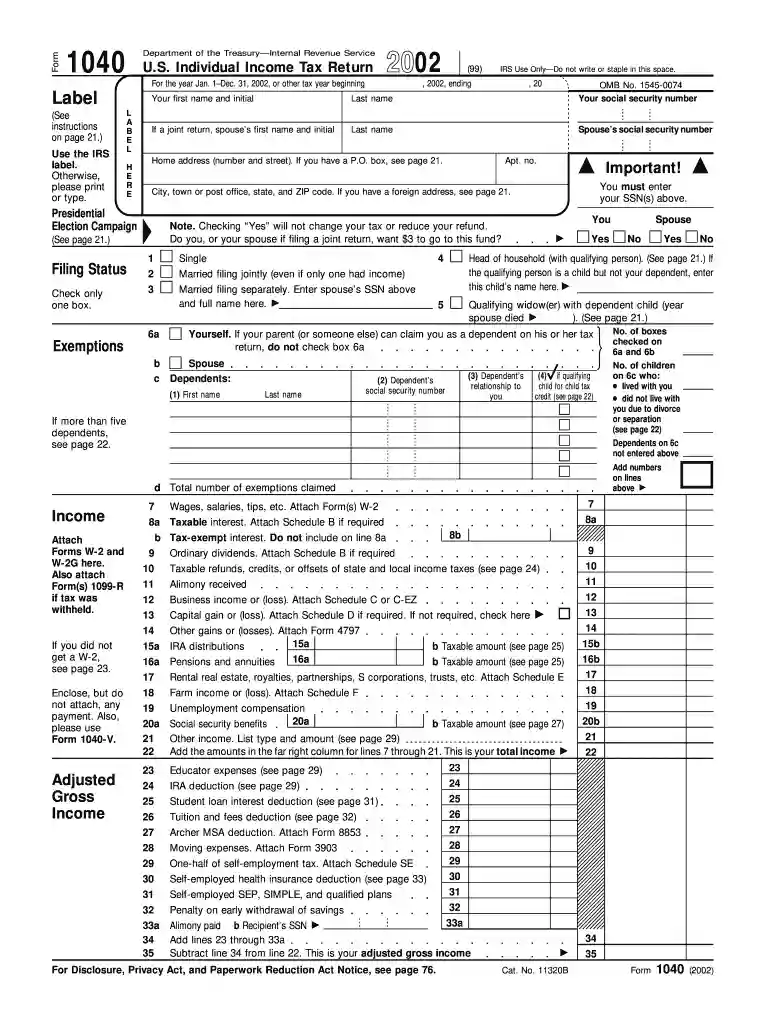
The 2002 IRS Form 1040 is a crucial document utilized by individuals in the United States to file their annual income tax returns. This form serves as a comprehensive tool for taxpayers to report their earnings, claim relevant deductions, and determine their tax responsibilities. It includes various sections designed to capture personal information, income details, and adjustments, ensuring accurate tax calculations.
For taxpayers, understanding the purpose of the Form 1040 is essential for fulfilling legal tax obligations. This form is essential in reflecting an individual's financial activities over the tax year, enabling both transparency and accuracy in tax reporting. Taxpayers utilize this form to achieve fair outcomes regarding their due taxes, liabilities, or potential refunds from the IRS.
Completing the Form 1040 involves a systematic approach for accuracy. Here's a step-by-step guide:
Gather Required Documentation:
Fill Personal Information:
Report Income:
Claim Deductions and Credits:
Calculate Tax Liability:
Review and Sign:
Accessing the 2002 IRS Form 1040 can be achieved through various methods:
IRS Website:
Postal Request:
Libraries and Post Offices:
Ensuring you have the correct version is vital for historical tax filing or amendment purposes.
The IRS provides specific guidance for the correct use of the Form 1040:
Accurate Reporting:
Filing Status Selection:
Deadline Adherence:
Failing to adhere to these guidelines can result in penalties and interest on unpaid taxes.
The Form 1040 comprises several critical sections each serving a unique function:
Personal Information:
Filing Status:
Income and Adjustments:
Tax Computation:
Each element contributes to the overall tax calculation, ensuring clarity and precision in tax reporting.
Non-compliance with IRS requirements can result in significant penalties:
Failure-to-File Penalty:
Late Payment Penalty:
Accuracy-Related Penalties:
Understanding these penalties emphasizes the importance of timely and accurate filing.
For the 2002 tax year, specific deadlines are critical:
Regular Filing Deadline:
Extended Deadline:
Meeting these deadlines ensures compliance and avoids unnecessary penalties.
Taxpayers have the option to file using either digital or paper formats:
Digital Filing:
Paper Filing:
Both methods are valid, but electronic filing is preferred for its efficiency and convenience.
We've got more versions of the 2002 form 1040 form. Select the right 2002 form 1040 version from the list and start editing it straight away!
| Versions | Form popularity | Fillable & printable |
|---|---|---|
| 2025 | 4.9 Satisfied (56 Votes) | |
| 2024 | 4.5 Satisfied (50 Votes) | |
| 2023 | 4.9 Satisfied (56 Votes) | |
| 2022 | 4.3 Satisfied (60 Votes) | |
| 2021 | 4.8 Satisfied (50 Votes) | |
| 2020 | 4.4 Satisfied (257 Votes) | |
| 2019 | 4.2 Satisfied (85 Votes) | |
| 2018 | 4.4 Satisfied (346 Votes) | |
| 2017 | 4 Satisfied (21 Votes) | |
| 2017 | 4.4 Satisfied (458 Votes) | |
| 2016 | 4.4 Satisfied (657 Votes) | |
| 2015 | 4.3 Satisfied (174 Votes) | |
| 2014 | 4 Satisfied (48 Votes) | |
| 2013 | 4 Satisfied (70 Votes) | |
| 2012 | 4 Satisfied (28 Votes) |
Based on eSignature regulations, forms approved digitally have the same validity as those approved with pen and paper. You can electronically sign almost any business and private paperwork. Four types of documents still call for wet signatures only - wills and testamentary trusts, court orders and other court papers, state statutes governing divorce, adoption, or other family law, and notice of cancellation of utility services. If you adhere to the regulations and use a trustworthy and compliant software solution, like DocHub, you can eSign your 1040 2002 without printing it.
You can complete and eSign your 2002 1040 online, even on a tight deadline. All you need to access top-notch editing instruments on any device is a DocHub profile, which you can sign up in a couple of moments. After you register, upload your document or find what you are looking for in our catalog, complete it using the editing instruments you want, and place your electronic signature on it at the end.
At DocHub, your data security is our priority. We follow HIPAA, SOC2, GDPR, and other standards, so you can work on your documents with confidence.
Certain item- ized deductions (including real estate taxes and home mortgage interest) are limited if your ad- justed gross income is more than $137,300. ($Read more
Form 1040 (2002). Amount from line 35 (adjusted gross income). 36. 36. Check if: 37a. Tax and. Credits. 37a. Add the number of boxes checked above and enter theRead more
List the organizations five current highest compensated employees (other than an officer, director, trustee, or key employee) who received reportableRead more


