




01. Edit your 2015 tax forms online
Type text, add images, blackout confidential details, add comments, highlights and more.

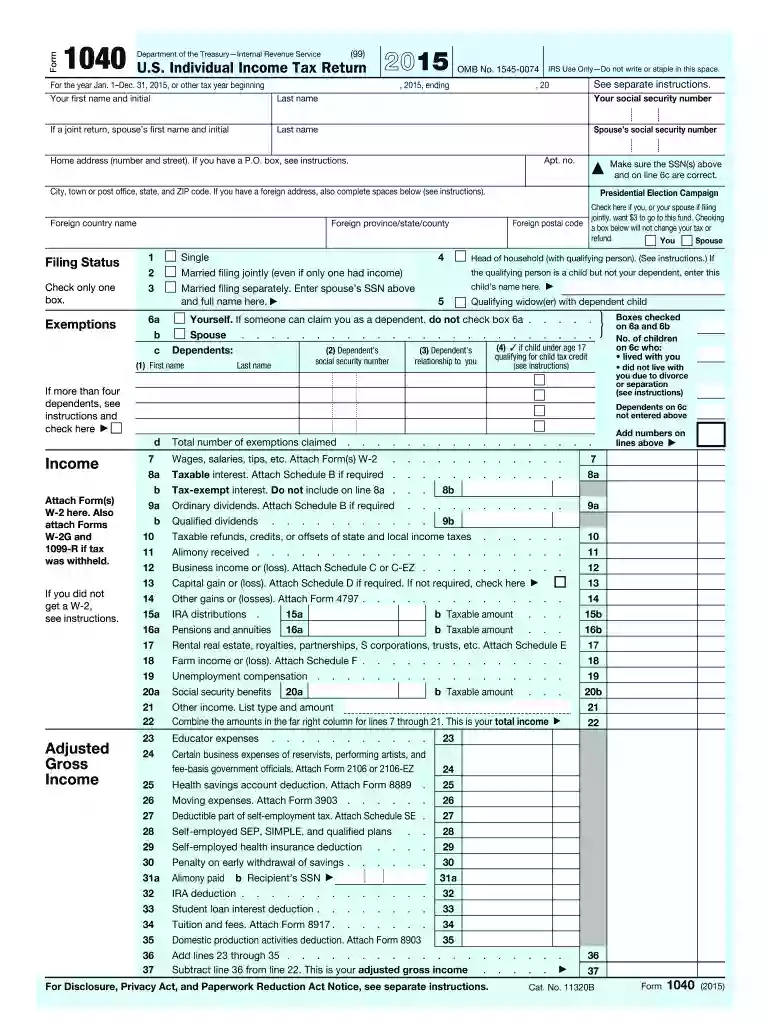
Type text, add images, blackout confidential details, add comments, highlights and more.

Draw your signature, type it, upload its image, or use your mobile device as a signature pad.

Send 2015 form 1040 pdf via email, link, or fax. You can also download it, export it or print it out.
The Form 1040 from 2015, known as the U.S. Individual Income Tax Return, is a document used by taxpayers in the United States to report annual income. It serves as a comprehensive record of income earned, deductions and credits claimed, and the calculation of taxes owed or refunds due for the year 2015. This form is crucial for individuals to comply with IRS regulations and ensure accurate financial reporting.
To accurately complete the Form 1040, taxpayers must gather all relevant financial documents, including W-2s, 1099s, and records of deductible expenses. The form mandates careful attention to detail to ensure that each section is completed correctly. Tax software can streamline this process by offering guidance and automatic calculations.
Forms can be accessed online directly from the IRS website or acquired physically at local IRS offices and some post offices. Tax preparation software typically includes options to download necessary forms and submit electronically.
Adhering to IRS guidelines ensures compliance and helps avoid penalties. Instructions for Form 1040 detail each section’s requirements and provide valuable examples to assist taxpayers in recording accurate data.
The deadline for filing the Form 1040 for the 2015 tax year was April 18, 2016, with extensions granted until October 17, 2016. Meeting these deadlines is critical for avoiding interest and penalties on late filings.
Failure to file by the deadline results in a penalty that is generally 5% of the unpaid taxes for each month the return is late, up to a maximum of 25%.
Completing the 1040 necessitates various documents that support income and deductions claims. These include:
Understanding key terms is essential for correctly interpreting the form's requirements:
Different taxpayers face unique circumstances when filing Form 1040. These variations influence deductions and how income is recorded.


By understanding these specific blocks related to Form 1040 for 2015, taxpayers can effectively navigate their tax filing responsibilities. Each section provides vital content that aids in the accurate and efficient completion of the form, ensuring compliance with IRS standards and potential tax benefits maximization.
We've got more versions of the 2015 tax forms form. Select the right 2015 tax forms version from the list and start editing it straight away!
| Versions | Form popularity | Fillable & printable |
|---|---|---|
| 2025 | 4.9 Satisfied (56 Votes) | |
| 2024 | 4.5 Satisfied (50 Votes) | |
| 2023 | 4.9 Satisfied (56 Votes) | |
| 2022 | 4.3 Satisfied (60 Votes) | |
| 2021 | 4.8 Satisfied (50 Votes) | |
| 2020 | 4.4 Satisfied (257 Votes) | |
| 2019 | 4.2 Satisfied (85 Votes) | |
| 2018 | 4.4 Satisfied (346 Votes) | |
| 2017 | 4 Satisfied (21 Votes) | |
| 2017 | 4.4 Satisfied (458 Votes) | |
| 2016 | 4.4 Satisfied (657 Votes) | |
| 2015 | 4.3 Satisfied (174 Votes) | |
| 2014 | 4 Satisfied (48 Votes) | |
| 2013 | 4 Satisfied (70 Votes) | |
| 2012 | 4 Satisfied (28 Votes) |
At DocHub, your data security is our priority. We follow HIPAA, SOC2, GDPR, and other standards, so you can work on your documents with confidence.





7a At any time during 2015, did you have a financial interest in or signature authority over a financial account (such as a bank account, securities account, orRead more
Apr 15, 2015 Whats New. Premium tax credit. You may be eligible to claim the premium tax credit if you, your spouse, or a dependent.Read more
by PE Campaign Cited by 1 U.S. Individual Income Tax Return 2015 OMB No. 1545-0074 IRS Use OnlyDo not write or staple in this space. For the year Jan. 1Dec. 31Read more


