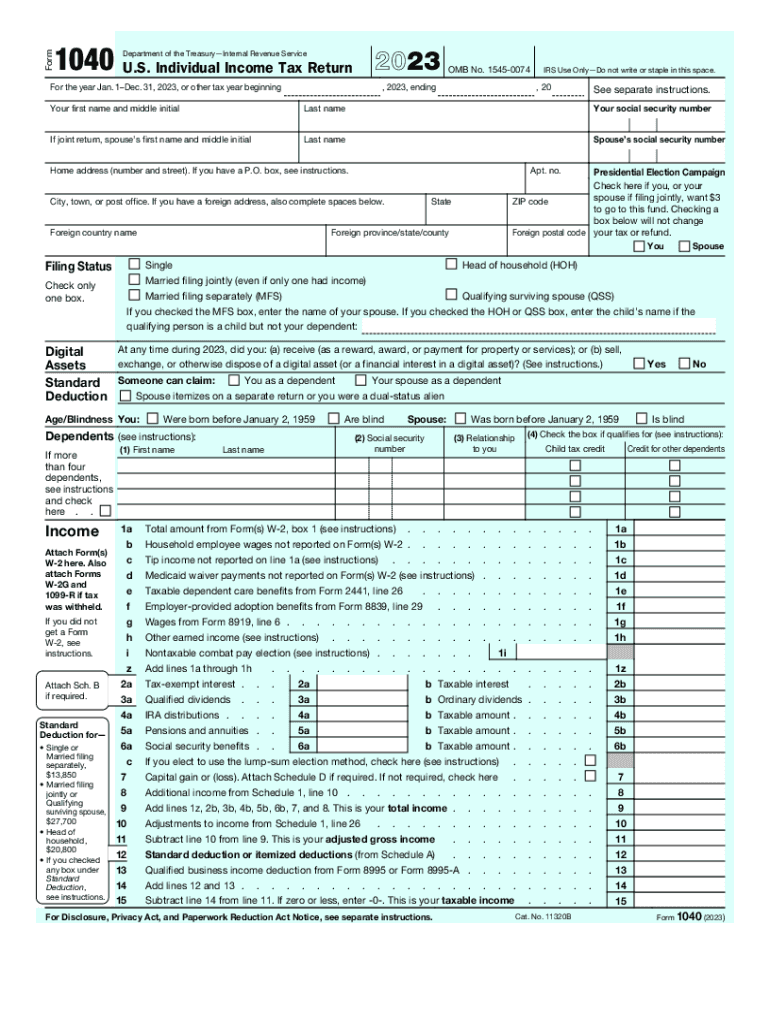







Definition & Meaning
The 2023 Form 1040, known officially as the U.S. Individual Income Tax Return, is the standard federal income tax form used by individuals to report their financial situation to the Internal Revenue Service (IRS). This form is pivotal for individuals to declare their income, compute tax liabilities, and claim deductions and credits. It’s an essential document in the U.S. tax system, as it provides an official record to report a taxpayer's income from various sources and compute the amount owed to the IRS or the refund due.
- Income Reporting: The form captures income from wages, dividends, capital gains, and other sources to provide a comprehensive view of a taxpayer's financial activity.
- Tax Determination: Form 1040 is used for calculating the amount of tax due, leveraging available deductions and credits. These calculations depend on the tax bracket applicable to the reported income.
Steps to Complete the 2023 Form 1040
Completing the 2023 Form 1040 involves a systematic approach to ensure accuracy and compliance with IRS requirements.
- Personal Information Section: Begin by entering personal details such as the taxpayer's name, Social Security Number, and filing status. Accurate entries are crucial for processing by the IRS.
- Income Details: Report all sources of income. This includes wages, salaries, tips, taxable interest, and more. Accuracy in declaring all income is essential to avoid IRS penalties.
- Adjustments and Deductions: Below the income section, detail adjustments that might reduce taxable income. This might include contributions to retirement accounts or student loan interest deductions.
- Tax and Credits Calculation: After adjustments, calculate the tax owed. Consider the eligibility for credits such as the Child Tax Credit or the Earned Income Tax Credit.
- Payments and Refunds: Mention any tax payments that have already been made, such as withholding from a paycheck, and calculate any additional tax owed or refund due.
- Signature and Date: Complete the form by signing and dating it. Failure to sign can result in processing delays.
Required Documents
When preparing to fill out the 2023 Form 1040, having the necessary documentation on hand can streamline the process and reduce errors.
- W-2 Forms: Document wages and taxes withheld by employers.
- 1099 Forms: Capture other types of income such as self-employment earnings, interest, dividends, or government payments.
- Receipts for Deductions: Proof of deductible expenses, such as charity contributions or certain medical expenses.
- Forms 1098: Documents such as mortgage interest paid that might be deductible.
- Previous Year Tax Returns: Helpful for cross-referencing and ensuring continuity.
IRS Guidelines
Following IRS guidelines when completing the 2023 Form 1040 ensures compliance and minimizes the likelihood of audit or error. The IRS provides detailed instructions, which can be crucial for more complex tax situations.
- Filing Requirements: Understand income thresholds that determine whether you are required to file a return.
- Deductions and Credits Eligibility: Follow guidance on which deductions or credits can be claimed based on income and filing status.
- Electronic Filing (e-File): The IRS endorses e-Filing for its speed, efficiency, and reduced margin of error compared to paper filing.
Form Submission Methods
The 2023 Form 1040 can be submitted through a variety of channels, offering flexibility and convenience.
- Electronic Filing (e-File): Preferred by the IRS for its speed and accuracy. Tax software can simplify the process and often offer direct e-File integration.
- Mail Submission: Traditional and still acceptable, but slower and more prone to error.
- Assistance Services: Utilize IRS partners like Volunteer Income Tax Assistance (VITA) or IRS Taxpayer Assistance Centers for help with form submission.
Filing Deadlines / Important Dates
Timely filing of the 2023 Form 1040 is crucial to avoid penalties and interest.
- April 15: Traditionally the deadline for filing federal tax returns and making any owed payments.
- Extensions: Extensions can be filed, typically providing an additional six months, but any taxes owed must still be paid by the April deadline to avoid penalties.
Penalties for Non-Compliance
Failure to file the 2023 Form 1040 by the deadline or to report income accurately can lead to penalties.
- Late Filing Penalty: Usually a percentage of the unpaid taxes for each month the return is late.
- Accuracy-Related Penalties: Can apply if the form is filed with errors due to negligence or substantial understatement of income.
Taxpayer Scenarios
Different types of taxpayers have varied experiences and potential complications with the 2023 Form 1040.
- Self-Employed Individuals: Must report business income and may need to pay estimated taxes quarterly.
- Retirees: Should consider distributions from retirement accounts, which are taxable income.
- Students: Might need to navigate education credits.
By carefully navigating the completion of the 2023 Form 1040 with the correct preparation, taxpayers can effectively manage their tax liability and take advantage of potential credits and deductions, ultimately contributing to a smoother filing experience.