2010 form 1040-2025

Get Form
2010 form 1040 Preview on Page 1

Here's how it works

01. Edit your 2010 form 1040 online
Type text, add images, blackout confidential details, add comments, highlights and more.

02. Sign it in a few clicks
Draw your signature, type it, upload its image, or use your mobile device as a signature pad.

03. Share your form with others
Send 1040 2010 via email, link, or fax. You can also download it, export it or print it out.

Definition and Overview of the 2010 Form 1040

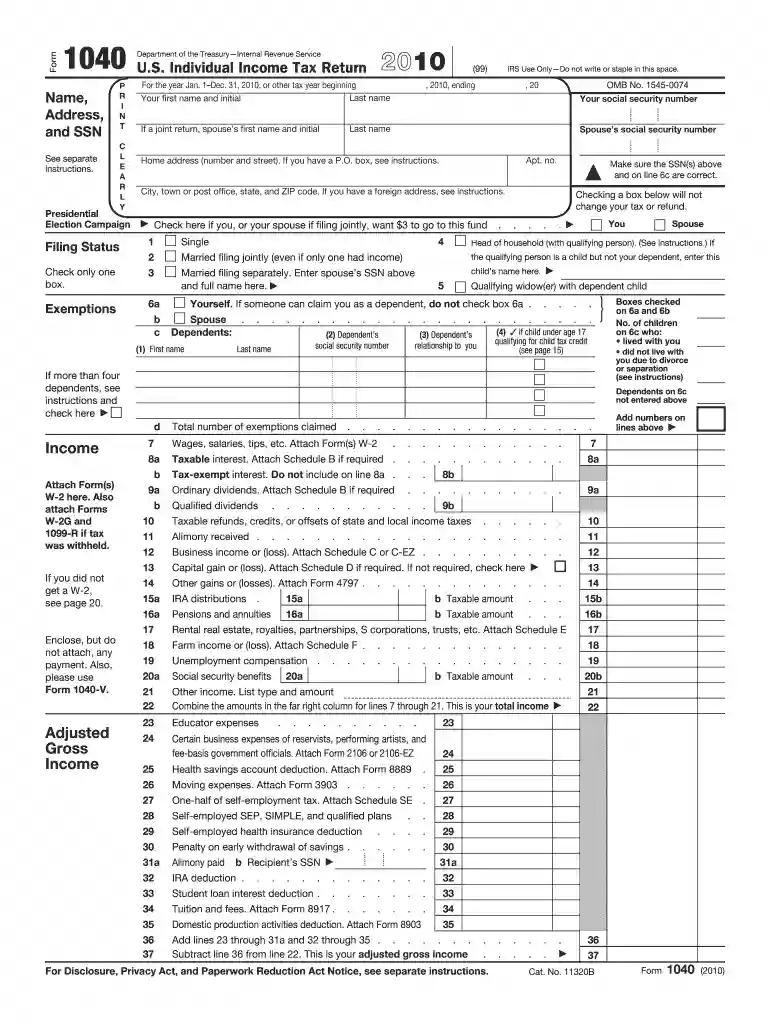
The 2010 Form 1040, also known as the U.S. Individual Income Tax Return, is a federal tax form utilized by individuals to report their income, assess applicable tax deductions and credits, and determine their overall tax liability for the 2010 tax year. This form is a vital tool for accurately reporting personal income to the Internal Revenue Service (IRS) and is essential for annual tax filing.

The form consists of several key sections where taxpayers provide personal information such as name, address, and filing status, along with detailed reports of income sources including wages, salaries, dividends, and capital gains. Taxpayers can also claim deductions for various categories like medical expenses or mortgage interest, and must calculate their tax obligations based on the total income and applicable tax rates.

Utilizing the 2010 Form 1040 correctly ensures compliance with tax regulations and can help taxpayers to achieve maximum financial benefits through appropriate deductions and credits.

Steps to Complete the 2010 Form 1040

Completing the 2010 Form 1040 involves several structured steps, each crucial for an accurate tax return. Here’s a detailed breakdown:

  1. Gather Required Documents: Collect essential documents such as W-2 forms from employers, 1099 forms for any freelance work, and other financial statements that detail income and deductible expenses.

  2. Fill Out Personal Information: Enter your name, address, and Social Security number. Properly designate your filing status—such as single, married filing jointly, or head of household.

  3. Report Your Income: On the income section of the form, list all sources of income. Include total wages from W-2 forms along with other income streams, and ensure all income is accurately reported to avoid penalties.

  4. Claim Deductions and Credits: Identify applicable tax deductions and credits you may qualify for. Enter these amounts in the respective sections for maximum tax savings. The 2010 Form 1040 allows standard deduction claims or itemized deductions, depending on which is more beneficial.

  5. Calculate Tax Liability: After listing income and applicable deductions, apply the IRS tax rates to compute your total tax liability. Consider any payments already made, such as withholding from paychecks or quarterly estimated tax payments.

  6. Sign and Date the Form: Ensure you sign and date the form before submission. If filing jointly, both spouses must sign.

Following these steps meticulously reduces the likelihood of errors and ensures proper compliance with IRS regulations.

Important Terms Related to the 2010 Form 1040

Understanding specific terminology is crucial for navigating the 2010 Form 1040 effectively. Here are some key terms:

  • Filing Status: Determines tax rates and deduction amounts based on the taxpayer’s marital status and family situation. Options include single, married filing jointly, married filing separately, and head of household.

  • Adjusted Gross Income (AGI): The total income available after subtracting allowable adjustments. AGI is critical as it influences eligibility for many deductions and credits.

  • Standard Deduction: A fixed dollar amount you can deduct from your taxable income. The amount varies based on filing status and can simplify the filing process when choosing not to itemize.

  • Itemized Deductions: Specific expenses that taxpayers can claim on their tax forms, such as medical expenses, charitable contributions, and mortgage interest. This method requires detailed record-keeping but can lead to higher deductions for some taxpayers.

  • Tax Credit: A direct reduction of the amount of tax owed, which can be more beneficial than deductions, as credits lower tax liability dollar-for-dollar.

Familiarity with these terms helps individuals navigate the tax preparation process with greater confidence and accuracy.

IRS Guidelines for the 2010 Form 1040

Adhering to IRS guidelines while completing the 2010 Form 1040 is vital for compliance and accuracy. Key guidelines include:

  • Correct Use of Form: Ensure you are using the correct version of the Form 1040 for the tax year being filed. The 2010 Form 1040 is specifically for the 2010 tax year, and using the wrong year’s form may result in processing delays or compliance issues.

  • Signature Requirement: Both taxpayers must sign the return if filing jointly. Unsigned returns may be treated as unfiled by the IRS, leading to penalties.

  • Filing Deadlines: The deadline for filing the 2010 Form 1040 is typically on April 15 of the following year (2011). It is essential to be aware of deadlines to avoid late fees and interest on any due taxes.

  • Amending Returns: If errors are discovered after submission, taxpayers can file Form 1040X, the Amended U.S. Individual Income Tax Return, to correct their 2010 tax return.

Following these guidelines will facilitate a smoother filing process and reduce the potential for issues with the IRS.

Filing and Submission Methods for the 2010 Form 1040

The 2010 Form 1040 can be filed using several methods, each with its benefits:

  • Online Filing: Taxpayers can electronically file their returns using tax preparation software compatible with IRS guidelines, dramatically speeding up the processing time for returns and potential refunds.

  • Mail Submission: For those preferring paper filing, completed forms can be mailed directly to designated IRS processing centers. It is advisable to send these forms via certified mail to ensure a record of submission.

  • In-Person Filing: While less common, some taxpayers may opt to submit their returns in person at local IRS offices, where assistance can also be provided.

Choosing the right submission method depends on personal preference as well as individual circumstances related to the complexity of the return.

Penalties for Non-Compliance with the 2010 Form 1040

Failure to correctly file or pay taxes associated with the 2010 Form 1040 can result in significant penalties. Understanding these consequences is crucial:

  • Late Filing Penalty: If a taxpayer fails to file by the deadline and does not request an extension, a penalty of five percent of the unpaid taxes for each month the return is late may be applied.

  • Failure to Pay Penalty: If taxes owed are not paid by the deadline, a penalty of half a percent of the unpaid amount will be charged for each month it remains unpaid.

  • Interest Charges: In addition to penalties, interest on unpaid taxes accrues from the due date until payment is made, adding to the total amount owed.

Being aware of these penalties can motivate timely and accurate filing to avoid unnecessary financial burden.

Examples of Using the 2010 Form 1040

Using the 2010 Form 1040 can vary significantly depending on individual circumstances. Here are some examples:

  • Employee with Full-Time Job: A salaried employee would report W-2 income, claim the standard deduction, and state any additional income, such as interest from a savings account.

  • Freelancer or Self-Employed Individual: A freelancer would report income from various clients through 1099 forms, had potential deductions for home office expenses, and would need to manage self-employment tax calculations.

  • Retiree Reporting Pension Income: A retiree receiving income from pensions and Social Security would report this income, possibly low enough to qualify for the standard deduction and various credits aimed at seniors.

These scenarios illustrate how diverse individual situations can impact the completion and outcomes of filing the 2010 form 1040. Understanding these cases helps in determining the most advantageous filing approach based on personal financial circumstances.

See more 2010 form 1040 versions

We've got more versions of the 2010 form 1040 form. Select the right 2010 form 1040 version from the list and start editing it straight away!
Versions Form popularity Fillable & printable
2023 4.9 Satisfied (56 Votes)
2022 4.3 Satisfied (60 Votes)
2021 4.8 Satisfied (50 Votes)
2020 4.4 Satisfied (257 Votes)
2019 4.2 Satisfied (85 Votes)
2018 4.4 Satisfied (346 Votes)
2017 4 Satisfied (21 Votes)
2017 4.4 Satisfied (458 Votes)
2016 4.4 Satisfied (657 Votes)
2015 4.3 Satisfied (174 Votes)
2014 4 Satisfied (48 Votes)
2013 4 Satisfied (70 Votes)
2012 4 Satisfied (28 Votes)
2011 4 Satisfied (44 Votes)
2010 4 Satisfied (29 Votes)
be ready to get more

Complete this form in 5 minutes or less

Get form

Got questions?

We have answers to the most popular questions from our customers. If you can't find an answer to your question, please contact us.
Contact us
You can download a PDF of the 1040 tax form on the IRS website. If you hire a tax preparer to help you, they might also provide the form.
Using a reputable tax preparer including certified public accountants, enrolled agents or other knowledgeable tax professionals can also help avoid errors. Entering information inaccurately. Incorrect filing status. Math mistakes. Figuring credits or deductions. Incorrect bank account numbers. Unsigned forms.
Even if youre living overseas, US taxes still apply to you. In fact, you may owe taxes in the country where youre living and in the US. However, your tax responsibilities depend on your income and how long youve lived outside the country.
You can get copies of your last 7 years of tax returns.
You can complete and sign the 2010 IRS Tax Forms here on eFile.com, then download, print, and mail them to the address listed on them or see IRS mailing addresses. Select your state(s) and download, complete, print, and sign your 2010 State Tax Return. You can no longer claim a refund for Tax Year 2010.
be ready to get more

Complete this form in 5 minutes or less

Get form

People also ask

To file a belated ITR, follow the below steps: Login to the income tax e-filing portal. Select the ITR form that matches your pay, deductions, and exemptions. Input your income, tax details, and other mandatory information in the ITR form. Ensure Return filed under section 139(4) under Filing Status.
Even so, the IRS can go back more than six years in certain instances. Unfortunately, there is a limit on how far back you can file a tax return to claim tax refunds and tax credits. This IRS only allows you to claim refunds and tax credits within three years of the tax returns original due date.
Is Form 1040 the Same As a W-2? Form 1040 is different from a W-2. A W-2 is a wage and tax statement that an employee receives from a company they worked for during the tax year. The information listed on the W-2 is used to fill out Form 1040.

2010 individual tax return