




01. Edit your 2019 form 1040 online
Type text, add images, blackout confidential details, add comments, highlights and more.

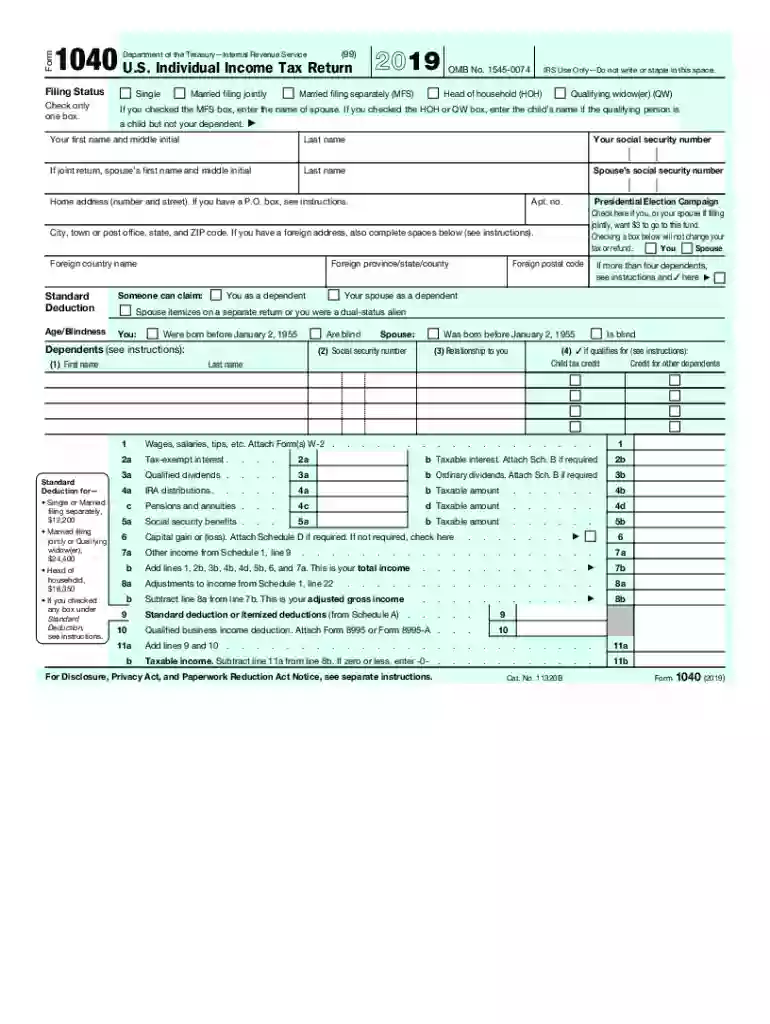
Type text, add images, blackout confidential details, add comments, highlights and more.

Draw your signature, type it, upload its image, or use your mobile device as a signature pad.

Send irs tax return 2019 via email, link, or fax. You can also download it, export it or print it out.
The 1040 form, officially known as the U.S. Individual Income Tax Return, is a critical document for reporting personal income, deductions, and tax liabilities to the Internal Revenue Service (IRS). This form captures key information necessary for calculating and filing taxes, which includes personal details, income, deductions, credits, and payment information.
The 1040 form can be easily obtained from several sources:
Individuals who earn varying levels of income and require detailed reporting of their financial activities typically use this form. This includes:


The form is designed in compliance with federal tax laws and is a legal requirement for eligible taxpayers in the United States. It helps the IRS:
The IRS sets specific guidelines for accuracy and submission:
Failure to file or inaccuracies can result in penalties:
We've got more versions of the 2019 form 1040 form. Select the right 2019 form 1040 version from the list and start editing it straight away!
| Versions | Form popularity | Fillable & printable |
|---|---|---|
| 2025 | 4.9 Satisfied (56 Votes) | |
| 2024 | 4.5 Satisfied (50 Votes) | |
| 2023 | 4.9 Satisfied (56 Votes) | |
| 2022 | 4.3 Satisfied (60 Votes) | |
| 2021 | 4.8 Satisfied (50 Votes) | |
| 2020 | 4.4 Satisfied (257 Votes) | |
| 2019 | 4.2 Satisfied (85 Votes) | |
| 2018 | 4.4 Satisfied (346 Votes) | |
| 2017 | 4 Satisfied (21 Votes) | |
| 2017 | 4.4 Satisfied (458 Votes) | |
| 2016 | 4.4 Satisfied (657 Votes) | |
| 2015 | 4.3 Satisfied (174 Votes) | |
| 2014 | 4 Satisfied (48 Votes) | |
| 2013 | 4 Satisfied (70 Votes) | |
| 2012 | 4 Satisfied (28 Votes) |
At DocHub, your data security is our priority. We follow HIPAA, SOC2, GDPR, and other standards, so you can work on your documents with confidence.



Do not file Schedule F (Form 1040) to report the following. Income from providing agricultural services such as soil preparation, veterinary, farm labor,Read more
Check if your filing status is MFS or HOH and you lived apart from your spouse for the last 6 months of 2025, or you are legally separatedRead more
In the space provided below, tell us why you are filing Form 1040-X. Attach any supporting documents and new or changed forms and schedules. Sign. Here.Read more


