




01. Edit your affidavit of cohabitation sample online
Type text, add images, blackout confidential details, add comments, highlights and more.

Type text, add images, blackout confidential details, add comments, highlights and more.

Draw your signature, type it, upload its image, or use your mobile device as a signature pad.

Send it via email, link, or fax. You can also download it, export it or print it out.
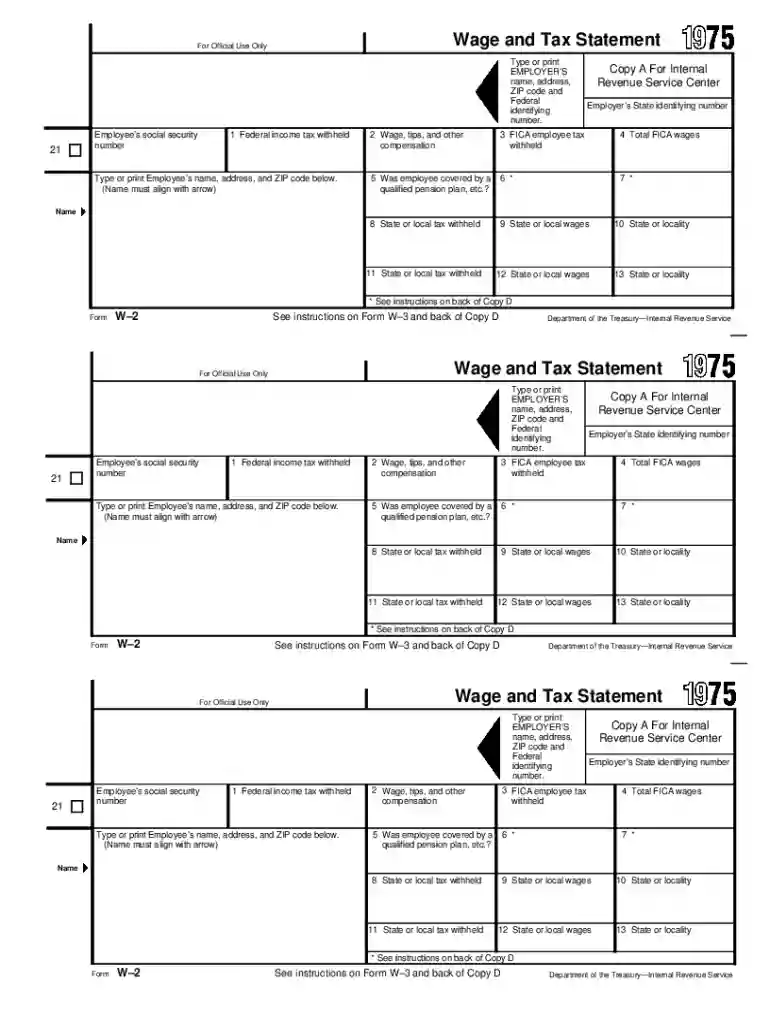
The Form W-2 (1975), known as the Wage and Tax Statement, is a crucial document used by employers in the United States to report wages paid to employees and the taxes withheld from them. It serves as an official record of an employee's annual earnings and the amount of taxes withheld by the employer. Employers send this form to the Internal Revenue Service (IRS) and provide a copy to the employee for filing their federal and state tax returns. The form captures distinct elements such as wages, tips, and other compensation, offering a comprehensive snapshot of the financial interaction between employer and employee.
Employees utilize the Form W-2 to prepare their annual income tax returns. Upon receipt, individuals should verify the information on the form, ensuring that their Social Security number, earnings, and withholding amounts are accurate. Employees use the W-2 data to complete their Form 1040, which is the primary form used for income tax filing. It is also essential for verifying income when applying for loans or mortgages. Taxpayers compare the information on the W-2 against their personal records to detect any discrepancies. After confirming the details, the W-2 should be kept with other important tax documents for future reference.
Employers are responsible for issuing the Form W-2 to employees by January 31 of each year, reflecting the previous calendar year's earnings and taxes withheld. Employees usually receive the form via mail or through an online payroll system if the employer offers digital access. If an employee does not receive their W-2 by early February, they should contact their employer for a copy. In scenarios where the employer is unresponsive, employees can reach out to the IRS for assistance after February 14. Additionally, some online tax preparation software can import W-2 information directly if the employer partners with the service.
The Form W-2 serves not only as a tax document but also as a legal record of wages paid and taxes withheld. Employers are required by law to accurately report all compensations for their employees. Failure to provide the Form W-2 or inaccuracies in the submission can result in penalties from the IRS. Employees use the form to file their income tax returns, and discrepancies can trigger audits or legal inquiries. The form can also be used in legal disputes as evidence of income and tax compliance. Employers must retain copies of W-2s as part of their records in compliance with federal regulations.
To accurately complete and issue Form W-2, employers need several key documents and information, including:
Employers must ensure that all employees receive their Form W-2 by January 31 each year. The deadline for filing copies with the Social Security Administration (SSA) is also January 31. If using paper forms, they must be postmarked by this date; electronic filings are subject to the same deadline. Meeting these deadlines is crucial to avoid penalties. Employees should file their income tax return by April 15, using their W-2 form, unless the date falls on a weekend or holiday, which can extend the deadline. Doing so helps ensure that employees comply with federal tax regulations and minimizes the risk of late tax penalties.
We've got more versions of the affidavit of cohabitation sample form. Select the right affidavit of cohabitation sample version from the list and start editing it straight away!
| Versions | Form popularity | Fillable & printable |
|---|---|---|
| 2024 | 4.7 Satisfied (35 Votes) | |
| 2023 | 4.4 Satisfied (26 Votes) | |
| 2022 | 4.7 Satisfied (59 Votes) | |
| 2021 | 4.8 Satisfied (120 Votes) | |
| 2020 | 4.4 Satisfied (218 Votes) | |
| 2019 | 4.4 Satisfied (910 Votes) | |
| 2018 | 4.4 Satisfied (233 Votes) | |
| 2017 | 4.2 Satisfied (267 Votes) | |
| 2016 | 4.4 Satisfied (882 Votes) | |
| 2015 | 4.3 Satisfied (259 Votes) | |
| 2014 | 4.2 Satisfied (43 Votes) | |
| 2013 | 3.9 Satisfied (53 Votes) | |
| 2013 | 4 Satisfied (60 Votes) | |
| 2012 | 4 Satisfied (53 Votes) | |
| 2011 | 4.2 Satisfied (74 Votes) |
With DocHub, it’s quite simple. The service offers users an add-on called DocHub for Gmail, which you can find in the Google Workspace Marketplace free of charge. Install it and give it access to your Google account. Open your email with your Form W-2 (1975). Wage and Tax Statement - irs attached and click on the add-on button in the right-side panel. Log in to your DocHub account, and upload the form to our editor, where you can fill it out and sign.
You need only a web connection and a browser to complete your Form W-2 (1975). Wage and Tax Statement - irs on an iOS phone. Open the DocHub website and authenticate. Then, add your document or choose it from the list in your dashboard. Then use our editing tools to complete your form and preserve all your modifications. You can also send it to a dedicated recipient immediately.
At DocHub, your data security is our priority. We follow HIPAA, SOC2, GDPR, and other standards, so you can work on your documents with confidence.
If this is a corrected form check the box in the left margin and type the words. CORRECTED RETURN in all caps directly above the title Wage and Tax Statement..Read more
List the organizations five current highest compensated employees (other than an officer, director, trustee, or key employee) who received reportableRead more
31.6053-2 Employer statement of uncollected employee tax. (a) Requirement that statement be furnished. If. (1) The amount of the employee tax imposedRead more


