




01. Edit your irs 2020 form 8863 online
Type text, add images, blackout confidential details, add comments, highlights and more.

Type text, add images, blackout confidential details, add comments, highlights and more.

Draw your signature, type it, upload its image, or use your mobile device as a signature pad.

Send free tax filing 2020 via email, link, or fax. You can also download it, export it or print it out.
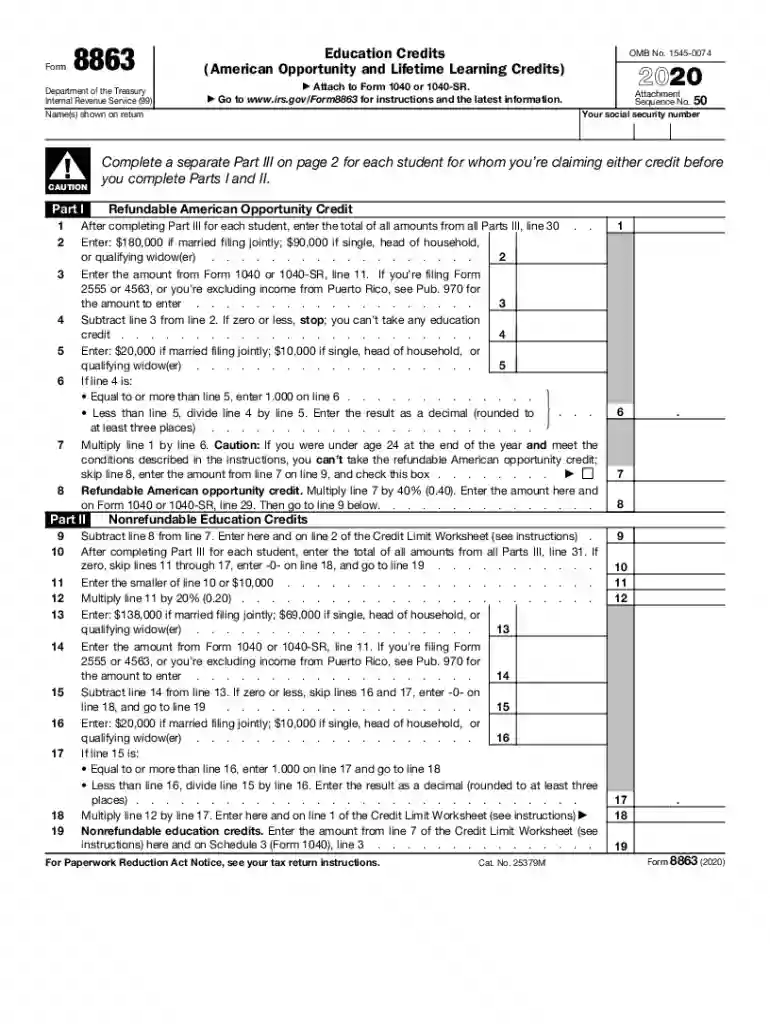
Form 8863 is a critical document used by U.S. taxpayers to claim education credits such as the American Opportunity Credit and Lifetime Learning Credit on their tax returns. These credits aim to reduce the burden of higher education costs by allowing eligible taxpayers to lower their tax liability based on qualified education expenses incurred for students. The form collects comprehensive information about the taxpayer, the educational institutions attended, and the eligible students. Completing Form 8863 correctly can result in significant tax savings, making it a valuable tool for those investing in education.
The American Opportunity Credit is specifically designed for undergraduate students attending their first four years of college. Taxpayers may claim this credit for each eligible student, covering tuition, fees, and course-related materials. However, the student must be enrolled at least half-time for one academic period and must not have any felony drug convictions. The credit provides a maximum of $2,500 per eligible student, of which 40% is refundable.
Unlike the American Opportunity Credit, the Lifetime Learning Credit can be claimed for an unlimited number of years, making it suitable for both undergraduate and graduate education. This credit allows taxpayers to claim 20% of the first $10,000 in eligible education expenses, up to a maximum of $2,000 per return. The credit is nonrefundable, meaning it can reduce the amount of tax owed to zero but cannot generate a refund.
Form 8863 is an essential document and is easily accessible through various methods. It can be downloaded directly from the IRS website, ensuring that taxpayers have the latest version. Tax preparation software packages also include Form 8863, streamlining the filing process for individuals leveraging digital tax solutions. Additionally, printed copies are available at IRS offices for those preferring a hard copy.
Gather Required Information: Collect all necessary details regarding your educational expenses, school enrollment forms, and any Form 1098-T received from educational institutions.
Complete Personal and Educational Details: Start by filling in your name, social security number, and the eligible student's information, including details about the educational institution attended.
Calculate Credits: Use the form instructions to calculate both refundable and nonrefundable credits based on your education expenses. Ensure you apply the correct rules for each type of education credit.
Transfer totals: After calculating the credits, transfer the appropriate totals to your Form 1040 or Form 1040A.
Review and File: Carefully check your completed Form 8863 for any errors. Once verified, submit it alongside your federal tax return.
To qualify for the education credits offered by Form 8863, taxpayers must meet specific criteria:
Notably, students should not have a felony drug conviction to qualify for the American Opportunity Credit.


The IRS sets forth specific guidelines to ensure accurate and compliant filing of Form 8863. Taxpayers must adhere to rules regarding the eligibility of expenses, proper credit calculations, and timely submission. Additionally, all supporting documentation, such as Form 1098-T and tuition statements, should be kept on file in case of an IRS inquiry. The IRS emphasizes the importance of understanding the distinctions between the two credits to avoid erroneous claims, which could lead to penalties.
Completing Form 8863 in alignment with federal tax filing deadlines is paramount. Generally, the form should be submitted with your annual tax return by April 15. Extensions for filing might give extra time, but paying any owed taxes by the original deadline is crucial to avoid penalties. Taxpayers should also remember the importance of receiving their educational institution's Form 1098-T before filing, ensuring all information is accurate and complete.
Failure to accurately complete Form 8863 or adhere to IRS guidelines may result in financial penalties. Incorrect claims of education credits can trigger fines or audits from the IRS. Late submissions not accompanied by proper extensions can also incur significant interest and fees on any unmet tax liability. Taxpayers are advised to ensure all details are thoroughly checked and verified before submission, or to seek assistance from a tax professional to mitigate risks of non-compliance.
Consider a college sophomore with $7,000 in qualified tuition and fees. Assuming no other scholarships or grants, the student could claim the American Opportunity Credit, resulting in maximum credit eligible for $2,500. Forty percent of this is refundable, providing potential direct funds.
A graduate student pursuing additional qualifications while working part-time could utilize the Lifetime Learning Credit. With $5,000 in eligible expenses, the taxpayer gains a $1,000 nonrefundable credit, directly reducing the tax burden for the year.
Though Form 8863 primarily serves federal tax purposes, some states might have additional regulations or credits related to education expenses. Taxpayers should consult state tax resources to determine if any specific provisions affect their state tax liability or provide extra benefits. Ensuring compliance with state laws can further maximize potential savings when using Form 8863.
Preparation for filing Form 8863 necessitates several key documents:
Having these documents readily available ensures accurate completion and strengthens your position should questions arise from the IRS.
We've got more versions of the irs 2020 form 8863 form. Select the right irs 2020 form 8863 version from the list and start editing it straight away!
| Versions | Form popularity | Fillable & printable |
|---|---|---|
| 2025 | 4.5 Satisfied (59 Votes) | |
| 2024 | 4.3 Satisfied (23 Votes) | |
| 2023 | 4.2 Satisfied (23 Votes) | |
| 2022 | 4.8 Satisfied (61 Votes) | |
| 2021 | 4.9 Satisfied (28 Votes) | |
| 2020 | 4.3 Satisfied (120 Votes) | |
| 2019 | 4.3 Satisfied (185 Votes) | |
| 2018 | 4.4 Satisfied (185 Votes) | |
| 2017 | 4.3 Satisfied (131 Votes) | |
| 2016 | 4.4 Satisfied (449 Votes) | |
| 2015 | 4 Satisfied (27 Votes) | |
| 2014 | 4 Satisfied (25 Votes) | |
| 2013 | 4.2 Satisfied (58 Votes) | |
| 2012 | 4.2 Satisfied (29 Votes) | |
| 2011 | 4.1 Satisfied (64 Votes) |
At DocHub, your data security is our priority. We follow HIPAA, SOC2, GDPR, and other standards, so you can work on your documents with confidence.
Form 8863 to figure and claim the education credits, which are based on qualified education expenses paid to an eligible postsecondary educational institution.Read more
Jan 29, 2026 Use Form 8863 to figure and claim your education credits, which are based on qualified education expenses paid to an eligible postsecondary educationalRead more
Form 7 Conduit Bodies. STAMPED STEEL CLIP-ON COVERS. Trade Size. Crouse 8863. COV1A. CC-125. 983. SC-64. L-102-4. 8864. COV112A. CC-200. 984. SC-66. L-102-5.Read more


