




01. Edit your form online
Type text, add images, blackout confidential details, add comments, highlights and more.

Type text, add images, blackout confidential details, add comments, highlights and more.

Draw your signature, type it, upload its image, or use your mobile device as a signature pad.

Send it via email, link, or fax. You can also download it, export it or print it out.
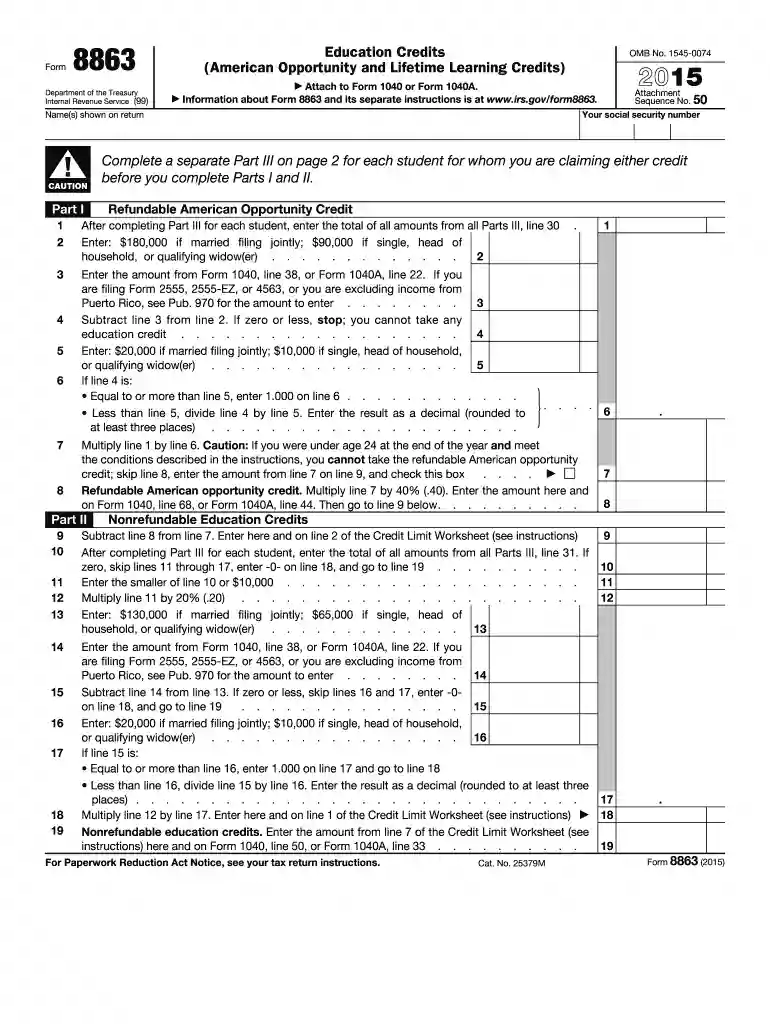
Form 8863, officially known as the Education Credits form, is used to claim education tax credits for eligible education expenses. It primarily allows eligible students to claim the American Opportunity Credit and the Lifetime Learning Credit. These credits can help reduce the amount of tax owed, based on the qualified educational expenses such as tuition, fees, and other necessary supplies related to enrolment or attendance.


The IRS issues specific guidelines concerning Form 8863, such as the types of educational expenses that qualify for credits. These guidelines also outline when and how to apply these credits, providing examples to help taxpayers understand and accurately complete their forms.
Individuals pursuing higher education or recognizing their dependent's education expenses are the primary users of Form 8863. This includes:

Failing to correctly file Form 8863 or providing inaccurate information can lead to penalties or the denial of credits. Misreported educational expenses can result in fines or the need to repay any credits received under false pretenses.
Tax preparation software like TurboTax or QuickBooks can simplify the submission of Form 8863. These platforms guide users through data entry, ensuring tax information is correct and optimizing credit application based on entered data.
The form can typically be accessed online via the IRS website or obtained through authorized tax preparation software. Users may also request a physical copy through IRS mailing services or visit local IRS offices to collect one in person.
Consider a full-time college student incurring $4,000 in eligible tuition expenses in 2015. By completing Form 8863:
These examples underscore the form's utility in lightening tax burdens during educational pursuits.
We've got more versions of the 2015 form 8863 form. Select the right 2015 form 8863 version from the list and start editing it straight away!
| Versions | Form popularity | Fillable & printable |
|---|---|---|
| 2025 | 4.5 Satisfied (59 Votes) | |
| 2024 | 4.3 Satisfied (23 Votes) | |
| 2023 | 4.2 Satisfied (23 Votes) | |
| 2022 | 4.8 Satisfied (61 Votes) | |
| 2021 | 4.9 Satisfied (28 Votes) | |
| 2020 | 4.3 Satisfied (120 Votes) | |
| 2019 | 4.3 Satisfied (185 Votes) | |
| 2018 | 4.4 Satisfied (185 Votes) | |
| 2017 | 4.3 Satisfied (131 Votes) | |
| 2016 | 4.4 Satisfied (449 Votes) | |
| 2015 | 4 Satisfied (27 Votes) | |
| 2014 | 4 Satisfied (25 Votes) | |
| 2013 | 4.2 Satisfied (58 Votes) | |
| 2012 | 4.2 Satisfied (29 Votes) | |
| 2011 | 4.1 Satisfied (64 Votes) |
At DocHub, your data security is our priority. We follow HIPAA, SOC2, GDPR, and other standards, so you can work on your documents with confidence.
Nov 13, 2017 To claim the AOTC or LLC, use Form 8863, Education Credits (American Opportunity and Lifetime Learning Credits). Additionally, if claimingRead more
Part I. Refundable American Opportunity Credit. 1. After completing Part III for each student, enter the total of all amounts from all Parts III, line 30 .Read more
Apr 15, 2015 expect that your 2015 Form 1040NR will show a tax refund or a tax balance due of less than $1,000. If your total estimated tax for 2015 isRead more


