




01. Edit your form 8863 online
Type text, add images, blackout confidential details, add comments, highlights and more.

Type text, add images, blackout confidential details, add comments, highlights and more.

Draw your signature, type it, upload its image, or use your mobile device as a signature pad.

Send form 8863 instructions via email, link, or fax. You can also download it, export it or print it out.
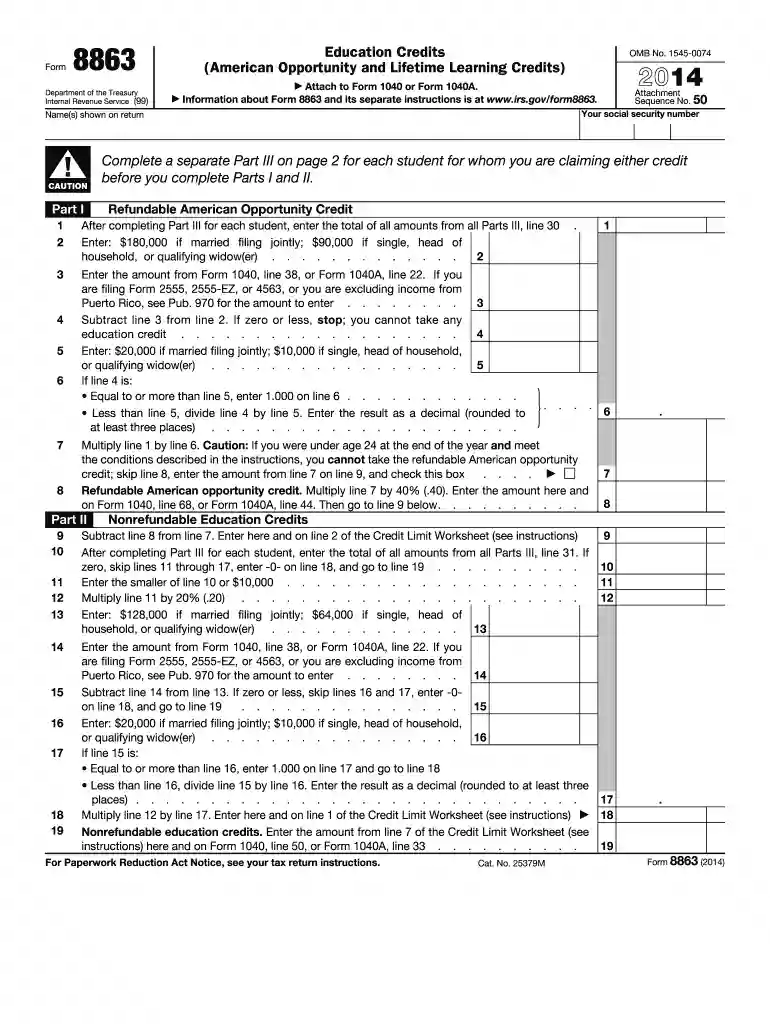
Form 8863, titled "Education Credits" for the tax year 2014, is utilized by taxpayers in the United States to claim education-related tax credits. It specifically facilitates the process of applying for the American Opportunity Credit and the Lifetime Learning Credit. These credits provide financial relief by reducing the amount of tax due for eligible education expenses. Understanding these credits is essential for taxpayers who have incurred qualified education expenses for themselves, their spouses, or their dependents, and wish to leverage these benefits for tax savings.
Completing Form 8863 involves a detailed process that requires careful attention to ensure accuracy. Here's a structured approach to filling out the form:
Determine Eligibility:
Gather Necessary Documentation:
Complete Personal Information:
Calculate Credits:
Transfer Results:
Eligibility for Form 8863 varies depending on the specific credit being claimed. Meeting these criteria is crucial for maximizing potential benefits.


Understanding key terms associated with Form 8863 is vital for accurate completion and optimization of eligible credits.
The IRS provides comprehensive guidelines to assist taxpayers in accurately completing Form 8863. Adherence to these rules ensures compliance and maximizes credit benefits.
The timely filing of Form 8863 ensures eligibility for applicable credits.
Gathering accurate and complete documentation is essential for a successful claim of education credits.
Taxpayers have multiple options for submitting Form 8863, allowing flexibility and convenience.
These comprehensive insights on Form 8863 will assist taxpayers in effectively leveraging education credits. By adhering to guidelines and thoroughly preparing documentation, individuals can maximize their potential savings while ensuring compliance with IRS regulations.
We've got more versions of the form 8863 form. Select the right form 8863 version from the list and start editing it straight away!
| Versions | Form popularity | Fillable & printable |
|---|---|---|
| 2025 | 4.5 Satisfied (59 Votes) | |
| 2024 | 4.3 Satisfied (23 Votes) | |
| 2023 | 4.2 Satisfied (23 Votes) | |
| 2022 | 4.8 Satisfied (61 Votes) | |
| 2021 | 4.9 Satisfied (28 Votes) | |
| 2020 | 4.3 Satisfied (120 Votes) | |
| 2019 | 4.3 Satisfied (185 Votes) | |
| 2018 | 4.4 Satisfied (185 Votes) | |
| 2017 | 4.3 Satisfied (131 Votes) | |
| 2016 | 4.4 Satisfied (449 Votes) | |
| 2015 | 4 Satisfied (27 Votes) | |
| 2014 | 4 Satisfied (25 Votes) | |
| 2013 | 4.2 Satisfied (58 Votes) | |
| 2012 | 4.2 Satisfied (29 Votes) | |
| 2011 | 4.1 Satisfied (64 Votes) |
Sign in to your DocHub account and import your icivics taxation answer key to our editor using one of its upload methods - from your device, cloud storage, protected URL, or your DocHub folders if you have already managed your document before. Open our editor, click the Sign button in the top toolbar, and choose your signing method. You can use a picture of your handwritten signature, draw it, enter your name, or use a QR code instead.
You can find the latest and most relevant version of the form 8863 2014 in our DocHub forms library. Search it by categories or use the search field to locate the exact template that fits your situation. You may open this form for editing once you find it.
At DocHub, your data security is our priority. We follow HIPAA, SOC2, GDPR, and other standards, so you can work on your documents with confidence.
Part I. Refundable American Opportunity Credit. 1. After completing Part III for each student, enter the total of all amounts from all Parts III, line 30 .Read more
Apr 15, 2021 8,863 Risk Factors of the Companys 2020 Annual Report on Form 10-K and in any of the Companys subsequent Securities and Exchange Commission.Read more
credits on Form 1040 or 1040A using Form 8863: Education Credits (American Opportunity and Lifetime Learning Credits), only for the qualified tuition andRead more


