
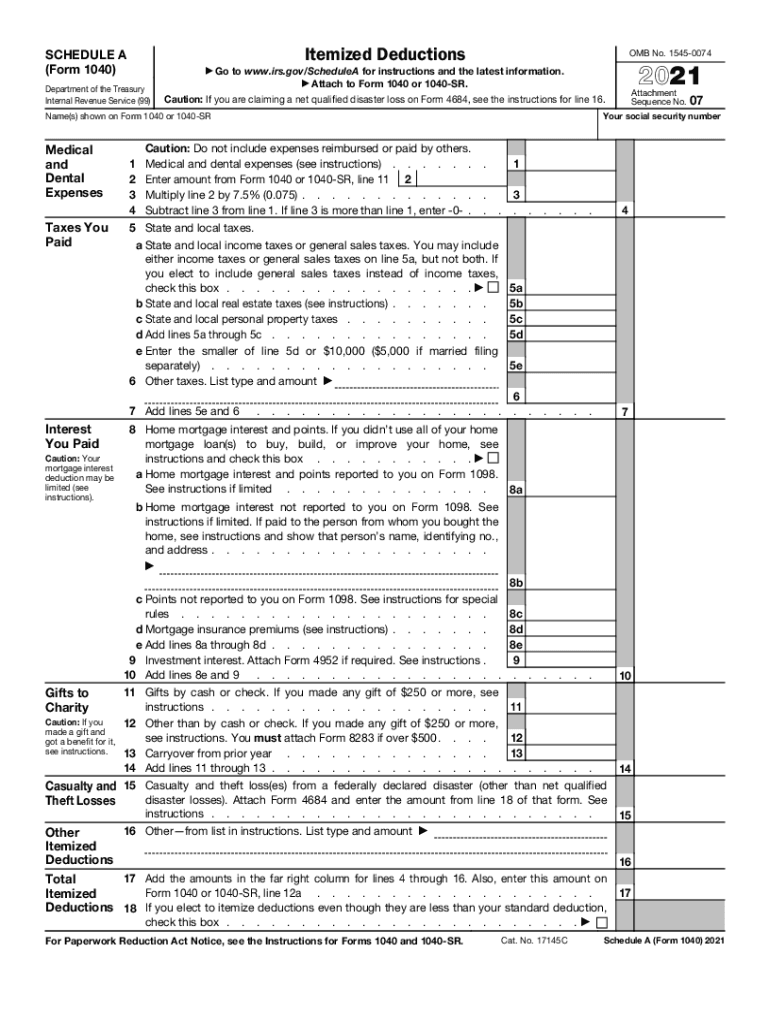







Definition & Meaning of Schedule A
"Schedule A" refers to a form used for itemizing deductions on individual income tax returns in the United States. This form enables taxpayers to list various deductible expenses, such as medical and dental costs, state and local taxes, mortgage interest, charitable contributions, and casualty losses. Instead of opting for the standard deduction, taxpayers may choose to use Schedule A to report their itemized deductions, which can result in tax savings. Understanding the specific categories and limits associated with this form is essential for maximizing your deductions.
Who Typically Uses the Schedule A
Schedule A is commonly utilized by individuals who incur significant deductible expenses each year. Taxpayers who often benefit from itemizing their deductions include:
- Homeowners with substantial mortgage interest or property taxes
- Individuals with high medical or dental expenses that exceed a certain percentage of their adjusted gross income
- Those who make considerable charitable donations
- Residents of states with high state and local taxes, as deducting these may provide a tax advantage
Due to the diverse range of expenses that Schedule A covers, it is essential for individuals who fall into these categories to thoroughly evaluate their financial situation annually.


Key Elements of the Schedule A
Several critical elements are involved in filling out Schedule A, each corresponding to different types of itemized deductions:
- Medical and Dental Expenses: Only expenses exceeding 7.5% of your adjusted gross income are deductible.
- Taxes You Paid: Includes state and local income taxes, real estate taxes, and personal property taxes, up to the applicable limits.
- Interest You Paid: Covers mortgage interest on your home and investment interest, with restrictions.
- Gifts to Charity: Deduct donations to qualified organizations, subject to percentage limits of adjusted gross income.
- Casualty and Theft Losses: Only casualties and theft losses attributable to a federally declared disaster are deductible.
Understanding these categories is vital for completing Schedule A accurately.
Steps to Complete the Schedule A
Completing Schedule A requires attention to detail and thorough documentation. Follow these steps to ensure accuracy:
- Gather Documentation: Collect all relevant documents reflecting itemized expenses, such as receipts, statements, and donation acknowledgment letters.
- Determine Eligibility: Verify that your expenses qualify as deductible according to IRS guidelines.
- Calculate Limits: For each category, calculate the deductible amount considering applicable percentage limits and caps.
- Fill Out the Form: Enter the calculated expenses into the respective fields of Schedule A.
- Attach to Form 1040: Once completed, file Schedule A along with your Form 1040.
Each step involves careful record-keeping and a clear understanding of IRS regulations pertaining to deductions.
IRS Guidelines for Schedule A
The IRS provides comprehensive guidelines for taxpayers using Schedule A. Key points include:
- Documentation Requirements: Maintain thorough records of all claimed deductions as evidence in case of IRS queries.
- Updates and Changes: Stay informed about annual updates to tax laws affecting allowable deductions and limitations.
- Audit Risks: Itemized deductions can trigger IRS scrutiny, so ensure all claims are legitimate and substantiated.
Adherence to IRS rules and regulations is crucial to avoid penalties and ensure eligible deduction claims.
Required Documents for Filing Schedule A
Preparing the necessary documents for Schedule A is a foundational step. Required documentation may include:
- Medical Bills: Receipts and statements for medical and dental expenses
- Property Tax Receipts: Documentation for state and local taxes paid
- Mortgage Statements: Proof of interest payments made to lenders
- Donation Receipts: Acknowledgment letters from charities
- Disaster Reports: For casualty losses, confirmation of federally declared disasters
Having these documents ready not only simplifies the filing process but also supports the accuracy of your claims.
Filing Deadlines and Important Dates
Timely submission of Schedule A, in conjunction with Form 1040, is essential:
- Filing Deadline: Typically, individual tax returns, including Schedule A, are due by April 15 each year.
- Extensions: If you require more time, you may file for an extension which usually grants an additional six months.
Staying informed about these deadlines ensures compliance and avoids late fees or penalties.
Software Compatibility for Schedule A
Various tax preparation software options facilitate the process of completing Schedule A:
- TurboTax: Guides you through itemizing deductions efficiently.
- H&R Block Software: Offers features for managing extensive documentation associated with deductions.
- TaxAct: Ensures compliance with updated tax laws and provides support for Schedule A specifics.
Using compatible software can streamline the filing process, reduce errors, and maximize potential refunds through accurate calculations.




