




01. Edit your form 2010 online
Type text, add images, blackout confidential details, add comments, highlights and more.

Type text, add images, blackout confidential details, add comments, highlights and more.

Draw your signature, type it, upload its image, or use your mobile device as a signature pad.

Send 1040a 2010 instructions via email, link, or fax. You can also download it, export it or print it out.
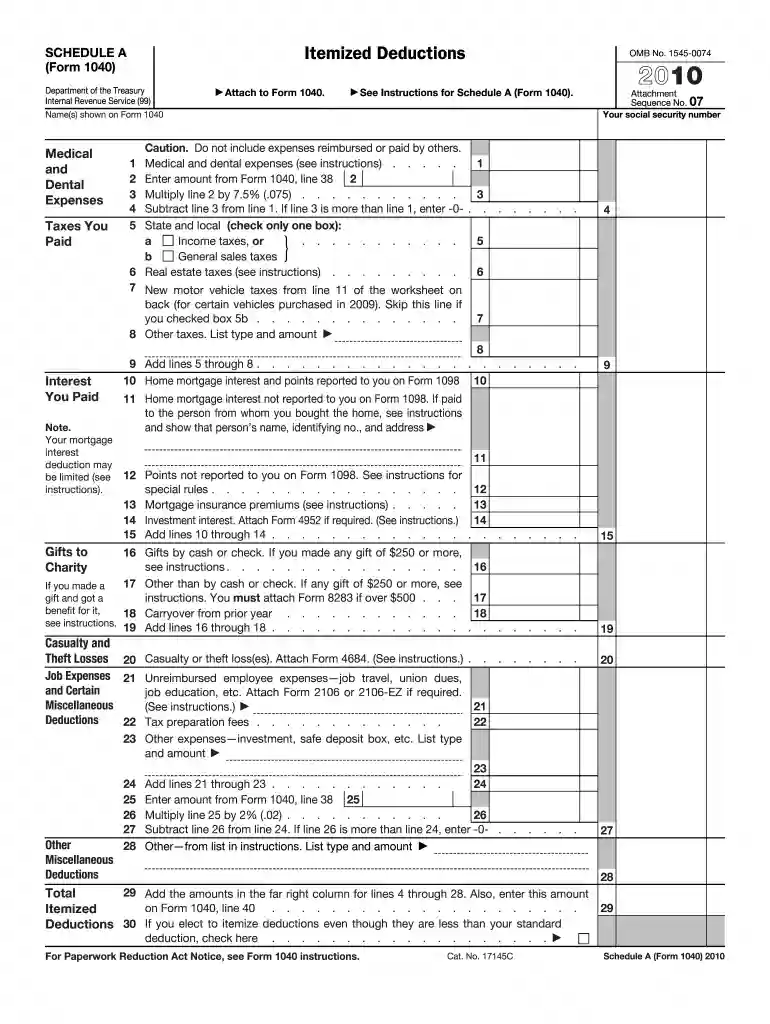
The 2010 Form 1040 Schedule A is a tax document used by taxpayers in the United States to calculate and report itemized deductions for their federal income tax returns. This form allows taxpayers to list their deductible expenses instead of taking the standard deduction, potentially reducing taxable income. Key categories for deductions include medical expenses, state and local taxes, mortgage interest, and charitable contributions. Understanding Schedule A is crucial for accurately maximizing eligible deductions and ensuring compliance with tax regulations.
Utilizing the 2010 Form 1040 Schedule A involves accurately tracking and documenting eligible expenses throughout the tax year. Taxpayers should organize receipts and records for deductible expenses, such as medical bills, charitable donations, and mortgage interest statements. This ensures the necessary documentation is available when completing the form. Using the form, taxpayers can sum each category of deductions and enter the total amounts in the designated sections. Completing this form accurately is essential, as it impacts the overall tax liability calculation.
Collect Necessary Documentation: Gather receipts, statements, and records for all deductible expenses.
Organize Expenses by Category: Group expenses into categories such as medical expenses, taxes paid, interest paid, etc.
Calculate Each Category Total: For each category, add up the expenses to determine the total deduction amount.
Enter Amounts on Schedule A: Input the total amounts for each category in the corresponding sections of Schedule A.
Sum the Total Deductions: Once all categories are filled out, calculate the total deductions and compare them to the standard deduction to decide which is more beneficial.
Attach to Form 1040: Submit Schedule A with the completed Form 1040 to the IRS when filing your tax return.
Adherence to IRS guidelines ensures compliance and accuracy in reporting deductions. Taxpayers must provide proof of expenses and may require attaching additional forms or documentation, such as Form 1098 for mortgage interest. The IRS also outlines specific thresholds and limitations for each deduction category, including caps on cash charitable contributions. Taxpayers should refer to IRS publications specific to the 2010 tax year for detailed guidance.
Filing a completed 2010 Form 1040 Schedule A typically coincides with the annual federal income tax deadline, generally April 15th of the following year. Taxpayers may apply for an extension to October 15th, extending the period to gather documentation and file. Failure to submit on time could lead to penalties, interest on unpaid taxes, or a forfeiture of refund opportunities. Therefore, timely submission is vital.
Failing to accurately complete or submit the 2010 Form 1040 Schedule A can result in various penalties. Misreporting deductions may incur fines or trigger an audit, while omissions or inaccuracies can lead to additional tax liabilities. Compliance with documentation requirements mitigates these risks, ensuring legitimate deductions are claimed. Taxpayers should consult with a tax professional if unsure about specific deductions or reporting obligations.
We've got more versions of the form 2010 form. Select the right form 2010 version from the list and start editing it straight away!
| Versions | Form popularity | Fillable & printable |
|---|---|---|
| 2025 | 4.1 Satisfied (27 Votes) | |
| 2024 | 4.9 Satisfied (59 Votes) | |
| 2023 | 4.9 Satisfied (45 Votes) | |
| 2022 | 4.6 Satisfied (38 Votes) | |
| 2021 | 4.8 Satisfied (181 Votes) | |
| 2020 | 4.3 Satisfied (81 Votes) | |
| 2019 | 4.1 Satisfied (40 Votes) | |
| 2018 | 4.2 Satisfied (65 Votes) | |
| 2017 | 4.4 Satisfied (61 Votes) | |
| 2016 | 4.4 Satisfied (673 Votes) | |
| 2015 | 4 Satisfied (35 Votes) | |
| 2014 | 4.3 Satisfied (52 Votes) | |
| 2013 | 4 Satisfied (21 Votes) | |
| 2012 | 3.9 Satisfied (29 Votes) | |
| 2010 | 4 Satisfied (56 Votes) |
At DocHub, your data security is our priority. We follow HIPAA, SOC2, GDPR, and other standards, so you can work on your documents with confidence.
by A SCHEDULE Cited by 4 Caution. Do not include expenses reimbursed or paid by others. 1 Medical and dental expenses (see instructions) . . . . . 1. 2 Enter amount from Form 1040,Read more
34. Miscellaneous itemized deductions from. Sch. A (Form 1040), line 24, or Sch. A. (Form 1040NR), line 10 (line 12 for 2007 throughRead more
1040 instructions (Online). Related to : United States. Internal Revenue Service. 1040 instructions, including instructions for schedules A, B, C, D, E, F, JRead more


