







Definition and Meaning
Schedules for Form 1040 and Form 1040-SR are supplementary forms used in conjunction with the main tax forms filed by individuals in the United States. These schedules allow taxpayers to report additional information about various types of income, deductions, credits, and other financial details that are not included on the standard Form 1040 or Form 1040-SR. Each schedule serves a unique purpose, assisting in calculating specific tax obligations or entitlements, making them crucial for accurate and comprehensive tax filing.
How to Use the Schedules
When filling out the Schedules for Form 1040 and Form 1040-SR, taxpayers must determine which schedules apply based on their financial activities during the tax year. Common schedules include:
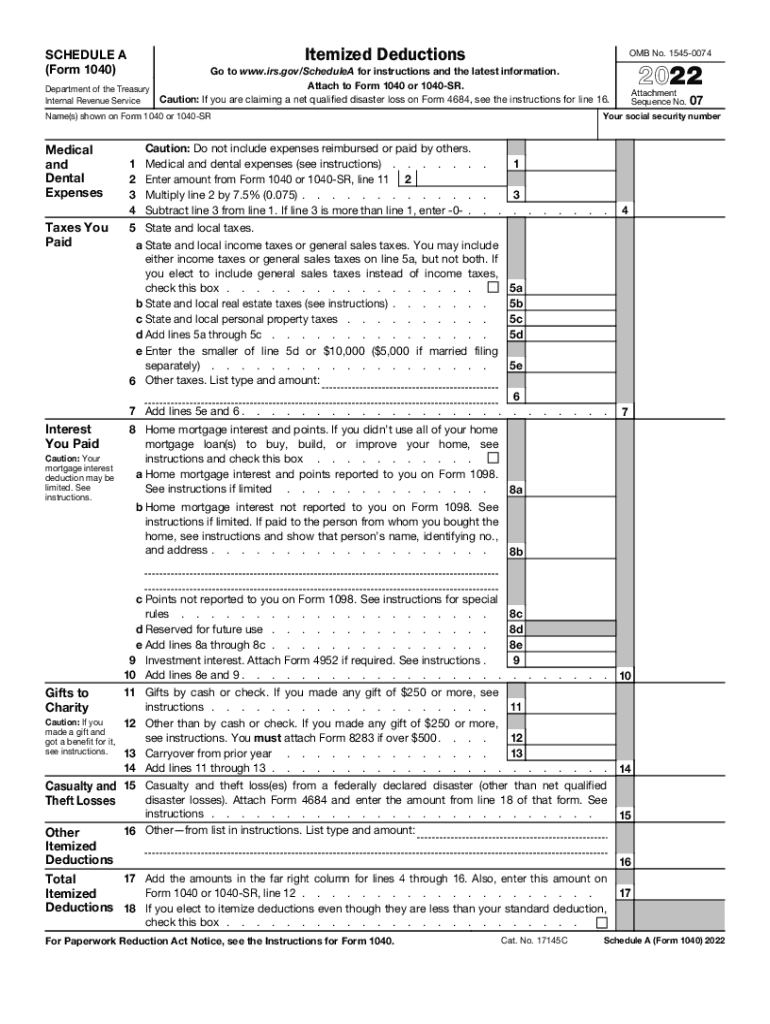
- Schedule A: For itemized deductions, covering expenses such as medical payments, mortgage interest, and charitable donations.
- Schedule B: Used to report interest and ordinary dividends.
- Schedule C: Complements those with business income, outlining profits and expenses from a sole proprietorship.
- Schedule D: Details capital gains and losses from investments.
Taxpayers begin by completing the applicable schedules and then transfer the results onto their main Form 1040 or Form 1040-SR.
Practical Examples
- Medical Expenses: If a taxpayer has significant medical expenses, they might use Schedule A to itemize their deductions.
- Business Income: A freelance graphic designer would use Schedule C to report their business income and associated expenses.
Steps to Complete the Schedules
- Identify Applicable Schedules: Review your financial documents to ascertain which schedules are needed.
- Gather Required Information: Collect income statements, receipts, and other documentation that supports your entries on each schedule.
- Complete the Schedules: Fill out each schedule accurately, ensuring that all figures are correct and all required fields are completed.
- Integrate with Form 1040 or 1040-SR: Transfer the necessary figures from the schedules to your main tax form to determine the overall tax liability or refund.
- Review and File: Double-check for accuracy and submit your completed forms by the due date.
Key Elements of the Schedules
Each schedule comes with distinct parts and forms that must be understood and filled out appropriately. Key elements include:
- Itemized Deductions (Schedule A): Consists of various sections like medical and dental expenses, taxes you paid, interest, and gifts to charity.
- Taxable Interest and Dividends (Schedule B): Requires you to list sources of interest and dividend income.
- Income or Loss from a Business (Schedule C): Sections include income, expenses, cost of goods sold, and vehicle information.
Detailed Breakdown
- Schedule C Expense Categories: Specific categories to detail include advertising, car and truck expenses, repairs and maintenance, and utilities.
IRS Guidelines
The Internal Revenue Service (IRS) provides comprehensive guidelines for completing each schedule. These guidelines explain:
- Eligibility Criteria: Conditions under which each schedule is applicable.
- Deductions and Credits: Specific rules for claiming deductions or credits.
- Penalty Provisions: Consequences of incorrect or late filing.
Example
Taxpayers using Schedule A need to adhere to IRS limits on certain deductions, like those for medical expenses, which must exceed a percentage of adjusted gross income.
Filing Deadlines and Important Dates
The standard deadline for filing Form 1040 and related schedules is April 15 each year. If this date falls on a weekend or holiday, the deadline is typically extended to the next business day. Extensions for filing can be requested, granting an additional six months to submit the forms.
Critical Dates
- January 31: Deadline for employers to send your W-2.
- April 15: Traditional tax filing deadline for individuals.
- October 15: Extended deadline for those who apply.
Required Documents
When preparing to file, taxpayers should gather all applicable documents, such as:
- W-2s and 1099s: Reported income sources.
- Receipts: For deductible expenses like business costs and medical payments.
- Previous Tax Returns: Useful for ensuring consistency and accuracy in reporting.
Tips for Document Management
- Use digital tools to scan and archive receipts and documents.
- Maintain organized folders for different types of documents to simplify retrieval.
Penalties for Non-Compliance
Failure to correctly complete and submit schedules with Form 1040 or 1040-SR can result in penalties, such as:
- Late Filing Penalties: Fees for missing the filing deadline without an approved extension.
- Accuracy-Related Penalties: Imposed for substantial understatements of tax due to negligence or disregard of IRS rules.
Penalty Examples
- Filing taxes late without an extension might incur a penalty of five percent of the unpaid tax for each month late, up to 25 percent of the total tax due.
Taxpayer Scenarios
Different taxpayer scenarios determine the use of schedules. Situations include:
- Self-Employed Individuals: Frequently require Schedule C for reporting business income and expenses.
- Retirees: May utilize Schedule D to report gains from investment accounts.
- Students: Often need to review requirements for educational credits on the relevant schedule.


Real-World Scenario
A retired individual with various investments might need to complete Schedules B and D to accurately report all sources of income.




