




01. Edit your 2023 schedule a online
Type text, add images, blackout confidential details, add comments, highlights and more.

Type text, add images, blackout confidential details, add comments, highlights and more.

Draw your signature, type it, upload its image, or use your mobile device as a signature pad.

Send income tax itemized deductions worksheet via email, link, or fax. You can also download it, export it or print it out.
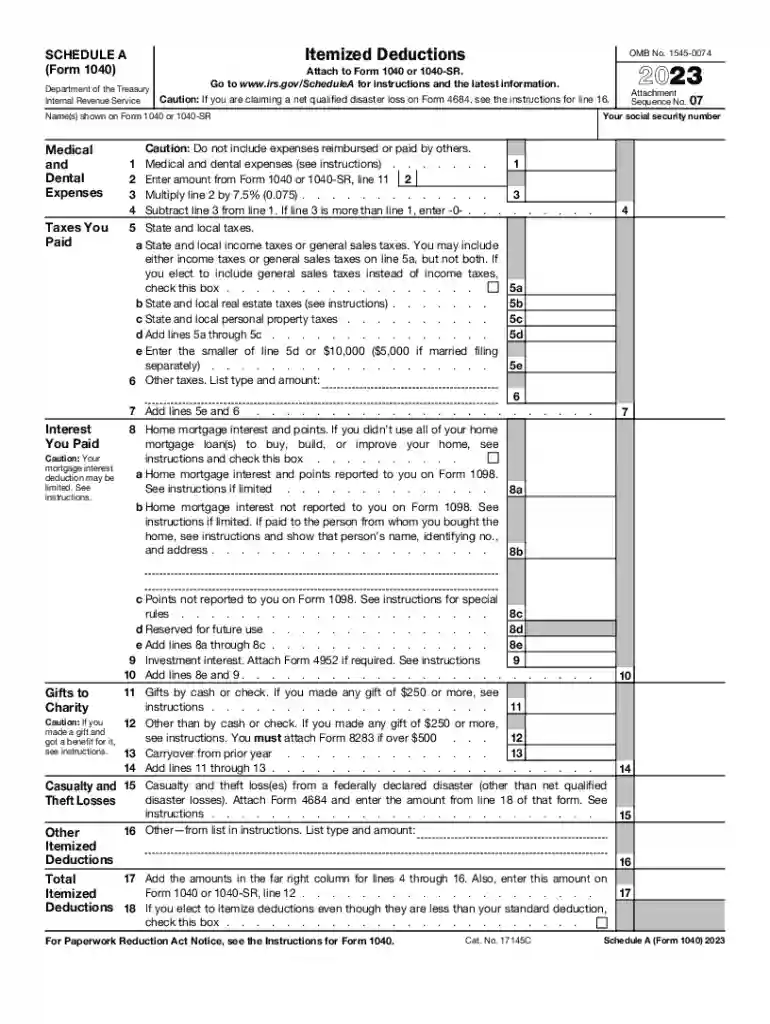
The 2023 Schedule A (Form 1040) is a crucial component of the federal income tax return process for taxpayers in the United States. It is used to report itemized deductions, which allows taxpayers to subtract certain allowable expenses from their taxable income. These deductions can include but are not limited to medical and dental expenses, state and local taxes, mortgage interest, charitable contributions, and casualty or theft losses. By itemizing, taxpayers can potentially lower their taxable income, which may reduce their overall tax liability.
The form consists of various sections, each catering to different types of deductions. Understanding each part is essential for correctly filling out the form:
The IRS provides detailed instructions on how to accurately fill out Schedule A. These guidelines include thresholds for deductions, definitions of allowed expenses, and specific rules for each category of deductions. Taxpayers should refer to IRS Publication 17 or visit the IRS website for comprehensive guidance on completing this form.
Opting to itemize deductions can be advantageous if your total itemized deductions exceed the standard deduction. This is often beneficial for individuals with significant medical expenses, mortgage interest, or charitable donations. Itemizing can potentially lead to a greater reduction of taxable income and, thus, a lower tax bill.
Taxpayers should be aware of the April 15 deadline for the submission of Form 1040 and accompanying schedules, including Schedule A. Extensions can be requested by submitting Form 4868, granting an additional six months to file. However, any taxes owed must still be paid by the original deadline to avoid penalties and interest.
To qualify for certain deductions, taxpayers need to meet eligibility requirements. For example, medical expenses must exceed a percentage of the AGI, and tax payments must pertain to state and local jurisdictions. Taxpayers should review IRS criteria and conditions related to each type of deduction before claiming them on Schedule A.


Understanding the process, requirements, and benefits associated with the 2023 Schedule A (Form 1040) Itemized Deductions allows taxpayers to make informed decisions during tax season, potentially leading to significant savings.
We've got more versions of the 2023 schedule a form. Select the right 2023 schedule a version from the list and start editing it straight away!
| Versions | Form popularity | Fillable & printable |
|---|---|---|
| 2025 | 4.1 Satisfied (27 Votes) | |
| 2024 | 4.9 Satisfied (59 Votes) | |
| 2023 | 4.9 Satisfied (45 Votes) | |
| 2022 | 4.6 Satisfied (38 Votes) | |
| 2021 | 4.8 Satisfied (181 Votes) | |
| 2020 | 4.3 Satisfied (81 Votes) | |
| 2019 | 4.1 Satisfied (40 Votes) | |
| 2018 | 4.2 Satisfied (65 Votes) | |
| 2017 | 4.4 Satisfied (61 Votes) | |
| 2016 | 4.4 Satisfied (673 Votes) | |
| 2015 | 4 Satisfied (35 Votes) | |
| 2014 | 4.3 Satisfied (52 Votes) | |
| 2013 | 4 Satisfied (21 Votes) | |
| 2012 | 3.9 Satisfied (29 Votes) | |
| 2010 | 4 Satisfied (56 Votes) |
At DocHub, your data security is our priority. We follow HIPAA, SOC2, GDPR, and other standards, so you can work on your documents with confidence.
by A SCHEDULE Cited by 4 Itemized Deductions Attach to Form 1040 or 1040-SR. Medical and Dental Expenses. Your mortgage interest deduction may be limited. Total Itemized Deductions
Information about Schedule A (Form 1040), Itemized Deductions, including recent updates, related forms, and instructions on how to file.
Apr 15, 1976 You can elect to deduct state and local general sales taxes instead of state and local income taxes as an itemized deduction on Schedule A (


