




01. Edit your irs schedule a 2018 online
Type text, add images, blackout confidential details, add comments, highlights and more.

Type text, add images, blackout confidential details, add comments, highlights and more.

Draw your signature, type it, upload its image, or use your mobile device as a signature pad.

Send 2018 schedule a via email, link, or fax. You can also download it, export it or print it out.
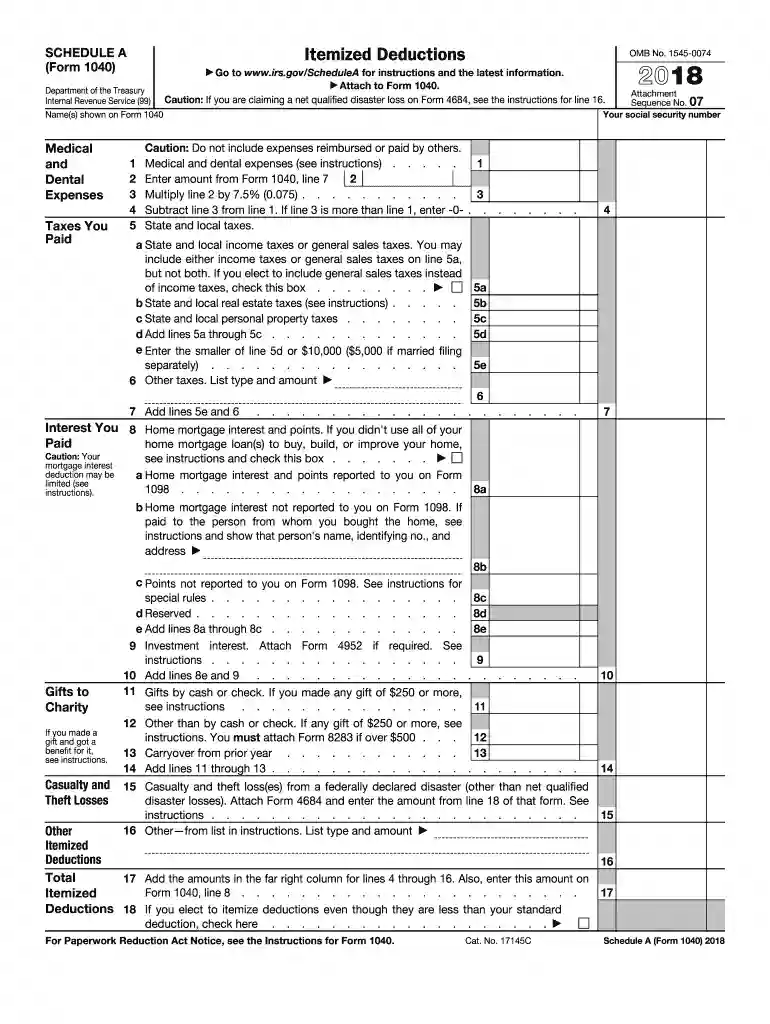
Schedule A, part of the IRS Form 1040, is used by taxpayers in the United States to itemize their deductions on federal income tax returns. It enables individuals to list specific expenses in order to reduce their taxable income, potentially resulting in lower tax liabilities. This form is suitable for taxpayers with eligible expenses exceeding the standard deduction threshold for 2016.
Schedule A includes several sections that detail different types of itemized deductions:
Schedule A is commonly used by taxpayers who have significant deductible expenses. This often includes:
The IRS provides guidance to ensure accurate reporting:
For the 2016 tax year, taxpayers were required to submit their completed Form 1040 and Schedule A by April 17, 2017. Extensions could be requested, but it is crucial to file or request an extension by this date to avoid penalties.
The 2016 Schedule A form can be accessed and downloaded directly from the IRS website. Taxpayers can also obtain paper copies by visiting local IRS offices or by calling the IRS to request forms be mailed.
Failing to accurately complete and submit the Schedule A can result in several penalties:
Popular tax preparation software like TurboTax and QuickBooks support Schedule A preparation. These platforms can simplify the process by importing necessary financial data and walking through deduction categories to maximize accuracy and benefit.
We've got more versions of the irs schedule a 2018 form. Select the right irs schedule a 2018 version from the list and start editing it straight away!
| Versions | Form popularity | Fillable & printable |
|---|---|---|
| 2025 | 4.1 Satisfied (27 Votes) | |
| 2024 | 4.9 Satisfied (59 Votes) | |
| 2023 | 4.9 Satisfied (45 Votes) | |
| 2022 | 4.6 Satisfied (38 Votes) | |
| 2021 | 4.8 Satisfied (181 Votes) | |
| 2020 | 4.3 Satisfied (81 Votes) | |
| 2019 | 4.1 Satisfied (40 Votes) | |
| 2018 | 4.2 Satisfied (65 Votes) | |
| 2017 | 4.4 Satisfied (61 Votes) | |
| 2016 | 4.4 Satisfied (673 Votes) | |
| 2015 | 4 Satisfied (35 Votes) | |
| 2014 | 4.3 Satisfied (52 Votes) | |
| 2013 | 4 Satisfied (21 Votes) | |
| 2012 | 3.9 Satisfied (29 Votes) | |
| 2010 | 4 Satisfied (56 Votes) |
A lot of software applications are available out there for document editing and signing. DocHub is one of the most popular online solutions that comply with all security and compliance requirements and guarantees your electronically signed paperwork is legally enforceable. All you need to try it out is to create an account, upload your 1040 schedule a 2018, provide the required information, and click Sign. Generate your eSignature by typing, drawing it, uploading its picture to your document, or scanning a unique QR code.
Having a swift editing system like DocHub, you do not need anything but a web browser and internet connection to edit your 2018 irs schedule a online swiftly. Add your file or get the appropriate form in DocHub’s catalog, open our editor with a single click, and finish it digitally. To edit your forms anytime, register a free profile with DocHub.
At DocHub, your data security is our priority. We follow HIPAA, SOC2, GDPR, and other standards, so you can work on your documents with confidence.
Schedule A. Charitable Deduction. Dont complete for a simple trust or a pooled income fund. Amounts paid or permanently set aside for charitable purposes fromRead more
Jan 19, 2017 2016 NOL forward, use Schedule A, Form 1045, to compute your 2016 NOL that will be carried over to 2017. Report your 2016 NOL from line 25Read more
Nov 28, 2016 Use Schedule A (Form 1040) to figure your itemized deductions. In most cases, your federal income tax will be less if you take the larger ofRead more


