



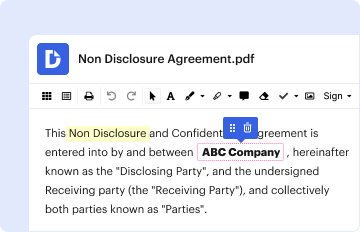
01. Edit your what is schedule a online
Type text, add images, blackout confidential details, add comments, highlights and more.

Type text, add images, blackout confidential details, add comments, highlights and more.
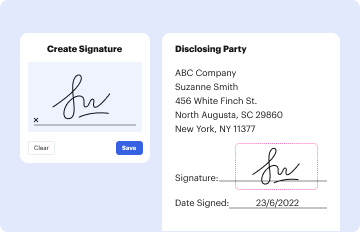
Draw your signature, type it, upload its image, or use your mobile device as a signature pad.

Send 2017 schedule a via email, link, or fax. You can also download it, export it or print it out.
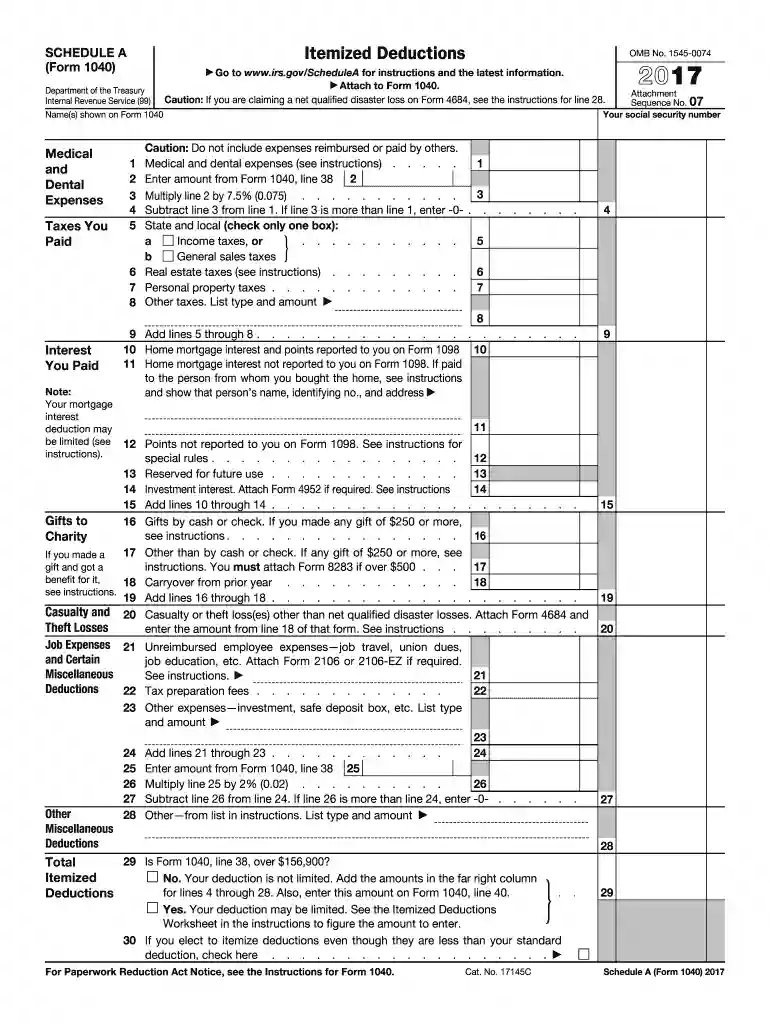
Schedule A, part of Form 1040, is used by taxpayers in the U.S. to itemize deductions on their federal income tax returns. It helps calculate deductions beyond the standard deduction, potentially reducing taxable income. Common deductible expenses include medical costs, taxes paid to state and local authorities, mortgage interest, charitable contributions, casualty losses, and certain miscellaneous expenses. This form is especially advantageous for individuals with significant deductible expenses surpassing the standard deduction.
Using Schedule A involves several key steps to maximize potential deductions. Taxpayers must begin by gathering relevant documents, such as receipts for medical expenses, mortgage interest statements, and records of charitable contributions. Each category of deductible expenses should be calculated separately. After determining the total for each category, they must be tallied to find the overall itemized deductions. If this total exceeds the standard deduction for the taxpayer's filing status, they can use Schedule A to report itemized deductions on Form 1040.
Schedule A for 2017 can be acquired through various methods. The IRS website offers downloadable forms and instructions, which can be printed for manual completion. Tax preparation software often includes Schedule A, streamlining the access and completion process. Additionally, professional tax preparers can provide the form and support in filling it out accurately. Taxpayers who require physical copies can request them by mail from the IRS.
Schedule A is primarily used by taxpayers whose itemized deductions are greater than the standard deduction. These include homeowners with mortgage interest, individuals with high medical expenses, and those making substantial charitable contributions. Self-employed individuals, retirees, and affluent taxpayers often itemize to reduce their taxable income effectively. Understanding the nuances of itemizing vs. taking the standard deduction is crucial for maximizing tax benefits.
Schedule A is divided into distinct sections, each addressing a specific type of deductible expense. The form includes lines for medical expenses, taxes paid, and interest paid, each requiring detailed calculation. The charitable contributions section demands careful tracking and proof of donations. Later sections cover casualty losses and miscellaneous deductions, each with specific instructions and limitations. Understanding these sections ensures accurate reporting of deductions.
The IRS mandates strict compliance with guidelines for itemizing deductions on Schedule A. Taxpayers must maintain clear records and receipts to substantiate every deduction. The IRS audits suspect deductions, particularly large donations or expenses. Adjustments to deductions when laws change, especially state and local tax deduction limits, impact the accuracy of Schedule A filings. Taxpayers must consult current IRS publications or professionals for updated guidance.
Schedule A should be filed with Form 1040 by the regular tax filing deadline, typically April 15. Taxpayers should note potential extensions for extenuating circumstances, but this does not extend the payment deadline. Required documentation includes medical receipts, interest statements, and charitable donation records. Ensuring all necessary documents are organized before filing helps prevent delays or rejections.
The digital version of Schedule A offers convenience through tax software, aiding precision with automatic calculations and current deduction limits. Software platforms like TurboTax and QuickBooks integrate with tax documents, simplifying the filing process. However, some taxpayers may prefer the tactile nature of a paper form, which can be filled out manually and mailed. Both methods require careful attention to detail and adherence to IRS instructions for accuracy.
While Schedule A deductions are federally standardized, state tax laws diverge significantly. Some states allow itemized deductions similar to the federal structure, while others conform to federal standards with exclusions. States may impose their limits on property tax deductions or exclude certain charitable contributions. Taxpayers should be aware of specific state rules to ensure compliance and optimize deductions on both federal and state returns.
We've got more versions of the what is schedule a form. Select the right what is schedule a version from the list and start editing it straight away!
| Versions | Form popularity | Fillable & printable |
|---|---|---|
| 2025 | 4.1 Satisfied (27 Votes) | |
| 2024 | 4.9 Satisfied (59 Votes) | |
| 2023 | 4.9 Satisfied (45 Votes) | |
| 2022 | 4.6 Satisfied (38 Votes) | |
| 2021 | 4.8 Satisfied (181 Votes) | |
| 2020 | 4.3 Satisfied (81 Votes) | |
| 2019 | 4.1 Satisfied (40 Votes) | |
| 2018 | 4.2 Satisfied (65 Votes) | |
| 2017 | 4.4 Satisfied (61 Votes) | |
| 2016 | 4.4 Satisfied (673 Votes) | |
| 2015 | 4 Satisfied (35 Votes) | |
| 2014 | 4.3 Satisfied (52 Votes) | |
| 2013 | 4 Satisfied (21 Votes) | |
| 2012 | 3.9 Satisfied (29 Votes) | |
| 2010 | 4 Satisfied (56 Votes) |
At DocHub, your data security is our priority. We follow HIPAA, SOC2, GDPR, and other standards, so you can work on your documents with confidence.
Feb 15, 2018 Use Schedule A (Form 1040) to figure your itemized deductions. In most cases, your federal income tax will be less if you take the larger ofRead more
Dec 6, 2017 If you are an individual, pages 1 and 2 of your 2017 Form 1040 and Schedules. A, D, and J (Form 1040), if applicable. Any Form 4952, InvestmentRead more
Jan 21, 2026 1040 Schedule A Itemized Deductions. Instructions for 1040 Schedule A NOTE: Beginning in 2017, if you claim the Earned Income TaxRead more


