
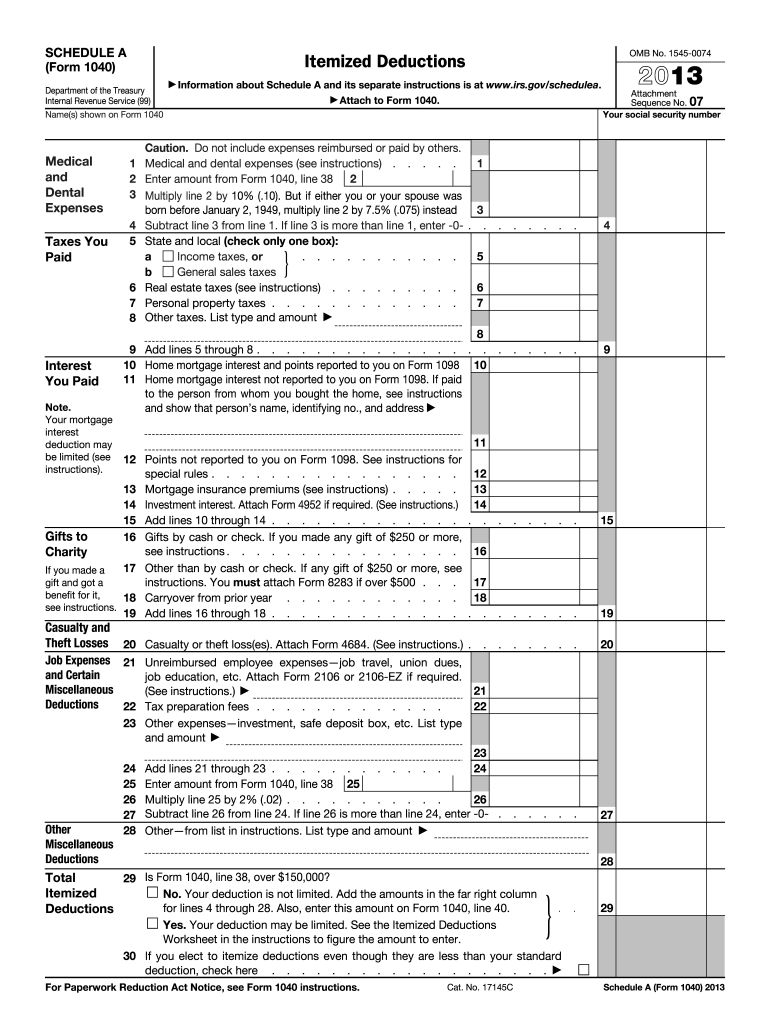







Definition and Purpose of Schedule A (Form 1040)
Schedule A (Form 1040) is an essential document for individual taxpayers in the United States who wish to itemize their deductions on their federal income tax return. By opting to use this form, taxpayers can potentially reduce their taxable income by listing various deductible expenses. The types of expenditures that can be itemized on Schedule A include:
- Medical and dental expenses
- Taxes paid, such as state, local, and real estate taxes
- Home mortgage interest
- Charitable contributions
- Casualty and theft losses
- Miscellaneous deductions
Examples of Deductions
For example, a taxpayer who incurred significant medical expenses throughout the year that were not covered by insurance could detail these costs on Schedule A. Similarly, charitable donations to qualifying organizations and interest payments on a home mortgage are valid deductions.
Steps to Complete the 2013 Schedule A (Form 1040)
Much like other IRS forms, accurate completion of the 2013 Schedule A is crucial for compliance and maximizing potential tax benefits. Here is a step-by-step guide to filling out the form:
-
Gather Necessary Documents:
- Collect records of all deductible expenses such as receipts for medical bills or documented real estate tax payments.
-
Medical and Dental Expenses:
- Calculate total unreimbursed medical and dental expenses. Subtract 10% of your adjusted gross income (AGI) from this amount to determine the deductible portion.
-
Taxes Paid:
- Itemize all state, local, and property taxes paid. Remember to differentiate between taxes that are deductible and those that do not qualify.
-
Interest Paid:
- Record the total amount of mortgage interest and points reported on Form 1098 by your mortgage lender.
-
Charitable Contributions:
- Provide documentation of all charitable gifts. The IRS accepts monetary donations and donated goods as allowable deductions.
-
Casualty and Theft Losses:
- Document any losses from events like theft or disaster. Subtract $100 from each loss event and then 10% of your AGI from the total to find the deductible amount.
-
Miscellaneous Deductions:
- Include deductions like unreimbursed employee expenses, tax preparation fees, and other authorized costs exceeding 2% of AGI.
-
Final Calculation:
- Sum all categories to determine total itemized deductions and transfer this to your Form 1040.
Required Documents for Filing
Before beginning the process of filing the Schedule A (Form 1040), ensure that you have collected the following documents:
- Medical and dental receipts
- Property tax statements
- Mortgage interest statements (Form 1098)
- Proof of charitable contributions
- Any other relevant receipts or documents detailing deductible expenses
Real-World Scenario
Imagine a retiree who has a complex portfolio of property investments and charitable work. By collecting all relevant documents, listing allowable deductions, and calculating each accurately on the Schedule A form, they can significantly reduce their taxable income.
Important IRS Guidelines for the Schedule A (Form 1040)
The IRS provides specific guidelines to ensure taxpayers correctly itemize deductions and maximize their benefits. Key points include:
- Understanding which medical expenses qualify
- Differentiating between deductible and non-deductible taxes and interest
- Maintaining accurate records of charitable contributions
- Adhering to the adjustment percentages, like the 2% floor on miscellaneous deductions
Variations and Edge Cases
Taxpayers should be cautious of tax law changes impacting the applicability or limits of deductions, understanding that wrong application, such as overstated deductions, can lead to audits or penalties.
Filing Deadlines and Important Dates
For most taxpayers, Schedule A (Form 1040) is filed along with their tax returns, typically due on April 15th of the following year. If you need extra time to gather documents or prepare your deductions:
- Consider filing for an extension using Form 4868 to extend the submission deadline to October 15.
How to Obtain the 2013 Schedule A (Form 1040)
Taxpayers can access the 2013 Schedule A form through multiple channels:
- Download directly from the IRS website as a fillable PDF
- Obtain printed copies at local libraries or IRS Taxpayer Assistance Centers
- Utilize tax preparation software that includes access to up-to-date forms
Practical Example
Using tax software such as TurboTax ensures you have the most current forms and simplifies calculating whether itemizing or opting for the standard deduction is more advantageous.
Penalties for Non-Compliance
Failing to correctly complete or submit Schedule A along with your Form 1040 can result in various penalties:
- Underreporting deductions may lead to IRS audits, additional taxes, and possible fines
- Incorrect filing without an approved extension is subject to late fees and interest charges
Regularly reviewing updated IRS rules and ensuring timely submission are critical to avoiding these potential pitfalls.
Software Compatibility for Schedule A (Form 1040)
Various popular tax preparation programs, including TurboTax and H&R Block, facilitate the completion of Schedule A by:
- Guiding users step-by-step through the itemization process
- Providing calculations to compare itemized deductions and standard deductions
- Offering e-filing options for convenience
These tools are particularly useful for individuals with evolving financial situations who benefit from professional guidance.




