




01. Edit your 2008 w2 online
Type text, add images, blackout confidential details, add comments, highlights and more.

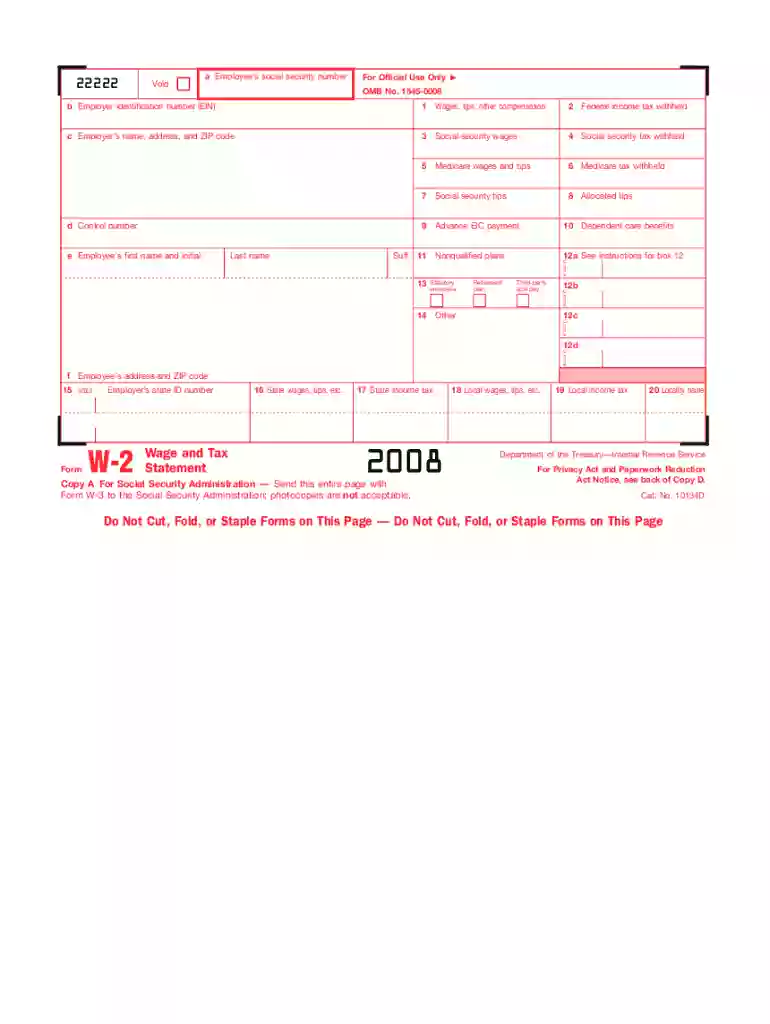
Type text, add images, blackout confidential details, add comments, highlights and more.

Draw your signature, type it, upload its image, or use your mobile device as a signature pad.

Send 2008 w 2 forms pdf via email, link, or fax. You can also download it, export it or print it out.
The 2008 Form W-2, formally known as the Wage and Tax Statement, is a crucial document used by employers in the United States to report wages paid to employees and the taxes withheld from those wages. This form is essential for both employers and employees as it is a foundational component of tax reporting and compliance. Employers are required to furnish this form to their employees, the Social Security Administration (SSA), and the Internal Revenue Service (IRS).
The primary purpose of the Form W-2 is to provide a detailed summary of an individual's annual earnings and withheld taxes. It includes information on federal income tax, Social Security tax, and Medicare tax withheld. Additional entries might include state and local taxes, employer-provided benefits, and other compensatory aspects. For employees, this form is vital for accurately filing their annual federal and state income tax returns.
Employees typically receive the 2008 Form W-2 from their employers by the end of January following the calendar year of earnings. It can be delivered in various formats, including a paper copy or a digital version sent via email or accessible through an employer-provided online portal. Employers must ensure the form is sent to the correct address on record for each employee to avoid issues in tax filing.
If an employee does not receive their Form W-2 by mid-February, they should contact their employer immediately to request a copy. Additionally, employees can reach out to the IRS for assistance. While the IRS does not issue the W-2 directly to employees, they can provide guidance on how to obtain it from one’s employer and recommend steps to take if the form is not delivered.
Filling out the 2008 Form W-2 requires attention to detail and accuracy to ensure compliance with IRS regulations. Employers should follow these steps:
Employee Information: Enter the employee’s Social Security Number, full name, and address.
Wage Details: Record the total wages, tips, and other compensation for the year.
Tax Withheld: Specify federal income tax withheld along with Social Security and Medicare taxes.
State and Local Details: Include state wages, tips, and income tax withheld for state-specific reporting.
Review and Verify: Verify all entered information for accuracy, including SSN and withholding amounts.
Distribute Copies: Provide copies to relevant parties:
The 2008 Form W-2 includes several key elements that are integral to tax and income reporting:
Box 1 - Wages, Tips, Other Compensation: This box captures the total earnings subject to income tax.
Box 2 - Federal Income Tax Withheld: Displays the amount of federal tax withheld from the employee's pay.
Box 12: Use code identifiers to report different types of compensation and benefits, such as retirement plan contributions (e.g., 401(k) contributions).
Box 14 - Other: May include additional tax information like union dues or non-taxable income, depending on employer specifications.
Employers must ensure each box reflects accurate data for proper tax reporting and compliance, minimizing the risk of IRS penalties.
Adherence to IRS guidelines for the 2008 Form W-2 is crucial for avoiding penalties. The IRS mandates that the form must be issued to employees by January 31 of the following year and filed with the SSA by the end of February (or end of March if filed electronically). Employers should evaluate their reporting methods early and choose to file electronically when possible, as it often provides efficiency and reduces the likelihood of errors.
Moreover, the IRS requires W-2 forms to be scannable, meaning that handwritten entries should be avoided to ensure the SSA can process the forms accurately. Compliance with these guidelines is essential not only to avoid fines but also to protect employees from tax reporting complications.
Non-compliance with the requirements of the 2008 Form W-2 can lead to significant penalties for employers. These penalties can vary based on the severity of the omission or error, timeliness of corrections, and whether the employer can prove a reasonable cause for the oversight. Penalties can escalate per instance and per day beyond the due date, making them costly if not addressed promptly.
Common causes of penalties include:
Employers should take every measure to avoid administrative errors that could lead to financial liabilities or further scrutiny from tax authorities.
Employees rely on the 2008 Form W-2 for several purposes, especially in preparing their annual taxes. They should carefully review all information on the form as soon as it arrives, looking for discrepancies such as incorrect wages or Social Security numbers. Addressing these promptly with the employer ensures the proper reflection of these figures in their tax return.
Taxpayer scenarios include different forms of employment and life situations, such as self-employment or retirement, which might alter how the W-2 interacts with other tax documents. Employees must consider how their tax situation might intersect with additional forms (e.g., Form 1099 for independent contractors).


Timeliness in handling the 2008 Form W-2 is crucial. Employers must still comply with precise deadlines which include:
January 31: Deadline to provide employees with their W-2 form.
Last day of February: Deadline to file paper copies with the SSA.
March 31: Deadline for electronic filing to the SSA.
Submission methods vary, including mail and electronic filing options. Although both methods are acceptable, electronic filing is encouraged due to its efficiency, accuracy, and tracking abilities. Additionally, electronic filing is often easier to verify and can minimize the risk of errors that can occur with manual entry forms.
We've got more versions of the 2008 w2 form. Select the right 2008 w2 version from the list and start editing it straight away!
| Versions | Form popularity | Fillable & printable |
|---|---|---|
| 2024 | 4.7 Satisfied (35 Votes) | |
| 2023 | 4.4 Satisfied (26 Votes) | |
| 2022 | 4.7 Satisfied (59 Votes) | |
| 2021 | 4.8 Satisfied (120 Votes) | |
| 2020 | 4.4 Satisfied (218 Votes) | |
| 2019 | 4.4 Satisfied (910 Votes) | |
| 2018 | 4.4 Satisfied (233 Votes) | |
| 2017 | 4.2 Satisfied (267 Votes) | |
| 2016 | 4.4 Satisfied (882 Votes) | |
| 2015 | 4.3 Satisfied (259 Votes) | |
| 2014 | 4.2 Satisfied (43 Votes) | |
| 2013 | 3.9 Satisfied (53 Votes) | |
| 2013 | 4 Satisfied (60 Votes) | |
| 2012 | 4 Satisfied (53 Votes) | |
| 2011 | 4.2 Satisfied (74 Votes) |
Microsoft Word doesn’t have signing tools to create valid electronic signatures and enforceable documents. Luckily, DocHub is an online eSignature-compliant editor that supports different document formats, such as .doc files. Sign in to your account and add the Word version of your 2008 w2 forms from your device and cloud, or URL - our editor will automatically convert it into an editable PDF. Make all necessary adjustments in your document and click Sign to create your own legally-binding eSignature. There are four signing methods from which to choose.
You can easily edit fill out your w2 form 2008 on any iOS gadget. Open an internet browser of your choice, visit the DocHub website, authorize or create a new account, upload your file for editing, and make your desired changes. Our service is mobile-friendly, so using its features on your smartphone will be a no-brainer, even on the first try.
At DocHub, your data security is our priority. We follow HIPAA, SOC2, GDPR, and other standards, so you can work on your documents with confidence.



Jan 27, 2009 The University has recently mailed over 32000 Calendar Year (CY) 2008 W-2 Forms to employees permanent addresses as they appear on the
May 2, 2017 Do not use these forms to report wages subject to U.S. income tax withholding. Instead, use Form W-2 to show U.S. income tax withheld. TreatmentRead more
Specific information needed to complete Form W-2 is available in a separate booklet titled 2008 Instructions for. Forms W-2 and W-3. You can order thoseRead more


