




01. Edit your form online
Type text, add images, blackout confidential details, add comments, highlights and more.

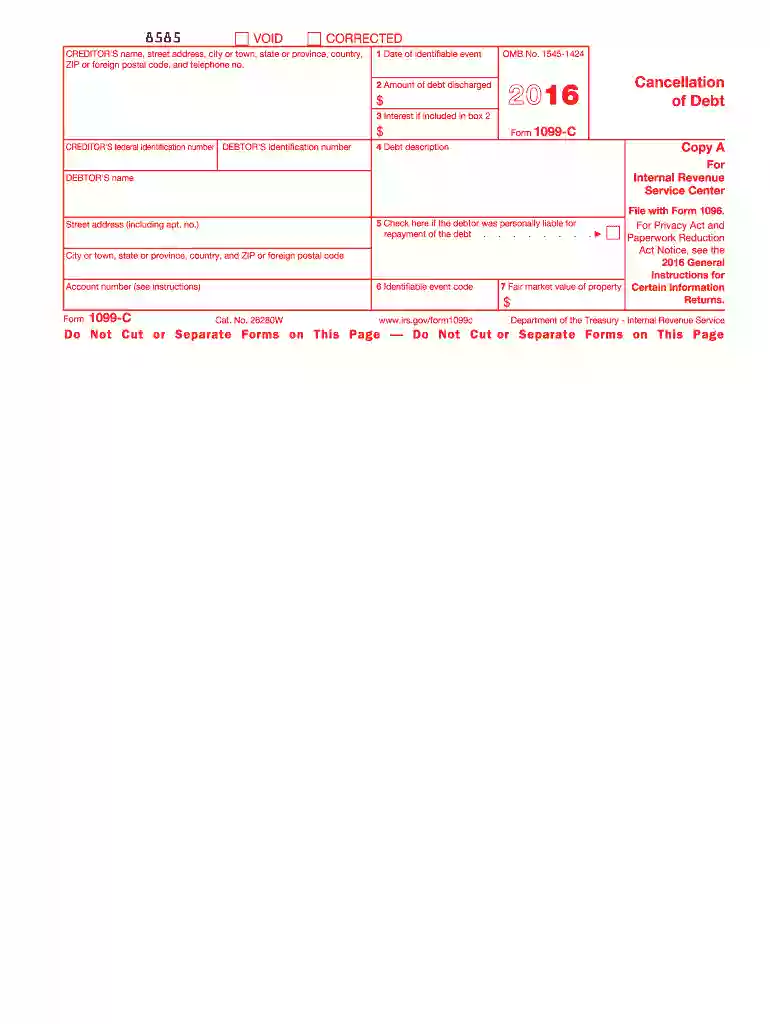
Type text, add images, blackout confidential details, add comments, highlights and more.

Draw your signature, type it, upload its image, or use your mobile device as a signature pad.

Send it via email, link, or fax. You can also download it, export it or print it out.
Form 1099-C, Cancellation of Debt, is a tax document used by lenders to report the cancellation of $600 or more of a borrower's debt. When a debt is canceled, forgiven, or discharged, the IRS treats this amount as taxable income, which is why such transactions must be documented using this form. Entities that typically use Form 1099-C include credit card companies, financial institutions, and the government.
Entities utilizing the Form 1099-C must understand its purpose and follow detailed steps to correctly use it for reporting debt cancellation. It is fundamental for both creditors, who are responsible for issuing the form, and for debtors, who need to report the canceled debt on their tax returns.
Securing Form 1099-C for reporting cancellation of debt transactions is essential for compliance. There are several avenues to obtain this IRS form.
Filling out the 1099-C form accurately ensures transparency and compliance with IRS regulations. Here's a detailed guide on completing this document.
Form 1099-C serves as a legal document to communicate debt cancellation to the IRS. Proper use is crucial for both compliance and tax accuracy.
Understanding specific terms linked to Form 1099-C is crucial to grasp its full implications.
Adhering to IRS guidelines for Form 1099-C ensures compliance and avoids penalties.
Staying informed on filing deadlines is vital for avoiding delays and penalties.
This comprehensive breakdown serves as an influential guide for understanding, completing, and correctly filing Form 1099-C for the year 2016, ensuring both compliance and financial clarity.
We've got more versions of the 1099c 2016 form form. Select the right 1099c 2016 form version from the list and start editing it straight away!
| Versions | Form popularity | Fillable & printable |
|---|---|---|
| 2022 | 4.5 Satisfied (52 Votes) | |
| 2021 | 4.8 Satisfied (205 Votes) | |
| 2020 | 4.4 Satisfied (266 Votes) | |
| 2019 | 4.4 Satisfied (163 Votes) | |
| 2018 | 4.2 Satisfied (39 Votes) | |
| 2017 | 4.4 Satisfied (568 Votes) | |
| 2016 | 4.2 Satisfied (122 Votes) | |
| 2015 | 4 Satisfied (34 Votes) | |
| 2014 | 4.1 Satisfied (73 Votes) | |
| 2013 | 4.3 Satisfied (55 Votes) | |
| 2012 | 4.4 Satisfied (70 Votes) | |
| 2011 | 4.1 Satisfied (36 Votes) | |
| 2010 | 4.3 Satisfied (66 Votes) | |
| 2001 | 4.2 Satisfied (61 Votes) |
At DocHub, your data security is our priority. We follow HIPAA, SOC2, GDPR, and other standards, so you can work on your documents with confidence.
To complete Form 1099-C, use: the 2016 General Instructions for Certain Information. Returns, and. the 2016 Instructions for Forms 1099-A and 1099-C. ToRead more
Form 1099-MISC (various 1-4-2016. Form 1098 (home mortgage interest), 1098-E (student loan interest), 1098-T. (tuition). Form 1099-C (canceled debt).Read more
Apr 15, 2015 You may be eligible to claim the premium tax credit if you, your spouse, or a dependent enrolled in health insurance through the HealthRead more


