




01. Edit your form online
Type text, add images, blackout confidential details, add comments, highlights and more.

Type text, add images, blackout confidential details, add comments, highlights and more.

Draw your signature, type it, upload its image, or use your mobile device as a signature pad.

Send it via email, link, or fax. You can also download it, export it or print it out.
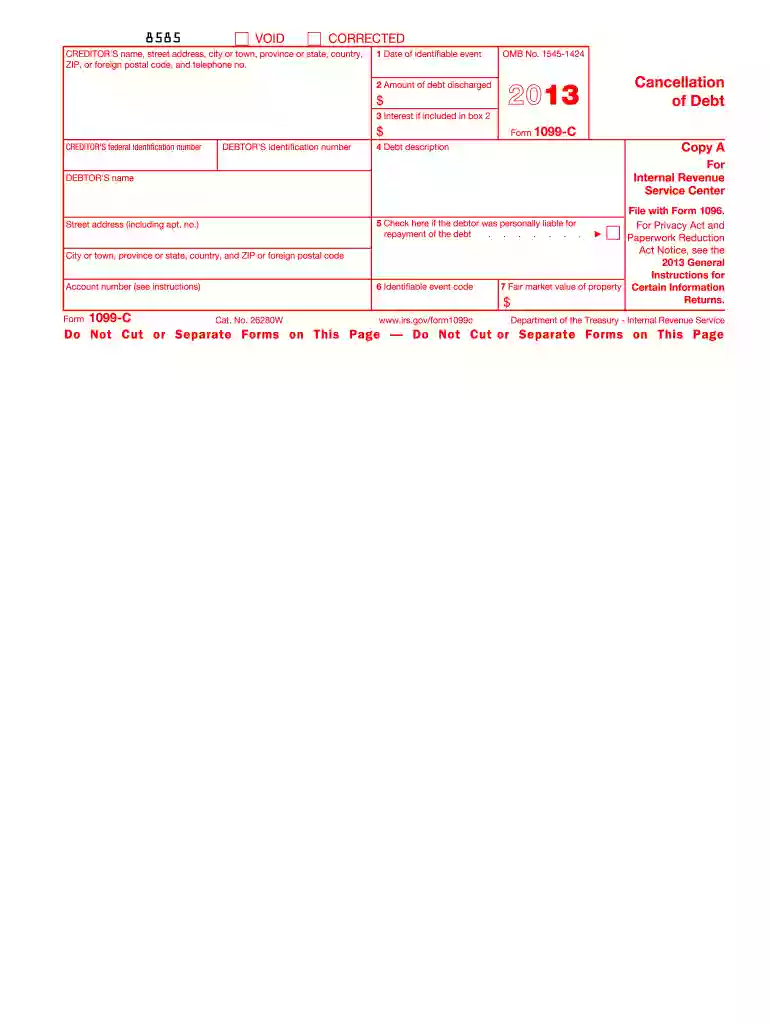
The 1099-C form is specifically designed for reporting canceled debts to the Internal Revenue Service (IRS). Issued by creditors, this form documents instances where a portion or all of a debt has been forgiven. For the 2013 tax year, the 1099-C encompasses various types of debt cancelations, including loans and credit card balances. Several events trigger the issuance of this form, such as a creditor deciding to stop attempting to collect on a debt or having a debt discharged through bankruptcy.
The primary purpose of the 1099-C form is for taxpayers to report canceled debts on their tax returns. Upon receiving the form, individuals should verify the accuracy of the information, including the amount of canceled debt, as it is considered taxable income. This form typically accompanies the taxpayer's annual tax return and is used to ensure that all income, including forgiven debt, is properly declared.
The IRS requires that the 1099-C form be issued for debts of $600 or more that have been canceled. However, there are exceptions to this rule, such as debts discharged in bankruptcy or insolvency. Taxpayers need to follow the IRS Publication 4681 for comprehensive guidance on canceled debts, as it explains how to report these amounts accurately and any potential exclusions.
Form 1099-C must be used in accordance with IRS regulations for reporting canceled debt. Failing to report a debt cancelation can result in penalties or audits. It is crucial for both creditors and debtors to adhere to these guidelines to avoid legal complications. For legal purposes, retaining copies of correspondence related to the 1099-C and any supporting documentation for a minimum of three years is recommended.
Non-compliance with the 1099-C form requirements can result in penalties from the IRS. Failure to file, late filing, or inaccuracies on the form may incur fines. It is essential for taxpayers to submit accurate information to avoid these penalties, adhering strictly to form deadlines and guidelines.
Several scenarios warrant the use of the 1099-C form, including:


Tax filing software such as TurboTax and QuickBooks supports the 1099-C form, making it easier for taxpayers to include canceled debts in their returns. These programs guide users through the process of reporting forgiven debts, ensuring compliance with IRS rules and reducing filing errors.
The 1099-C form must be mailed to the debtor by January 31 and filed with the IRS by the last day of February for paper submissions, or by March 31 when filing electronically. Meeting these deadlines is critical to avoid penalties and to ensure accurate tax reporting.
While the 1099-C is federally mandated, some states have additional rules that impact how forgiven debts are processed. For example, different states may have unique tax treatments or exclusions for certain types of debt forgiveness, such as those related to mortgage debts under state-specific relief programs.
By comprehensively understanding these aspects of the 1099-C form, taxpayers and businesses can ensure accurate tax filing, avoid legal pitfalls, and manage the financial implications of canceled debt effectively.
We've got more versions of the 1099 c 2013 form form. Select the right 1099 c 2013 form version from the list and start editing it straight away!
| Versions | Form popularity | Fillable & printable |
|---|---|---|
| 2022 | 4.5 Satisfied (52 Votes) | |
| 2021 | 4.8 Satisfied (205 Votes) | |
| 2020 | 4.4 Satisfied (266 Votes) | |
| 2019 | 4.4 Satisfied (163 Votes) | |
| 2018 | 4.2 Satisfied (39 Votes) | |
| 2017 | 4.4 Satisfied (568 Votes) | |
| 2016 | 4.2 Satisfied (122 Votes) | |
| 2015 | 4 Satisfied (34 Votes) | |
| 2014 | 4.1 Satisfied (73 Votes) | |
| 2013 | 4.3 Satisfied (55 Votes) | |
| 2012 | 4.4 Satisfied (70 Votes) | |
| 2011 | 4.1 Satisfied (36 Votes) | |
| 2010 | 4.3 Satisfied (66 Votes) | |
| 2001 | 4.2 Satisfied (61 Votes) |
At DocHub, your data security is our priority. We follow HIPAA, SOC2, GDPR, and other standards, so you can work on your documents with confidence.
You should use the 2013 General. Instructions for Certain Information Returns and the. 2013 Instructions for Forms 1099-A and 1099-C to complete Form 1099-C. ARead more
Even if the taxpayer does not receive a Form 1099-C, the canceled debt must be reported as gross income on the tax return unless an exception applies. For debtsRead more
Sep 16, 2013 Specifically, the Secretary of Commerce requested disclosure of the following ad- ditional items: (1) total number of docu- ments reported onRead more


