







Definition & Meaning
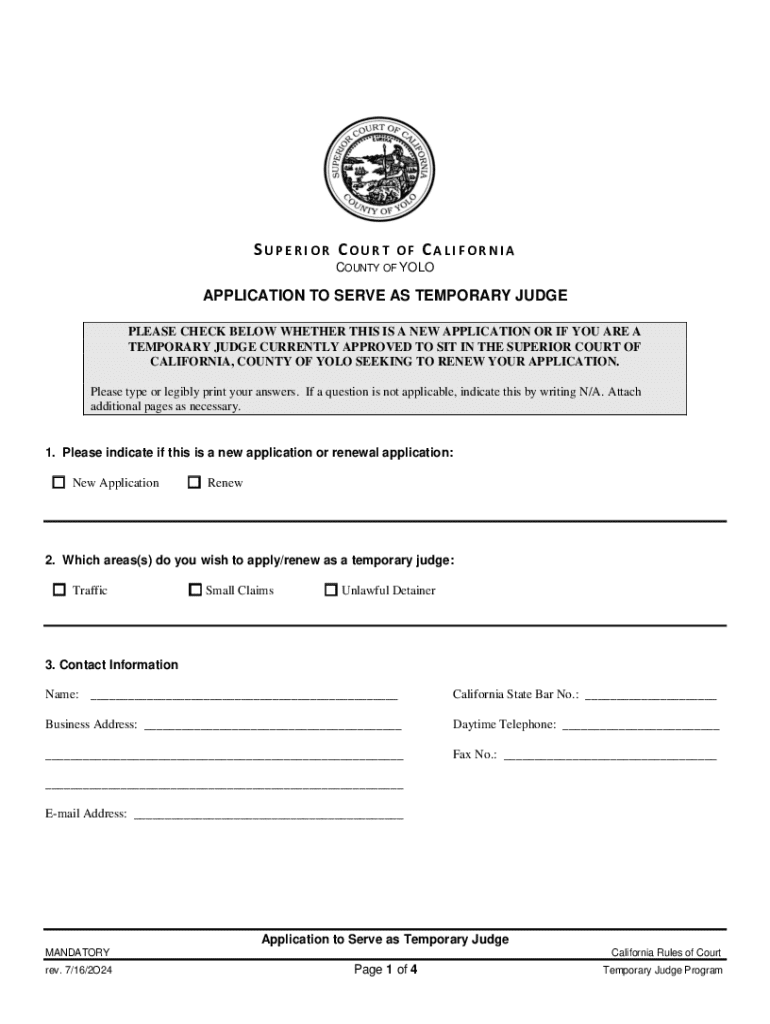
The "Temporary Judge ApplicationSuperior Court of California" refers to an application form used by individuals who wish to serve as temporary judges in the Superior Court of California. This form is integral for those aspiring to join the judicial system on a temporary basis, given its function to assess potential candidates' qualifications, experience, and standing with the State Bar of California. It includes sections where applicants can indicate their interest in specific areas like Traffic or Small Claims Court. The form also includes detailed requests for personal and professional information to ensure applicants meet the required standards for judicial conduct and ethics.
Eligibility Criteria
To be eligible to apply using the "Temporary Judge ApplicationSuperior Court of California," applicants must fulfill several criteria. They need to be members in good standing with the State Bar of California and meet specified experience requirements, particularly in legal proceedings related to the areas they wish to serve. Additionally, the form requires disclosure of any disciplinary actions or legal proceedings involving the applicant, ensuring adherence to ethical standards and a lack of conflict of interest.
- State Bar Membership: Applicants must hold an active membership with the State Bar.
- Experience: Demonstrated expertise in the relevant areas of law is crucial.
- Disclosure: Applicants need to provide a transparent record of any past or present legal issues.


Steps to Complete the Temporary Judge ApplicationSuperior Court of California
Completing the "Temporary Judge ApplicationSuperior Court of California" involves several key steps to ensure accuracy and completeness.
- Download the Application: Access the form from the official Superior Court of California website.
- Personal Information: Fill in all personal details, ensuring accuracy to avoid delays in processing.
- Professional Background: Provide comprehensive information about legal experience relevant to the areas of interest.
- Ethical Compliance: Complete the section related to ethical queries, including any past disciplinary actions or investigations.
- Review and Submit: Carefully review all entries, ensuring there are no mistakes or omissions before submission.
Each step requires detailed attention to ensure that the application reflects the candidate's qualifications accurately.
Key Elements of the Temporary Judge ApplicationSuperior Court of California
Personal and Professional Information
The application requires a robust collection of personal and professional details.
- Personal Details: Full name, contact information, bar membership number, and profile.
- Professional History: Detailed account of legal experience, particularly in areas the candidate wishes to adjudicate.
Areas of Interest
Applicants must specify the areas they wish to serve, such as:
- Traffic Court
- Small Claims Court
- Family Law
This specification ensures that applicants are considered for roles matching their expertise.
Disclosure of Legal and Ethical Issues
An essential section of the form involves the disclosure of:
- Disciplinary History: Any past or ongoing disciplinary actions.
- Legal Matters: Disclosure of cases where the applicant has been a party.
This section upholds the integrity and impartiality of the judicial process.
Legal Use of the Temporary Judge ApplicationSuperior Court of California
The application serves a critical legal function. It is used to evaluate and approve candidates who can temporarily fulfill judicial functions, maintaining court operations' efficiency and effectiveness. The document supports judicial ethics compliance, ensuring candidates can serve impartially while adhering to the ethical standards required by the Superior Court of California.
- Judicial Ethics: Complies with required norms and ethical considerations.
- Efficiency: Supports the operational needs of the court by providing qualified temporary judges.
Application Process & Approval Time
The process and timeline for approval are crucial for applicants to understand:
- Submission: Applicants can submit the form via mail or through an online process provided by the Superior Court.
- Review Period: The review period varies but typically ranges from several weeks to a few months, depending on the volume of applications.
- Communication: The court communicates acceptance or denial, providing reasons if an application is rejected.
This clarity in the process helps applicants understand what to expect and how to plan their potential judicial tenure.
Form Submission Methods (Online / Mail / In-Person)
The "Temporary Judge ApplicationSuperior Court of California" can be submitted through various methods:
- Online: Many prefer online submission for its convenience and speed.
- Mail: Traditional mail submission is available for those who need it.
- In-Person: In-person submission may be an option, depending on the specific county's practices.
Each method has its own set of instructions and guidelines, which should be meticulously followed to ensure the application is processed correctly.
Required Documents
Applicants must attach several documents to their application for it to be considered.
- Proof of State Bar Membership: Verification through official documentation.
- Professional References: Letters from peers or supervisors who can attest to the applicant's legal expertise and ethical standing.
- Disclosure Statements: Full accounts of any legal or disciplinary issues as required by the form.
Ensuring these documents are correctly compiled and submitted with the application is crucial for a successful application process.




