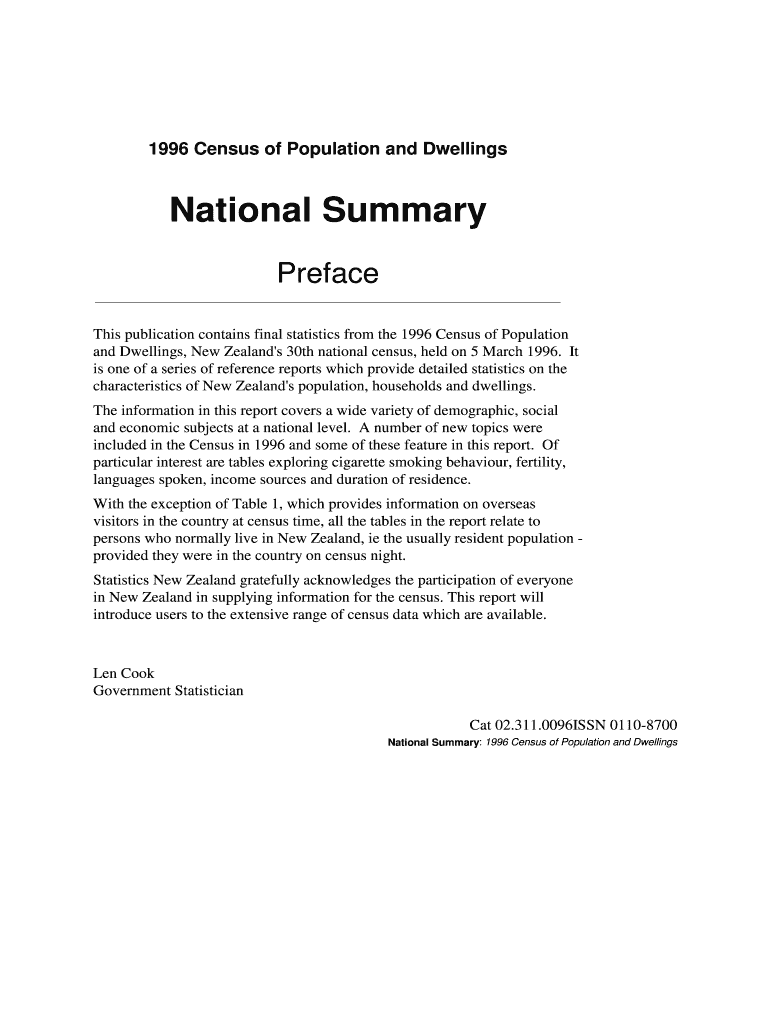







Definition and Meaning of National Summary
The "National Summary" serves as a comprehensive document that aggregates and presents key statistical data, often used for various analytical purposes. Organizations, government bodies, and businesses rely on it to gain insights into diverse aspects such as demography, economic trends, and social dynamics within a specific timeframe. These summaries provide a snapshot that helps in decision-making processes, planning, and policy formulation. By synthesizing large volumes of raw data, the National Summary ensures that stakeholders can access and interpret critical information efficiently.
How to Use the National Summary
Utilizing a National Summary effectively requires understanding its structure and content. Start by identifying the areas relevant to your needs, whether they pertain to specific demographic data, economic conditions, or social metrics. Compare these figures with previous summaries to detect trends and changes over time. This comparative analysis can reveal shifts in population demographics, economic growth, or decline, and changes in societal behaviors. Organizations often use this information to strategize their operations, forecast future developments, and develop informed policies.
- Example Uses:
- A business might analyze the summary to determine target markets for expansion.
- Government agencies may use it to allocate resources effectively and address emerging needs.
Key Elements of the National Summary
A thorough National Summary typically includes several core components that provide a detailed depiction of the national landscape. These elements might encompass categories such as:
- Population Statistics: Data on growth rates, age distribution, and ethnic composition.
- Economic Indicators: Metrics such as GDP, employment rates, and income levels.
- Social Metrics: Information on education, health, and living conditions.
Each section within these categories offers insights that help paint a comprehensive picture of the country’s current state. Analysts and policymakers depend on these elements to formulate strategies and make informed decisions.
Who Typically Uses the National Summary
The audience for National Summaries is diverse, including individuals and entities seeking to understand more about the socio-economic environment. Common users include:
- Government Officials: Use it for policy-making and budgeting.
- Academics and Researchers: Utilize data for studies, reports, and papers.
- Business Leaders: Employ it for market analysis and strategic planning.
Each group utilizes the summary’s insights differently, tailoring the data to their specific sector or field of interest.

Steps to Complete an Analysis with the National Summary
Analyzing a National Summary involves a systematic approach to extract meaningful conclusions:
- Identify Objective: Determine the purpose of the analysis.
- Select Relevant Sections: Focus on segments pertinent to your objectives.
- Data Comparison: Align current data with historical data to note changes.
- Interpret Findings: Draw conclusions based on identified trends and patterns.
- Formulate Actions: Develop strategies or policies informed by the analysis.
Such structured analysis aids in deriving actionable insights from the summarized data.
Examples of Using the National Summary
Real-world applications of the National Summary are numerous, showcasing its versatility and utility:
- Policy Implementation: A city government may use summary data to implement housing initiatives based on identified population growth and housing needs.
- Market Expansion: A retail company could leverage economic data to decide on opening new store locations in areas with rising disposable income levels.
These examples highlight how diverse entities apply insights from the National Summary to practical situations.
State-Specific Rules for the National Summary
While the National Summary provides an overarching view, state-specific nuances often require supplementary data. Different states may have unique legal, cultural, or economic conditions that affect the applicability of national data. For example, specific demographic shifts or local economic policies in one state may not be reflected nationally. Users should be aware of these differences to accurately interpret and apply summary findings within state contexts. Some states may also publish their own localized summaries to aid in more precise regional decision-making.
Legal Use of the National Summary
The legal use of a National Summary mainly involves ensuring that the data is utilized responsibly and ethically. Since the summary often contains aggregated data that may influence public and governmental approaches, any dissemination or application should adhere to data privacy laws and ethical guidelines. Misinterpretation or misrepresentation of the data could lead to inappropriate policies or decisions. Understanding these legal implications is crucial for stakeholders who employ this data in regulatory measures, research, and decision-making processes.