01. Edit your form online
Type text, add images, blackout confidential details, add comments, highlights and more.

Type text, add images, blackout confidential details, add comments, highlights and more.

Draw your signature, type it, upload its image, or use your mobile device as a signature pad.

Send it via email, link, or fax. You can also download it, export it or print it out.
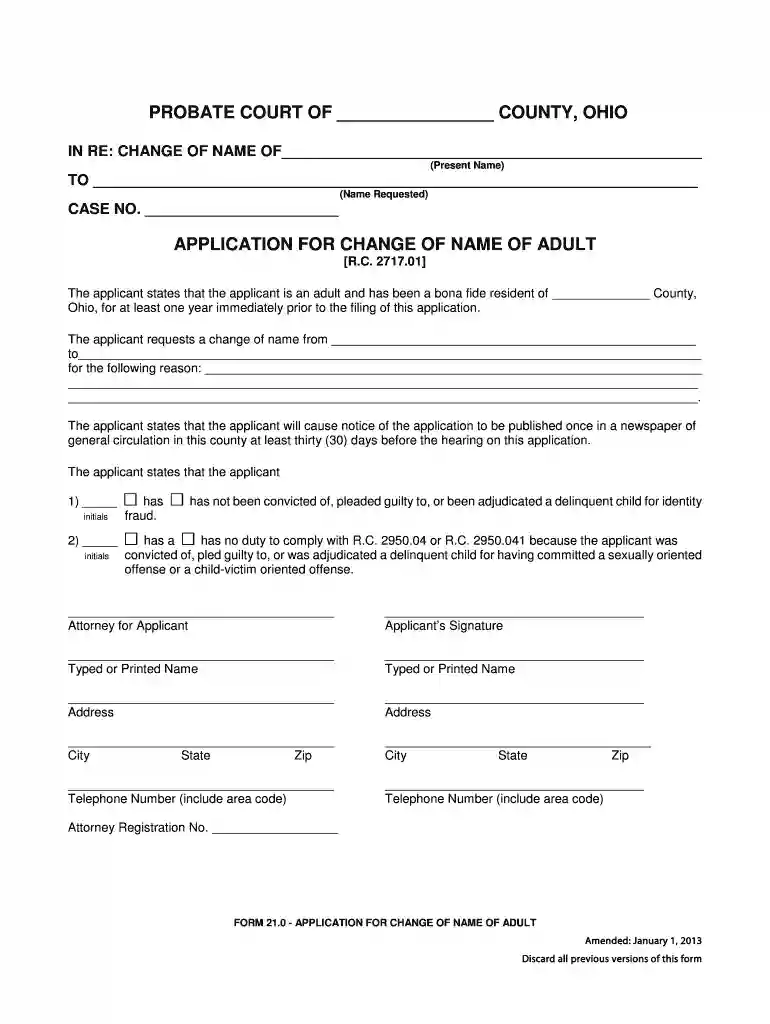
The "PROBATE COURT OF COUNTY, OHIO, JUDGE IN RE: CHANGE OF" form is a legal document used for applying for a name change in the probate court of a specific county in Ohio. The form serves as an official request to the court, detailing the applicant's intent to change their name and providing reasons for the change. It requires the applicant to declare residency in the county where the name change is being requested, as well as any prior criminal convictions.
To use the form, applicants must first ensure they meet the residency requirements for the county probate court in which they are filing. The form must be completed with accurate personal information, reasons for the name change, and any legal declarations required by the court. Once filled out, the form needs to be submitted to the respective county's probate court, following any specific instructions regarding publication of the name change request and the hearing process.
The form can typically be obtained from the official website of the county probate court where the name change is being filed. Alternatively, applicants may visit the probate court in person to request a physical copy. Some counties may also provide downloadable versions from their official site. It's important to use the correct form for the specific county to ensure compliance with local regulations.
This form is primarily used by adults residing in the specified county in Ohio who wish to legally change their name for personal, professional, or legal reasons. It may also be required for individuals correcting errors on their legal documents or aligning their name with their gender identity.


The form is a legal document that, once approved by the court, allows the applicant to officially change and use the new name in all legal contexts. This includes updating identification documents, altering financial accounts, and notifying government agencies of the change.
Name changes in Ohio require applicants to follow state-specific procedures, which include notification of a hearing, potential publication requirements, and demonstration of reasonable cause. Each county court may have additional rules and timelines for processing these requests. It is crucial for applicants to review the specific requirements of their county to ensure compliance and avoid delays.
The meticulous completion of these sections is essential for the approval of a name change application in the Ohio probate court system. Applicants should always verify details to comply with the local legal framework.
We've got more versions of the PROBATE COURT OF COUNTY, OHIO , JUDGE IN RE: CHANGE OF form. Select the right PROBATE COURT OF COUNTY, OHIO , JUDGE IN RE: CHANGE OF version from the list and start editing it straight away!
| Versions | Form popularity | Fillable & printable |
|---|---|---|
| 2025 | 4 Satisfied (34 Votes) | |
| 2025 | 4.8 Satisfied (31 Votes) | |
| 2025 | 4.3 Satisfied (34 Votes) | |
| 2025 | 4.2 Satisfied (34 Votes) | |
| 2025 | 4.6 Satisfied (55 Votes) | |
| 2025 | 4.5 Satisfied (44 Votes) | |
| 2025 | 4.2 Satisfied (37 Votes) | |
| 2025 | 4.7 Satisfied (34 Votes) | |
| 2024 | 4.3 Satisfied (21 Votes) | |
| 2024 | 4.6 Satisfied (51 Votes) | |
| 2024 | 4.5 Satisfied (23 Votes) | |
| 2024 | 4.8 Satisfied (29 Votes) | |
| 2024 | 4.1 Satisfied (28 Votes) | |
| 2024 | 4.9 Satisfied (51 Votes) | |
| 2024 | 4.4 Satisfied (31 Votes) |
At DocHub, your data security is our priority. We follow HIPAA, SOC2, GDPR, and other standards, so you can work on your documents with confidence.