




01. Edit your form online
Type text, add images, blackout confidential details, add comments, highlights and more.

Type text, add images, blackout confidential details, add comments, highlights and more.

Draw your signature, type it, upload its image, or use your mobile device as a signature pad.

Send it via email, link, or fax. You can also download it, export it or print it out.
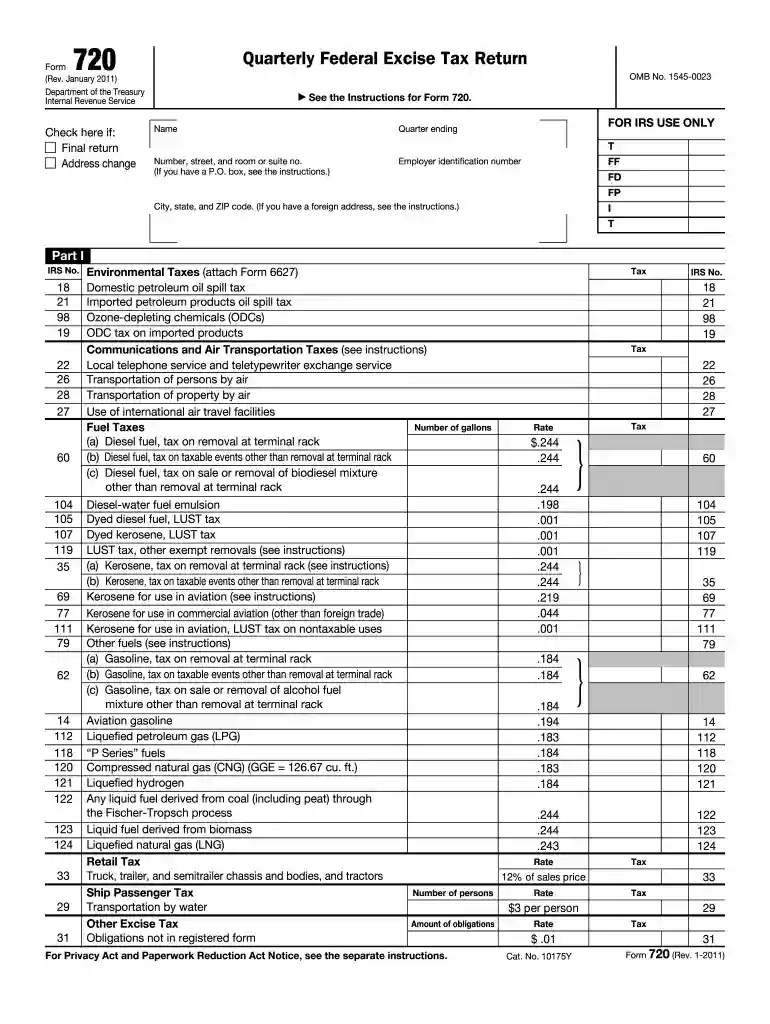
Form 720 is the IRS's Quarterly Federal Excise Tax Return, primarily used by businesses to report and remit federal excise taxes on specific goods and services. The form includes several sections that cater to different types of excise taxes, such as environmental taxes, communications and air transportation taxes, fuel taxes, and other excise-related obligations. It necessitates providing detailed taxpayer information, tax liabilities, potential claims for refunds or credits, and payment instructions. Understanding the nuances of Form 720 is crucial for businesses to ensure compliance and avoid penalties.
Filing the 2011 version of Form 720 involves several critical steps:
Accessing the 2011 version of Form 720 can be done through several channels:
The 2011 Form 720 is comprised of several key components:
The IRS provides specific guidelines that must be adhered to when filling out the 2011 Form 720:
Failing to comply with requirements associated with Form 720 can lead to significant penalties:
Different business entities that engage in goods and services subject to excise tax typically file Form 720:


Remembering the quarterly deadlines is crucial for remaining compliant:
Adhering to these respective deadlines helps avoid penalties and ensures the timely filing of excise taxes.
We've got more versions of the 2011 720 form form. Select the right 2011 720 form version from the list and start editing it straight away!
| Versions | Form popularity | Fillable & printable |
|---|---|---|
| 2025 | 4.5 Satisfied (21 Votes) | |
| 2025 | 4.5 Satisfied (23 Votes) | |
| 2024 | 4.2 Satisfied (28 Votes) | |
| 2024 | 4.3 Satisfied (26 Votes) | |
| 2023 | 4.6 Satisfied (31 Votes) | |
| 2023 | 4.4 Satisfied (58 Votes) | |
| 2022 | 4.1 Satisfied (22 Votes) | |
| 2022 | 4.8 Satisfied (140 Votes) | |
| 2021 | 4.3 Satisfied (170 Votes) | |
| 2021 | 4.4 Satisfied (97 Votes) | |
| 2020 | 4.2 Satisfied (117 Votes) | |
| 2020 | 4.4 Satisfied (333 Votes) | |
| 2019 | 4.3 Satisfied (79 Votes) | |
| 2018 | 4.3 Satisfied (189 Votes) | |
| 2017 | 4.3 Satisfied (128 Votes) |
At DocHub, your data security is our priority. We follow HIPAA, SOC2, GDPR, and other standards, so you can work on your documents with confidence.
You must complete Schedule A if you have a liability for any tax in Part I of Form 720. Do not complete Schedule A for. Part II taxes or for a one-time filingRead more
RFP 720-2011 Santa Rita Well Restoration Project (UNL), Mar 11th, 2020, RFP Dependent Grandchild Certification Form More Info on Grandchild CertificationRead more
Oct 29, 2025 OIG also offers a FOIA Electronic Reading Room, where it provides frequently requested records for public inspection in electronic form.Read more


