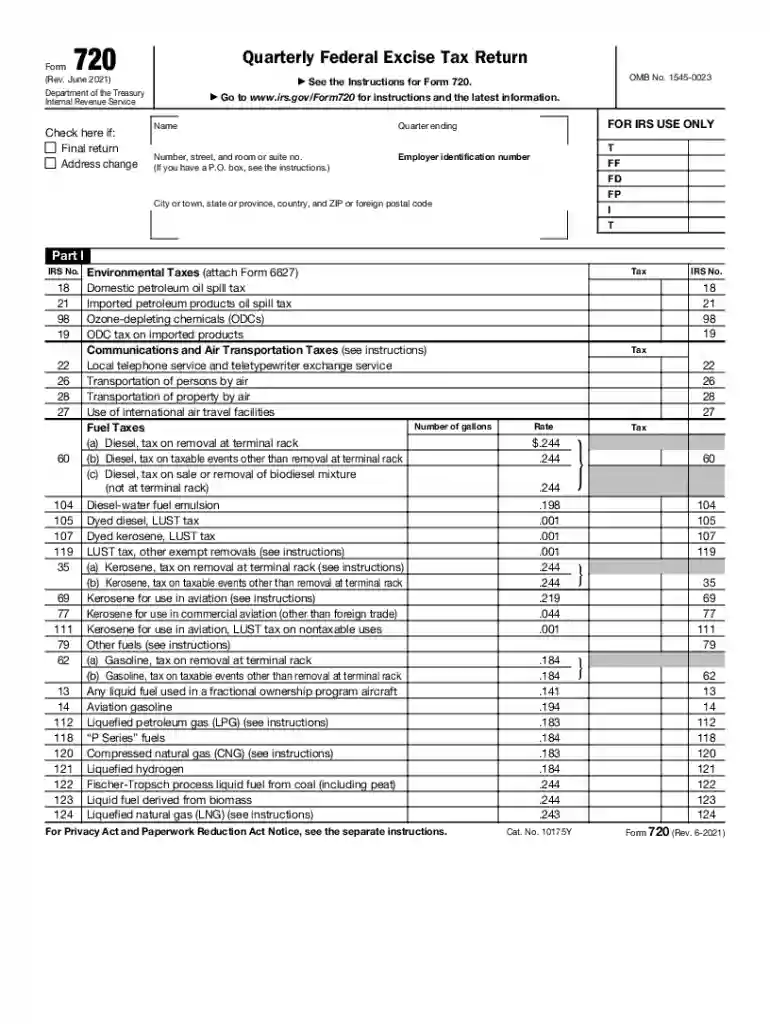
Form 720 (Rev. June 2021). Quarterly Federal Excise Tax Return-2026

Get Form
form 720 2021 Preview on Page 1

Here's how it works

01. Edit your form 720 2021 online
Type text, add images, blackout confidential details, add comments, highlights and more.

02. Sign it in a few clicks
Draw your signature, type it, upload its image, or use your mobile device as a signature pad.

03. Share your form with others
Send 2021 form 720 via email, link, or fax. You can also download it, export it or print it out.

Definition & Meaning of Form 720 (Rev. June 2021)

Form 720, the Quarterly Federal Excise Tax Return, is an essential document used by businesses to report and pay federal excise taxes on a variety of goods and services. This form covers specific areas such as environmental taxes, fuel taxes, taxes related to transportation services, and other targeted excise taxes.

Businesses that engage in activities liable for excise taxes are mandated to submit this form to the Internal Revenue Service (IRS) on a quarterly basis. The information collected via Form 720 includes details about the taxpayer, the amounts of taxes owed, and any claims for refunds or credits. For instance, if a company sells certain fuels or takes part in the environmental sector, it must accurately report relevant taxes via this return.

This form provides the IRS with comprehensive data essential for tracking tax liabilities, ensuring compliance, and redistributing funds collected from such taxes to relevant state and federal programs. Non-compliance can lead to significant penalties, underscoring the importance of accurate and timely submission.

Steps to Complete the Form 720 (Rev. June 2021)

Completing Form 720 requires attention to precise details and adherence to IRS guidelines. The following steps outline a structured approach for taxpayers engaging with this form:

  1. Obtain the Form:

    • Download the latest version of Form 720 from the IRS website or utilize DocHub to access a fillable format for convenience.
  2. Gather Necessary Information:

    • Collect all relevant data, including the business's name, address, and Employer Identification Number (EIN).
  3. Categorize Taxes:

    • Identify which types of excise taxes apply based on the goods or services offered. This may include:
      • Environmental taxes related to air and water quality.
      • Fuel taxes for transportation or other activities.
      • Taxes related to communications, such as telephone services.
  4. Calculate Tax Liabilities:

    • Assess the amounts for each type of tax applicable to the quarter. This calculation is critical for ensuring that accurate totals are reported.
  5. Complete the Form:

    • Enter the gathered information and calculated amounts into the appropriate fields on the form. Pay careful attention to ensure clarity and accuracy in every section.
  6. Review and Sign:

    • Before submission, thoroughly review the filled form to confirm all details are correct. Sign and date the form to validate the submission.
  7. Submit the Form:

    • Depending on your preference or requirements, submit the completed form electronically through authorized e-filing services or mail it to the indicated address for compliance.

By following these systematic steps, businesses can ensure compliance with federal regulations and avoid potential penalties associated with errors in tax filings.

Important Terms Related to Form 720 (Rev. June 2021)

Understanding key terminology is crucial when dealing with Form 720 to ensure clarity on compliance and tax-related obligations. Here are important terms associated with this form:

  • Excise Tax: A tax imposed on specific goods and services, typically calculated based on quantity rather than value. Examples include fuel taxes and environmental taxes.

  • Employer Identification Number (EIN): A unique nine-digit number assigned by the IRS to business entities for identification and tax reporting purposes.

  • Tax Liability: The total amount of tax that a business is legally obligated to pay to the IRS based on the goods or services it provides.

  • Quarterly Filing: Refers to the requirement to submit the Form 720 four times during the tax year, typically corresponding to the end of each quarter (January to March, April to June, July to September, October to December).

  • Refund or Credit Claims: Requests made by taxpayers for refunds or credits for excise taxes overreported or paid in error, which can reduce future tax liabilities.

By familiarizing oneself with these terms, businesses can navigate the complexities of excise tax reporting more effectively.

Filing Deadlines / Important Dates for Form 720 (Rev. June 2021)

Filing deadlines are critical for maintaining compliance with IRS rules when using Form 720. Here are the key deadlines relevant to the form:

  • Quarterly Due Dates:

    • 1st Quarter (January 1 - March 31): Due by April 30.
    • 2nd Quarter (April 1 - June 30): Due by July 31.
    • 3rd Quarter (July 1 - September 30): Due by October 31.
    • 4th Quarter (October 1 - December 31): Due by January 31 of the following year.
  • Penalties for Late Filing:

    • Missed deadlines can result in penalties, which may include significant fines and interest on amounts owed. It is imperative to submit Form 720 on time to avoid these consequences.
  • Extension Possibilities:

    • While the IRS does not typically allow extensions for filing Form 720 beyond the quarterly deadlines, businesses may explore options for penalty relief or other guidelines offered based on their circumstances.

Being aware of these important dates ensures that businesses adhere to their tax obligations without incurring additional costs due to late submissions.

IRS Guidelines for Form 720 (Rev. June 2021)

Filing Form 720 requires compliance with a series of IRS guidelines designed to standardize reporting and ensure accuracy. Key guidelines include:

  • Complete Information Disclosure: All sections of the form must be filled out accurately and completely to avoid processing delays or audits. This includes providing all necessary taxpayer details and precise calculations of owed taxes.

  • Use of Correct Version: Ensure you are using the most current version of Form 720, as updates may contain critical changes in reporting requirements or tax rates.

  • Supporting Documentation: In certain cases, the IRS may require additional documentation to support claims made on Form 720, especially when claiming refunds or credits.

  • Online Filing Requirements: The IRS encourages electronic filing for faster processing times. Utilize appropriate e-filing software or platforms like DocHub that are compatible with IRS requirements.

  • Keep Records: Retain copies of submitted forms and any supporting documentation for at least three years, as the IRS may require them for verification or audits.

Adhering to these guidelines decreases the likelihood of discrepancies and enhances compliance with federal tax regulations related to excise taxes.

See more Form 720 (Rev. June 2021). Quarterly Federal Excise Tax Return versions

We've got more versions of the Form 720 (Rev. June 2021). Quarterly Federal Excise Tax Return form. Select the right Form 720 (Rev. June 2021). Quarterly Federal Excise Tax Return version from the list and start editing it straight away!
Versions Form popularity Fillable & printable
2024 4.2 Satisfied (28 Votes)
2023 4.6 Satisfied (31 Votes)
2023 4.4 Satisfied (58 Votes)
2022 4.1 Satisfied (22 Votes)
2022 4.8 Satisfied (140 Votes)
2021 4.4 Satisfied (97 Votes)
2021 4.3 Satisfied (170 Votes)
2020 4.4 Satisfied (333 Votes)
2020 4.2 Satisfied (117 Votes)
2019 4.3 Satisfied (79 Votes)
2018 4.3 Satisfied (189 Votes)
2017 4.3 Satisfied (128 Votes)
2016 4.4 Satisfied (547 Votes)
2016 4.3 Satisfied (57 Votes)
2015 4 Satisfied (60 Votes)
be ready to get more

Complete this form in 5 minutes or less

Get form

Got questions?

We have answers to the most popular questions from our customers. If you can't find an answer to your question, please contact us.
Contact us
Tax form 720, Quarterly Federal Excise Tax Return, is used to calculate and make excise tax payments on certain categories of income/assets. Excise taxes are taxes paid when purchases are made on a specific good. Most excise tax in some ways resembles a state sales tax. They are paid on purchases of specific goods.
LLCs must file and pay the annual tax and fee if any of the following conditions apply: They organized in California. They registered with the SOS to do business in California. They do business in California (RTC Section 23101).
Do I need to file Form 720 for my business? If you own a business that sells various goods or services subject to federal excise taxes, you must generally file Form 720. Applicable excise taxes include those on: Fuel.
1. Businesses. Any entity, whether a sole proprietorship, partnership, corporation, or a limited liability company, dealing in goods or services subject to federal excise taxes must file Form 720.
Excise taxes are taxes imposed on certain goods, services, and activities. Taxpayers include importers, manufacturers, retailers, and consumers, and vary depending on the specific tax. Excise taxes may be imposed at the time of: Entry into the United States, or sale or use after importation.

Security and compliance

At DocHub, your data security is our priority. We follow HIPAA, SOC2, GDPR, and other standards, so you can work on your documents with confidence.

Learn more
be ready to get more

Complete this form in 5 minutes or less

Get form

People also ask

You can electronically file Form 720 through any electronic return originator (ERO), transmitter, and/or intermediate service provider (ISP) participating in the IRS e-file program for excise taxes. For more information on e-file, go to Excise Tax e-File Compliance (ETEC) Programs - Forms 720, 2290, and 8849.
You should file Form 720 if you collect any excise tax during the current quarter. If you were responsible for collecting excise taxes during any quarter during the year and you have not filed a final excise tax return, you should file Form 720.

form 2021 720