




01. Edit your 720 quarterly excise tax form online
Type text, add images, blackout confidential details, add comments, highlights and more.

Type text, add images, blackout confidential details, add comments, highlights and more.

Draw your signature, type it, upload its image, or use your mobile device as a signature pad.

Send it via email, link, or fax. You can also download it, export it or print it out.
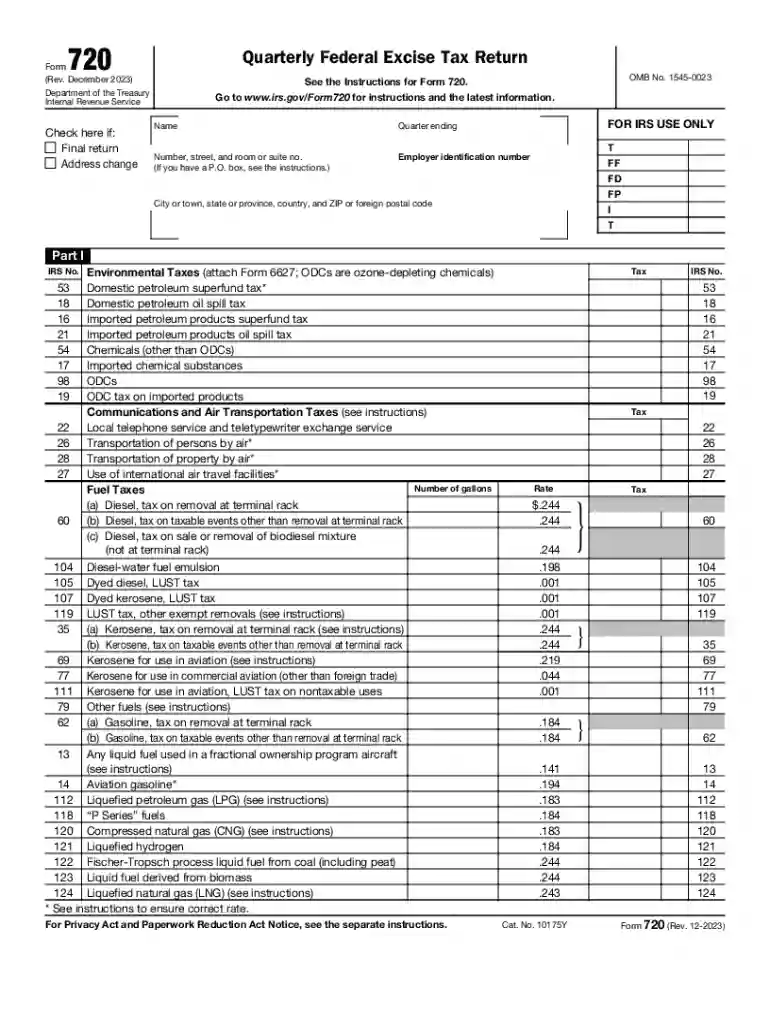
Form 720, officially known as the Quarterly Federal Excise Tax Return, is a document used by businesses in the United States to report and pay excise taxes. Excise taxes are taxes paid when purchases are made on a specific good, such as gasoline. They can also be imposed on activities, such as highway usage by trucks. The form is used to capture various categories of excise taxes, including environmental taxes, communication taxes, and fuel taxes, which are paid to the Internal Revenue Service.
When completing Form 720, several key sections should be properly understood:
Completing the Form 720 involves several important steps:
Form 720 must be filed quarterly. The deadlines for submission are:
Failing to file by the deadline can result in penalties, usually calculated as a percentage of the tax owed, with interest accruing on unpaid taxes.
Form 720 can be submitted in multiple ways to accommodate various business needs:
Non-compliance with Form 720 filing obligations can lead to several penalties:
Form 720 is primarily used by businesses involved in specific industries and activities subject to federal excise taxes:
The IRS provides comprehensive guidelines on completing and submitting Form 720:
We've got more versions of the 720 quarterly excise tax form form. Select the right 720 quarterly excise tax form version from the list and start editing it straight away!
| Versions | Form popularity | Fillable & printable |
|---|---|---|
| 2025 | 4.5 Satisfied (21 Votes) | |
| 2025 | 4.5 Satisfied (23 Votes) | |
| 2024 | 4.2 Satisfied (28 Votes) | |
| 2024 | 4.3 Satisfied (26 Votes) | |
| 2023 | 4.6 Satisfied (31 Votes) | |
| 2023 | 4.4 Satisfied (58 Votes) | |
| 2022 | 4.1 Satisfied (22 Votes) | |
| 2022 | 4.8 Satisfied (140 Votes) | |
| 2021 | 4.3 Satisfied (170 Votes) | |
| 2021 | 4.4 Satisfied (97 Votes) | |
| 2020 | 4.2 Satisfied (117 Votes) | |
| 2020 | 4.4 Satisfied (333 Votes) | |
| 2019 | 4.3 Satisfied (79 Votes) | |
| 2018 | 4.3 Satisfied (189 Votes) | |
| 2017 | 4.3 Satisfied (128 Votes) |
According to eSignature laws, forms signed electronically have the same validity as traditionally approved ones. You can eSign almost any business and personal paperwork. Four types of documents still call for wet signatures only - wills and testamentary trusts, court orders and other court papers, state statutes regulating divorce, adoption, or other family law, and notice of cancellation of utility services. If you follow the rules and utilize a trustworthy and compliant software solution, like DocHub, you can eSign your Form 720: a guide to Quarterly Federal Excise Tax Return without printing it.
With DocHub, there are several convenient ways to edit your Form 720: a guide to Quarterly Federal Excise Tax Return online. You can drag and drop the form and edit it straight at the DocHub site or use our browser extension to fill out your form immediately. On top of that, you can edit your PDF on your smartphone, as DocHub works with all the available mobile platforms.
At DocHub, your data security is our priority. We follow HIPAA, SOC2, GDPR, and other standards, so you can work on your documents with confidence.
Information about Form 720, Quarterly Federal Excise Tax Return, including recent updates, related forms, and instructions on how to file. Report liability by
720 Quarterly Federal Excise Tax tax), and Return c) call 18008291040. reported ments and claims taken,
Before you prepare a paper return, Use Form: to: IT-2 report wages and NYS, NYC, or Yonkers tax withheld


