




01. Edit your form 720 for 2021 online
Type text, add images, blackout confidential details, add comments, highlights and more.

Type text, add images, blackout confidential details, add comments, highlights and more.

Draw your signature, type it, upload its image, or use your mobile device as a signature pad.

Send 2021 form 720 via email, link, or fax. You can also download it, export it or print it out.
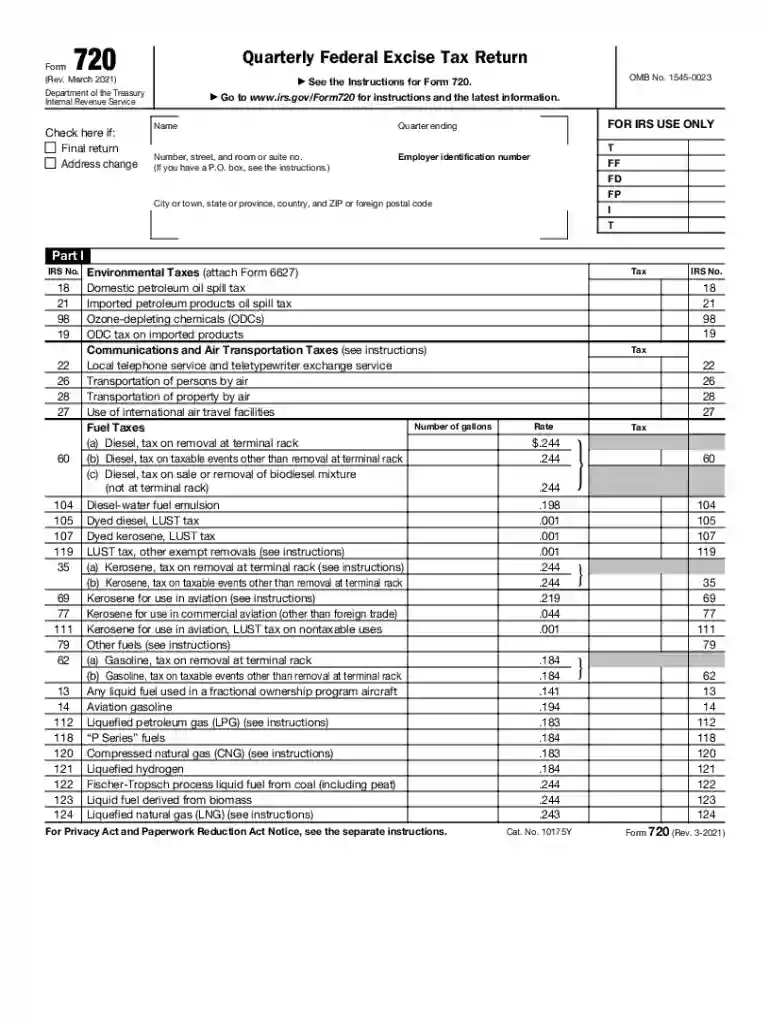
Form 720, officially known as the Quarterly Federal Excise Tax Return, is used by the Internal Revenue Service (IRS) to collect excise taxes from businesses operating in the United States. These taxes are applied to a variety of goods and services including environmental taxes, communication services, air transportation, and certain fuels. The form serves as a comprehensive document for businesses to report and pay federal excise taxes, ensuring compliance with U.S. tax laws.
Completing Form 720 accurately is crucial for compliance. Follow these step-by-step instructions to ensure proper filing.
Gather Necessary Information:
Identify the Relevant Taxes:
Complete Tax Calculations:
Claim Credits and Refunds:
Complete and Sign the Form:
Form 720 can be obtained through multiple channels:
Form 720 is a quarterly return with specific deadlines throughout the year:
Timely filing is essential to avoid penalties and interest charges.
Form 720 is primarily used by businesses in industries subject to federal excise taxes. This includes:
Understanding the structure of Form 720 is essential for correct filing:
Failure to correctly file Form 720 can lead to significant penalties:
The IRS provides detailed guidelines on completing Form 720, ensuring businesses comply with federal tax regulations. Adherence to these guidelines is critical for avoiding legal discrepancies and ensuring that all excise taxes are properly calculated and paid.
For businesses unfamiliar with complex tax laws, consulting a tax professional can be beneficial in ensuring adherence to IRS regulations and optimizing tax responsibilities.
Form 720 can be managed through various tax preparation software, improving accuracy and efficiency.
While Form 720 is a federal document, businesses should also consider state-level regulations. Some states have additional excise tax requirements that may require separate filing processes.
Keeping abreast of both federal and state requirements ensures comprehensive compliance across all jurisdictions.
We've got more versions of the form 720 for 2021 form. Select the right form 720 for 2021 version from the list and start editing it straight away!
| Versions | Form popularity | Fillable & printable |
|---|---|---|
| 2025 | 4.5 Satisfied (21 Votes) | |
| 2025 | 4.5 Satisfied (23 Votes) | |
| 2024 | 4.2 Satisfied (28 Votes) | |
| 2024 | 4.3 Satisfied (26 Votes) | |
| 2023 | 4.6 Satisfied (31 Votes) | |
| 2023 | 4.4 Satisfied (58 Votes) | |
| 2022 | 4.1 Satisfied (22 Votes) | |
| 2022 | 4.8 Satisfied (140 Votes) | |
| 2021 | 4.3 Satisfied (170 Votes) | |
| 2021 | 4.4 Satisfied (97 Votes) | |
| 2020 | 4.2 Satisfied (117 Votes) | |
| 2020 | 4.4 Satisfied (333 Votes) | |
| 2019 | 4.3 Satisfied (79 Votes) | |
| 2018 | 4.3 Satisfied (189 Votes) | |
| 2017 | 4.3 Satisfied (128 Votes) |
Approving documents on a mobile device is quick, simple, and doesn’t require software installation when you have an account with DocHub. Sign in from any browser, complete your blank fields with your information, and click on Sign → Create your signature. You can draw your electronic signature just as you usually do on paper, add its image to your 2021 form 720 pdf, or type in your name and stylize its look. No matter what option you select, your form will be valid.
When you edit your form 7202 for 2021 with DocHub, you merely require a steady web connection and virtually any browser installed on your device. No need to set up any third-party applications or study tutorials. Simply open a tab with DocHub, drag and drop your file, and modify it on the spot.
At DocHub, your data security is our priority. We follow HIPAA, SOC2, GDPR, and other standards, so you can work on your documents with confidence.
Use Form 720 and attachments to: Report liability by IRS number. Pay the excise taxes listed on the form. Current revision. Form 720 PDF.Read more
2. Check this box if the organization discontinued its operations or disposed of more than 25% of its net assets. 3. Number of voting members of theRead more
The return is filed to report excise tax on foreign insurance premiums, telecommunication charges, and Patient-Centered Outcomes Research Institute Fee (PCORI).Read more


