




01. Edit your fillable form 720 online
Type text, add images, blackout confidential details, add comments, highlights and more.

Type text, add images, blackout confidential details, add comments, highlights and more.

Draw your signature, type it, upload its image, or use your mobile device as a signature pad.

Send form 720 fillable via email, link, or fax. You can also download it, export it or print it out.
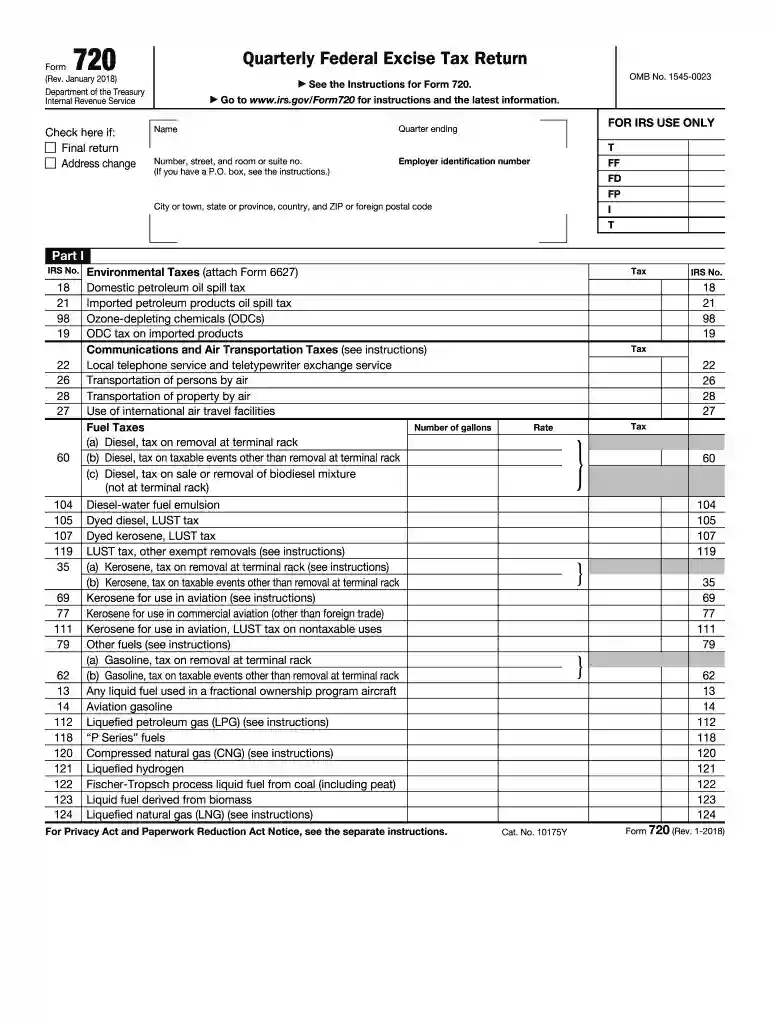
Form 720 is known as the Quarterly Federal Excise Tax Return. It is a critical document for certain businesses that are required to report and pay excise taxes to the Internal Revenue Service (IRS) on a quarterly basis. Excise taxes typically apply to the sale of specific goods and services, including environmental products, communication and air transportation services, fuel, and some health-related goods. The form serves as a means for the IRS to monitor these tax obligations and ensure compliant payment practices.
Using Form 720 involves several essential steps. Primarily, taxpayers must accurately detail all applicable excise taxes within the form's schedules. Each schedule corresponds to a specific type of excise tax, such as fuel or environmental taxes. Taxpayers should ensure all entries reflect the amounts due for the filing quarter and calculate any potential refunds or credits. Proper understanding of each section of Form 720 can ensure that taxpayers accurately report taxable activities and avoid potential discrepancies in future audits.
Form 720 is due quarterly, aligning with the following schedule:
These dates are critical as late submissions may result in penalties and interest charges. Businesses must maintain timely filing practices to avoid additional financial burdens.
Several documents are necessary to accurately complete Form 720:
Proper documentation ensures accurate reporting and substantiates claims for credits if audited by the IRS.
The IRS offers comprehensive guidelines for completing Form 720. These guidelines provide detailed instructions for each section and schedule. Additionally, the IRS outlines compliance requirements, definitions for excise taxes, and information on how to request guidance for specialized queries. Understanding these guidelines fully is crucial to achieving compliance and minimizing potential tax liabilities.
Form 720 contains several key components:
Failing to submit Form 720 or submitting inaccurate information can incur penalties. The IRS may impose penalties for late filing, underpayment of taxes, or failure to furnish accurate information. Penalty amounts vary based on the severity and duration of the non-compliance. Interest on unpaid taxes can accumulate, increasing the overall financial burden. Therefore, compliance through accurate and timely filing is crucial.
Taxpayers can submit Form 720 using varied methods:
Taxpayers have the option to file using either digital or paper versions of Form 720:
We've got more versions of the fillable form 720 form. Select the right fillable form 720 version from the list and start editing it straight away!
| Versions | Form popularity | Fillable & printable |
|---|---|---|
| 2025 | 4.5 Satisfied (21 Votes) | |
| 2025 | 4.5 Satisfied (23 Votes) | |
| 2024 | 4.2 Satisfied (28 Votes) | |
| 2024 | 4.3 Satisfied (26 Votes) | |
| 2023 | 4.6 Satisfied (31 Votes) | |
| 2023 | 4.4 Satisfied (58 Votes) | |
| 2022 | 4.1 Satisfied (22 Votes) | |
| 2022 | 4.8 Satisfied (140 Votes) | |
| 2021 | 4.3 Satisfied (170 Votes) | |
| 2021 | 4.4 Satisfied (97 Votes) | |
| 2020 | 4.2 Satisfied (117 Votes) | |
| 2020 | 4.4 Satisfied (333 Votes) | |
| 2019 | 4.3 Satisfied (79 Votes) | |
| 2018 | 4.3 Satisfied (189 Votes) | |
| 2017 | 4.3 Satisfied (128 Votes) |
At DocHub, your data security is our priority. We follow HIPAA, SOC2, GDPR, and other standards, so you can work on your documents with confidence.
The return is filed to report excise tax on foreign insurance premiums, telecommunication charges, and Patient-Centered Outcomes Research Institute Fee (PCORI).Read more
Aug 27, 2025 Complete Form 720-V if youre making a payment by check or money order with Form 720, Quarterly Federal. Excise Tax Return. We will use theRead more
Apr 23, 2025 ISCR refers to the category of in situ groundwater remediation technologies where treatment occurs primarily by chemical reduction of contaminants.Read more


