




01. Edit your form online
Type text, add images, blackout confidential details, add comments, highlights and more.

Type text, add images, blackout confidential details, add comments, highlights and more.

Draw your signature, type it, upload its image, or use your mobile device as a signature pad.

Send it via email, link, or fax. You can also download it, export it or print it out.
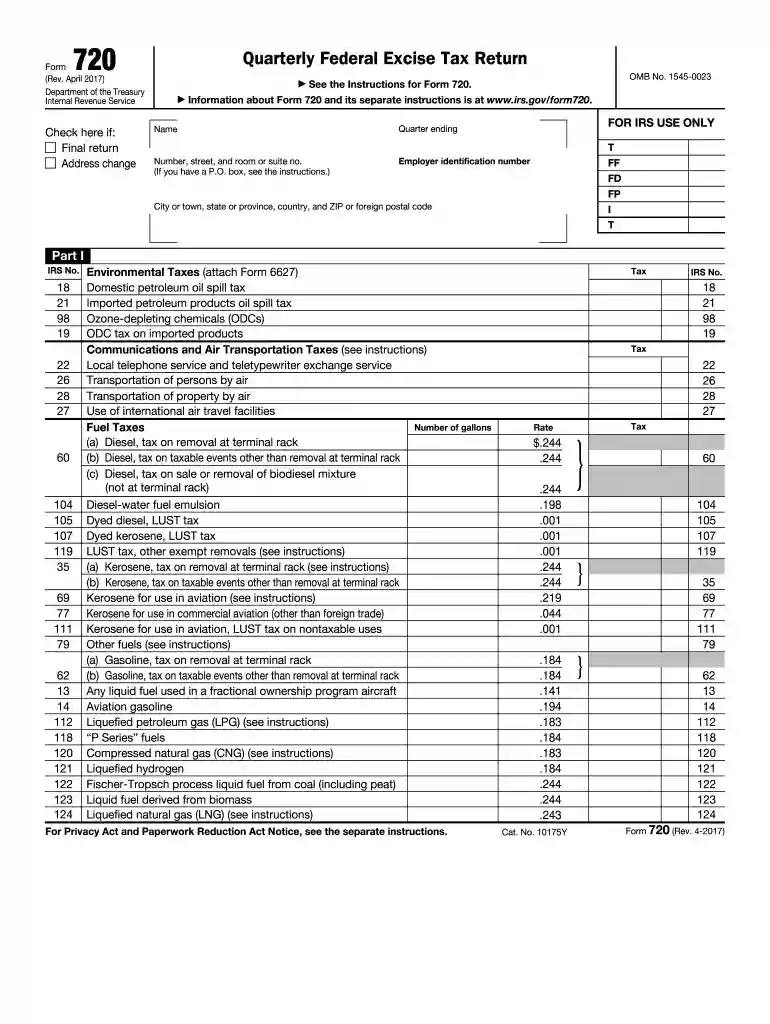
Form 720, also known as the Quarterly Federal Excise Tax Return, is a tax form utilized by businesses in the United States to report and pay excise taxes. These taxes are primarily for specific goods and activities, such as fuel, transportation of persons by air, and indoor tanning services. The form is crucial for ensuring compliance with federal tax obligations, particularly for businesses involved in activities subject to excise taxes.
Completing IRS Form 720 requires careful attention to detail. Here are the steps you should follow:
Gather Necessary Information: Collect relevant business information, including your employer identification number (EIN), the type of excise taxes applicable, and the tax period for which you are filing.
Identify Applicable Taxes: Read through the detailed list of excise taxes in the form instructions to determine which taxes apply to your business.
Fill Out Part I and II: Enter the appropriate excise taxes in Part I or Part II, depending on the type. Part I covers environmental, communication, and air transportation taxes, while Part II includes fuel-related taxes and other types.
Calculate Totals: Sum up the listed taxes and transfer totals to the relevant sections as instructed. Ensure that calculations are accurate to avoid errors and potential penalties.
Complete the Schedule A: If applicable, schedule A must be completed to report any claims or payments that can be credited against your tax liability.
Review and Submit: Double-check all information and ensure that all calculations are correct before submitting the form.
Filing Form 720 is required quarterly. Here are the crucial dates you need to remember:
It is critical to file by these deadlines to avoid penalties and interest charges. Filing extensions are not typically available for this form.
Form 720 can be obtained directly from the IRS website, where it is available for download in PDF format. Alternatively, businesses can request a physical copy by contacting the IRS through mail or telephone. Many tax software programs also include this form as part of their offerings, facilitating easier access for regular users.
Understanding specific terms related to Form 720 is essential for accurate completion:
The IRS provides detailed guidelines for completing Form 720, emphasizing accuracy in reporting and compliance with applicable tax codes. It is important to consult these guidelines thoroughly to ensure proper understanding and adherence to all requirements. In addition, the IRS offers helplines and online resources for assistance with specific inquiries.
Failing to file Form 720 or reporting incorrect information can result in penalties. Common penalties include:
These penalties make it crucial to ensure timely and accurate filing of Form 720.
Form 720 is primarily used by business entities engaged in activities or sales of goods subject to excise taxes. This includes manufacturers, retailers, and service providers involved in sectors such as oil production, telecommunications, air transportation, and health and fitness services. Understanding whether your business activities fall under these categories is essential for determining the necessity of this form.
Businesses have the option to file Form 720 electronically or via paper submission. The electronic method is generally convenient, allowing for quicker processing and confirmation of submission. This option is recommended for entities using tax software compatible with IRS submissions, such as TurboTax or QuickBooks. However, those preferring traditional methods can still opt for paper filing, ensuring timely postal submission.
We've got more versions of the form 720 2017 form. Select the right form 720 2017 version from the list and start editing it straight away!
| Versions | Form popularity | Fillable & printable |
|---|---|---|
| 2025 | 4.5 Satisfied (21 Votes) | |
| 2025 | 4.5 Satisfied (23 Votes) | |
| 2024 | 4.2 Satisfied (28 Votes) | |
| 2024 | 4.3 Satisfied (26 Votes) | |
| 2023 | 4.6 Satisfied (31 Votes) | |
| 2023 | 4.4 Satisfied (58 Votes) | |
| 2022 | 4.1 Satisfied (22 Votes) | |
| 2022 | 4.8 Satisfied (140 Votes) | |
| 2021 | 4.3 Satisfied (170 Votes) | |
| 2021 | 4.4 Satisfied (97 Votes) | |
| 2020 | 4.2 Satisfied (117 Votes) | |
| 2020 | 4.4 Satisfied (333 Votes) | |
| 2019 | 4.3 Satisfied (79 Votes) | |
| 2018 | 4.3 Satisfied (189 Votes) | |
| 2017 | 4.3 Satisfied (128 Votes) |
At DocHub, your data security is our priority. We follow HIPAA, SOC2, GDPR, and other standards, so you can work on your documents with confidence.
See Where To File in the. Instructions for Form 720. ▽. Detach Here and Mail With Your Payment and Form 720. ▽. Form 720-V (2017). 720-V. Department of theRead more
Dec 1, 2017 Form 720 taxes. File Form 720 for the fourth quarter of 2017. Wagering tax. File Form 730 and pay the tax on wagers accepted during December.Read more
Tax Form 720 - Quarterly Federal Excise Tax Return. Record description 2017. Administrative unit responsible for establishing retention criteria.Read more


