




01. Edit your form online
Type text, add images, blackout confidential details, add comments, highlights and more.

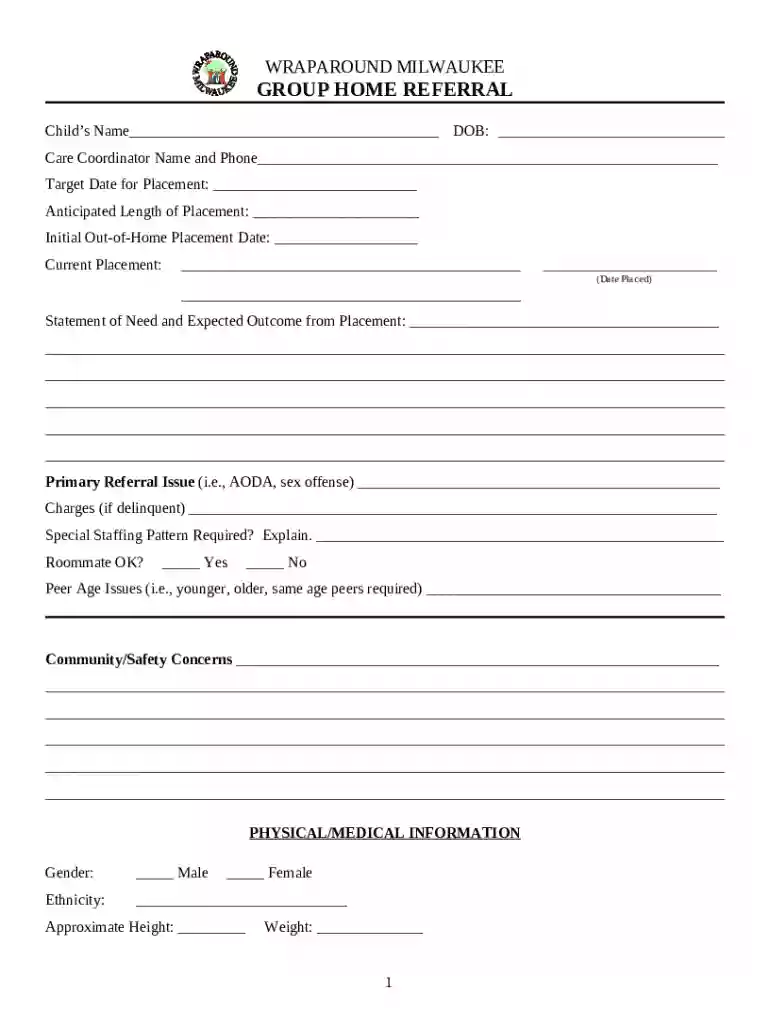
Type text, add images, blackout confidential details, add comments, highlights and more.

Draw your signature, type it, upload its image, or use your mobile device as a signature pad.

Send it via email, link, or fax. You can also download it, export it or print it out.
The "Group Home Referral" is a crucial document used for placing children into group homes under specific programs such as Wraparound Milwaukee. This form serves as a comprehensive tool to gather essential information about the child, ensuring a smooth transition and successful placement. The form includes details about the child's personal data, medical history, visitation guidelines, and critical transitional information. It also covers the child's behavioral, cognitive, and academic functioning to tailor the placement according to individual needs.
To effectively use the Group Home Referral form, it is important to understand the key sections and how to fill them accurately. Each section of the form requires detailed input:
The objective is to provide comprehensive data for program coordinators to make informed decisions about placements, ensuring that all necessary aspects are covered to facilitate the child's adjustment to the group home environment.
Completing the Group Home Referral form involves several meticulous steps:
Each step requires precision to ensure the information provided supports the child's successful placement in a group home.
Understanding the terminology associated with the Group Home Referral form is essential for accurate completion and interpretation:
These terms are key to understanding the intricate aspects of the referral process.
Several key elements must be thoroughly addressed within the Group Home Referral form:
Each element plays a critical role in determining the suitability of the group home environment for the child's specific requirements.
The legal use of the Group Home Referral is dictated by the need to ensure the document's compliance within the child welfare system. The form must:
This ensures that the form serves its purpose of guiding legal and ethical placements within the child welfare framework.
Various documents may be necessary to support the Group Home Referral process:
These documents provide a detailed understanding of the child's needs and are critical in supporting the referral information.
The Group Home Referral form is typically used by:
Each user plays an integral role in utilizing the referral to ensure the child's best interests are prioritized in the placement process.


Different states within the U.S. may have specific rules regarding the use and submission of the Group Home Referral form:
Understanding state-specific rules is essential in ensuring that referrals meet all legal prerequisites for successful placement.
We've got more versions of the GROUP HOME REFERRAL form. Select the right GROUP HOME REFERRAL version from the list and start editing it straight away!
| Versions | Form popularity | Fillable & printable |
|---|---|---|
| 2007 | 4.1 Satisfied (23 Votes) |
At DocHub, your data security is our priority. We follow HIPAA, SOC2, GDPR, and other standards, so you can work on your documents with confidence.



Access Line: 317.880.8491. Group Homes Florence House is a 10-bed group home open 24 hours a day, seven days a week serving clients with serious mental illness
Go Skate Weekend Event. Hit the streets of San Van to throw down with the community for 4 days to celebrate the love of skateboarding! Promotional art for skateRead more
Support includes assistance with daily care, medication management, appointment scheduling and more. Group Homes (Group) Get help at home


