




01. Edit your 2019 form 990 schedule a online
Type text, add images, blackout confidential details, add comments, highlights and more.

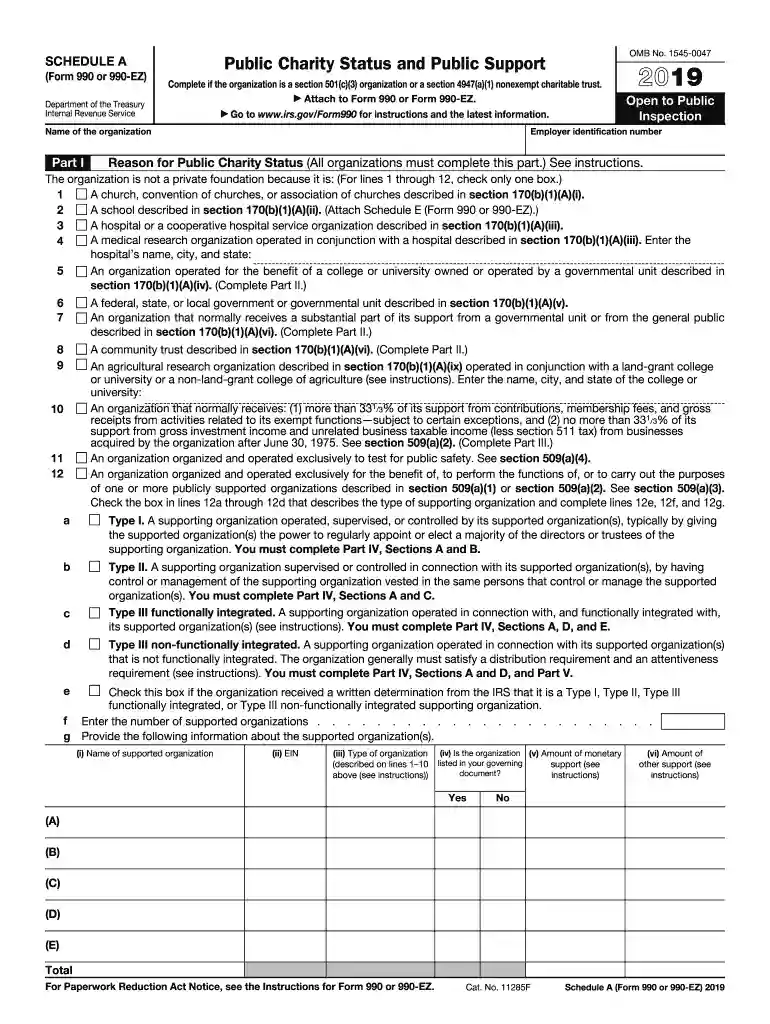
Type text, add images, blackout confidential details, add comments, highlights and more.

Draw your signature, type it, upload its image, or use your mobile device as a signature pad.

Send 2019 schedule a form via email, link, or fax. You can also download it, export it or print it out.
IRS Form 990 is a mandatory annual reporting return required for tax-exempt organizations, non-exempt charitable trusts, and section 527 political organizations. Its primary purpose is to provide the IRS and the public with detailed information about an organization's activities, governance, and financial conditions. Organizations with gross receipts over $200,000 or assets over $500,000 must file IRS Form 990, illustrating their commitment to transparency and accountability. This form serves as a public record, offering stakeholders, donors, and researchers insight into the financial health and governance practices of these organizations.
Several types of organizations must file IRS Form 990. Primarily, these include charities classified under section 501(c)(3), social welfare organizations under section 501(c)(4), and political organizations falling under section 527. In addition, nonprofit organizations not categorized by the IRS as private foundations often file Form 990 to maintain their tax-exempt status. These filings ensure compliance with federal regulations and maintain the organizations' eligibility for certain grants and donations.
Completing IRS Form 990 requires a systematic approach. Organizations should start by gathering all necessary financial documents from the fiscal year, including income statements and balance sheets. This form has multiple parts, such as Part I, which provides a summary of the organization, and Part III, which details program services and accomplishments.
Collect Financial Data: Obtain financial records, such as revenue, expenses, and assets, for accuracy.
Fill Organizational Information: Start with Part I, where basic information and a summary of financial activities are recorded.
Detail Program Services: In Part III, describe individual programs and the metrics showing their impact.
Report Governance Information: Part VI requires details about governance practices, including information about the board and policies.
Calculate Financial Totals: In Parts VII to XI, total financial numbers, including compensation, revenue, and financial conditions.
Review and Proofread: Ensure all sections are complete and accurate before submission.
Several schedules might need to be attached to the IRS Form 990, depending on the organization's answers in preceding sections. For instance, Schedule A is crucial for organizations aiming to establish their public charity status, providing data on public support. Other common schedules include Schedule B, which discloses donors, and Schedule C, focusing on political activities. Each schedule requires specific information that organizations must prepare beforehand to justify tax-exempt operations.
Compliance with the IRS regulations through proper filing of Form 990 is vital to maintaining tax-exempt status. The form must be truthful and consistent with financial records, as discrepancies can trigger audits or penalties. Moreover, organizations are legally obligated to provide Form 990 for public inspection, which reinforces operational transparency and trust within the community.
Failure to file the IRS Form 990 on time can lead to penalties. For regular non-compliance, the IRS may impose daily monetary penalties based on the organization's gross receipts. Repeated failures may result in an organization losing its tax-exempt status. Timely and accurate submission is crucial to avoid such consequences and maintain an organization's good standing.
Accurate disclosure is a fundamental aspect of IRS Form 990. It requires details on governance, finances, and operational practices. Important elements include:
Adhering to IRS guidelines ensures accurate completion of Form 990. The IRS provides tools like instructions and frequently asked questions to help organizations understand filing requirements and common errors. They emphasize ensuring consistency with prior filings and keeping abreast of changes in tax laws affecting nonprofit reporting. Utilizing these resources aids in compliance and can prevent potential issues.
Organizations must adhere to the IRS deadlines for filing Form 990. Typically, the form is due on the 15th day of the fifth month after the organization's accounting period ends. For organizations operating on a calendar year, this date falls on May 15th. Extensions may be requested if additional time is needed, but they must be filed before the original due date.
Organizations can easily obtain IRS Form 990 from the IRS website or through tax software packages. The completed form can be submitted through electronic filing systems, which the IRS encourages for accuracy and efficiency. Electronic filing reduces errors often associated with manual entries and offers a streamlined process for both organizations and the IRS.
Popular software solutions, such as TurboTax and QuickBooks, facilitate the completion of IRS Form 990. These applications often integrate directly with an organization's existing financial records, minimizing the likelihood of data entry errors and ensuring compliance with financial reporting standards. Integration with bookkeeping software streamlines the filing process and enhances data accuracy.
There are several variations of IRS Form 990, catering to the size and type of organizations. For smaller organizations, the IRS Form 990-EZ offers a less complex alternative, while churches and state institutions might use other specific forms exempt from typical 990 requirements. Understanding the right form for the entity ensures compliance without unnecessary administrative burdens.
While IRS Form 990 is a federal requirement, certain states have additional reporting obligations. Organizations should check state-specific requirements to ensure comprehensive compliance. Some states might have stricter guidelines requiring supplemental information or additional state-specific forms, which can impact an organization's yearly reporting process.
Overall, accurately completing and submitting IRS Form 990 is essential for tax-exempt organizations to maintain compliance, transparency, and public trust. Each section and schedule of the form plays a crucial role in portraying the organization's integrity and financial practices, making this an indispensable part of nonprofit management in the United States.
We've got more versions of the 2019 form 990 schedule a form. Select the right 2019 form 990 schedule a version from the list and start editing it straight away!
| Versions | Form popularity | Fillable & printable |
|---|---|---|
| 2025 | 4.5 Satisfied (34 Votes) | |
| 2024 | 4.1 Satisfied (50 Votes) | |
| 2023 | 4.3 Satisfied (26 Votes) | |
| 2022 | 4.3 Satisfied (28 Votes) | |
| 2021 | 4.9 Satisfied (57 Votes) | |
| 2020 | 4.2 Satisfied (32 Votes) | |
| 2019 | 3.9 Satisfied (28 Votes) | |
| 2018 | 4.3 Satisfied (116 Votes) | |
| 2017 | 4.3 Satisfied (60 Votes) | |
| 2016 | 4.4 Satisfied (536 Votes) | |
| 2015 | 4.3 Satisfied (36 Votes) | |
| 2014 | 4 Satisfied (21 Votes) | |
| 2013 | 4.2 Satisfied (57 Votes) | |
| 2012 | 4 Satisfied (20 Votes) | |
| 2011 | 4.1 Satisfied (54 Votes) |
At DocHub, your data security is our priority. We follow HIPAA, SOC2, GDPR, and other standards, so you can work on your documents with confidence.



Jan 31, 2026 Tax-exempt organizations, nonexempt charitable trusts, and section 527 political organizations file Form 990 to provide the IRS with the information requiredRead more
All Form 990 filers are required to complete Schedule O . . . . . . . . . . . . . . 38. Form 990 (2011). Page 5. Form 990 (2011).Read more


