




01. Edit your pit form online
Type text, add images, blackout confidential details, add comments, highlights and more.

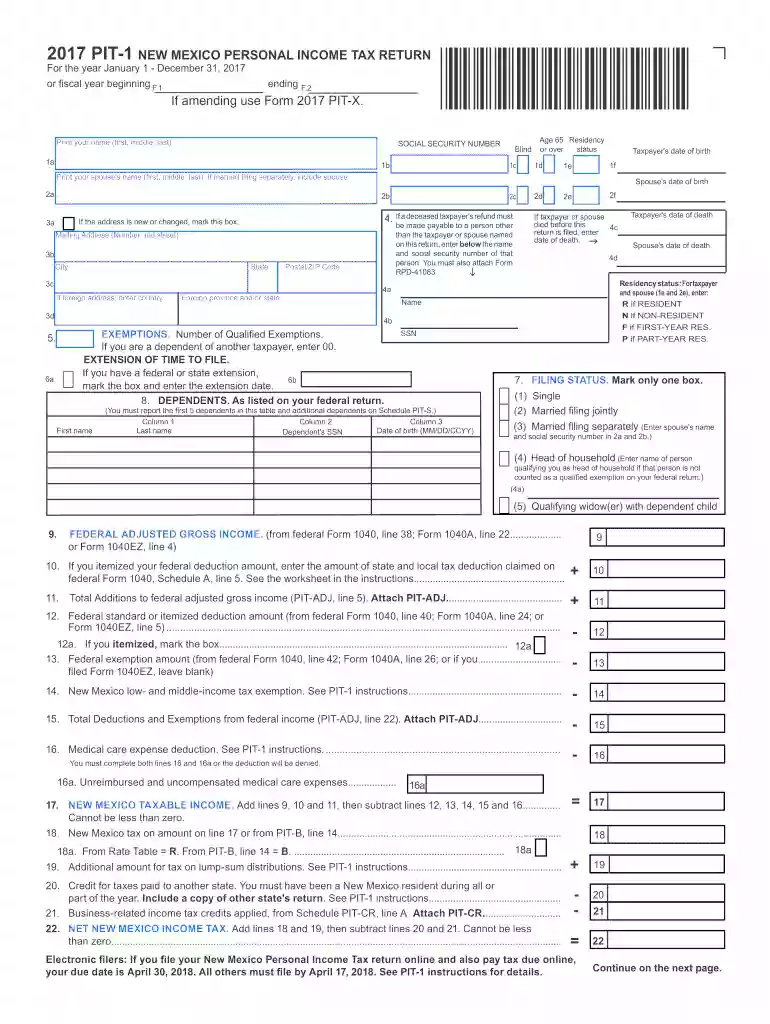
Type text, add images, blackout confidential details, add comments, highlights and more.

Draw your signature, type it, upload its image, or use your mobile device as a signature pad.

Send form pit 1 via email, link, or fax. You can also download it, export it or print it out.
Form PIT-1, the New Mexico Personal Income Tax Return, is used by residents and non-residents to report income and calculate state tax liability for a given year. It serves as a crucial document for individuals and households to declare financials such as income, deductions, and tax credits specific to the tax laws of New Mexico. This form is essential for ensuring compliance with state tax obligations and for assessing potential refunds or additional taxes owed.
Acquiring Form PIT-1 is integral for effective tax filing. Taxpayers have multiple avenues to obtain this form:
The form facilitates tax compliance by guiding users through complex tax calculations and ensuring that individuals report and pay the accurate amount of tax due. Understanding its availability and access points can mitigate delays in tax preparation and submission.
Form PIT-1 is predominantly utilized by:
Understanding the user demographics of Form PIT-1 can help customize interpretations and applications to each taxpayer’s unique situation.
New Mexico law affects how the Form PIT-1 is processed and utilized:
These guidelines highlight the importance of understanding local tax statutes and employing them effectively within the Form PIT-1 framework.
Timeliness is crucial in tax submissions to avoid penalties:
Form PIT-1 provides flexibility in submission:
Filing Form PIT-1 has legal implications ensuring all legal standards and compliance requirements are met:
Understanding the legal landscape surrounding Form PIT-1 ensures that taxpayers remain informed and compliant with state tax regulations.
We've got more versions of the pit form form. Select the right pit form version from the list and start editing it straight away!
| Versions | Form popularity | Fillable & printable |
|---|---|---|
| 2025 | 4.1 Satisfied (57 Votes) | |
| 2024 | 4.4 Satisfied (41 Votes) | |
| 2023 | 4.6 Satisfied (50 Votes) | |
| 2022 | 4.9 Satisfied (45 Votes) | |
| 2021 | 4.3 Satisfied (58 Votes) | |
| 2020 | 4.8 Satisfied (90 Votes) | |
| 2019 | 4.2 Satisfied (38 Votes) | |
| 2018 | 4.4 Satisfied (56 Votes) | |
| 2017 | 4.2 Satisfied (59 Votes) | |
| 2016 | 4.4 Satisfied (188 Votes) | |
| 2015 | 4.1 Satisfied (58 Votes) | |
| 2014 | 4.9 Satisfied (30 Votes) | |
| 2014 | 4 Satisfied (29 Votes) | |
| 2013 | 4 Satisfied (34 Votes) | |
| 2013 | 4 Satisfied (25 Votes) |
At DocHub, your data security is our priority. We follow HIPAA, SOC2, GDPR, and other standards, so you can work on your documents with confidence.
Everyone who is required to file a New Mexico personal income tax return must complete and file a form PIT-1, New Mexico Personal Income Tax Return.Read more
This article provides a table of Buildings in Farthest Frontier with high-level details. For an index of all Buildings visit: Category:Buildings.Read more
It is for those who file a New Mexico return and have tax due. See the instructions for. Form PIT-1. There is also an exemp- tion for low and middle income.Read more


