




01. Edit your form 990 ez schedule a 2022 online
Type text, add images, blackout confidential details, add comments, highlights and more.

Type text, add images, blackout confidential details, add comments, highlights and more.

Draw your signature, type it, upload its image, or use your mobile device as a signature pad.

Send 2022 schedule a form via email, link, or fax. You can also download it, export it or print it out.
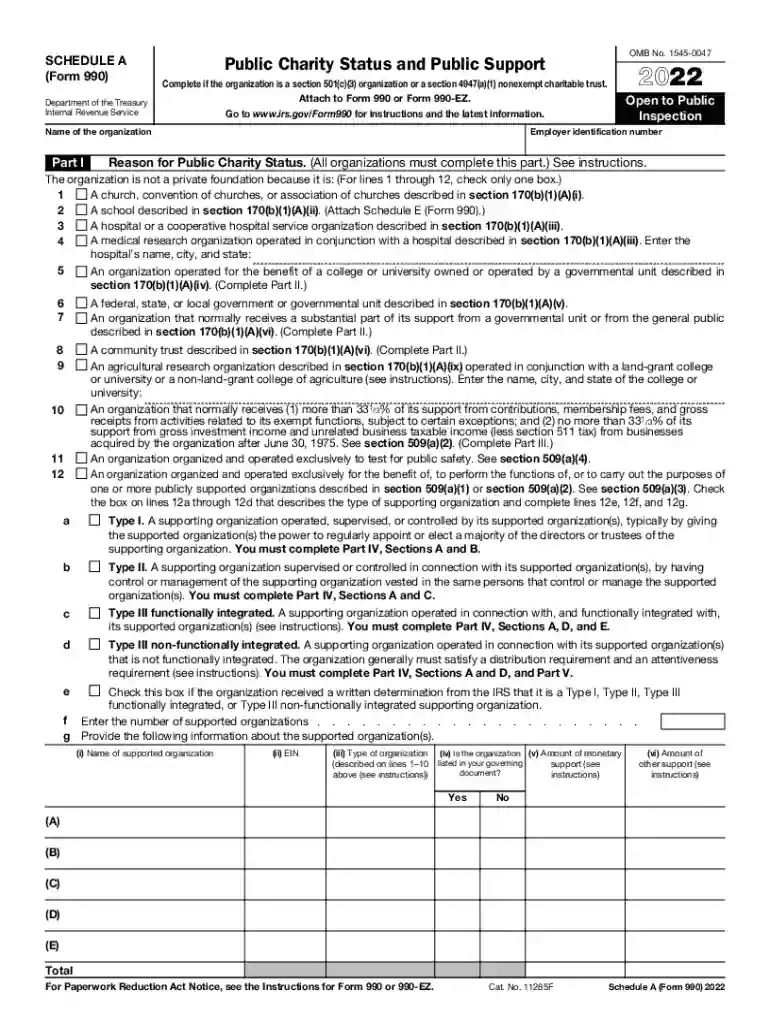
The 2022 Schedule A (Form 990) is an integral part of tax documentation for organizations classified as public charities under section 501(c)(3) of the Internal Revenue Code. This form is essential for determining whether an organization meets the qualifications for public charity status, which entails specific benefits and obligations. Public charity status relies on certain financial thresholds related to public support, emphasizing contributions from a broad segment of the population. Organizations must use Schedule A to outline their sources of support and substantiate their status as public charities or nonexempt charitable trusts. This process involves detailed accounting of donations, government grants, and other forms of public support.
Gather Necessary Financial Information: Collect detailed records of donations, grants, and other income sources the organization received.
Fill Out Top Information: Enter the legal name, address, and Employer Identification Number (EIN) of the organization.
Reporting Contributions: List and categorize contributions received from the public, government, and any unusual grants.
Calculate Public Support Percentage: Utilize the support items listed to compute the public support percentage, which is pivotal for substantiating public charity status.
Provide Additional Information: Complete any additional sections that request details about the organization’s activities, governance, or affiliations.
Review and Submit: Double-check all entries for accuracy, ensure compliance with the IRS guidelines, and submit the form via the appropriate method (online or by mail).
Public Support Test: A major nonprofit qualification assessing the extent of an organization's public support versus funding from single sources.
Exempt Function Income: Earnings from activities in alignment with an organization's stated exempt purpose.
Supporting Organization: A specific type of charity closely tied to a supported public charity, influencing its qualification and reporting details on Schedule A.
Typically, organizations that file a Form 990, including public charities and some private foundations, must complete Schedule A to evaluate their financial support sources. These organizations vary widely, such as educational institutions, hospitals, churches, and other nonprofits classified under section 501(c)(3). The form is crucial in validating ongoing eligibility for tax-exempt status by confirming public charity qualifications each year.


Schedule A serves a legally binding function in ensuring tax-exempt organizations follow federal law by providing sufficient information to the IRS about their financial activities. It aids in ensuring transparency and accountability, enabling the IRS to verify that these organizations continue to function primarily for tax-exempt purposes.
Schedule A is to be filed annually with Form 990. Organizations must submit it to the IRS by the 15th day of the fifth month after the end of the fiscal year. Extensions are permissible through Form 8868, which provides an additional six-month window.
Failure to accurately file Schedule A can lead to significant IRS penalties. Misreporting financial details or failing to maintain public charity status can result in fines, revocation of tax-exempt status, or obligatory remedial actions to align with IRS standards.
We've got more versions of the form 990 ez schedule a 2022 form. Select the right form 990 ez schedule a 2022 version from the list and start editing it straight away!
| Versions | Form popularity | Fillable & printable |
|---|---|---|
| 2025 | 4.5 Satisfied (34 Votes) | |
| 2024 | 4.1 Satisfied (50 Votes) | |
| 2023 | 4.3 Satisfied (26 Votes) | |
| 2022 | 4.3 Satisfied (28 Votes) | |
| 2021 | 4.9 Satisfied (57 Votes) | |
| 2020 | 4.2 Satisfied (32 Votes) | |
| 2019 | 3.9 Satisfied (28 Votes) | |
| 2018 | 4.3 Satisfied (116 Votes) | |
| 2017 | 4.3 Satisfied (60 Votes) | |
| 2016 | 4.4 Satisfied (536 Votes) | |
| 2015 | 4.3 Satisfied (36 Votes) | |
| 2014 | 4 Satisfied (21 Votes) | |
| 2013 | 4.2 Satisfied (57 Votes) | |
| 2012 | 4 Satisfied (20 Votes) | |
| 2011 | 4.1 Satisfied (54 Votes) |
At DocHub, your data security is our priority. We follow HIPAA, SOC2, GDPR, and other standards, so you can work on your documents with confidence.
Dec 18, 2024 SCHEDULE A. (Form 990). Department of the Treasury. Internal Revenue Service. Public Charity Status and Public Support. Complete if theRead more
Public Charity Status and Public Support. Complete if the organization is a section 501(c)(3) organization or a section 4947(a)(1) nonexempt charitable trust.Read more


