




01. Edit your dmo state of michigan online
Type text, add images, blackout confidential details, add comments, highlights and more.

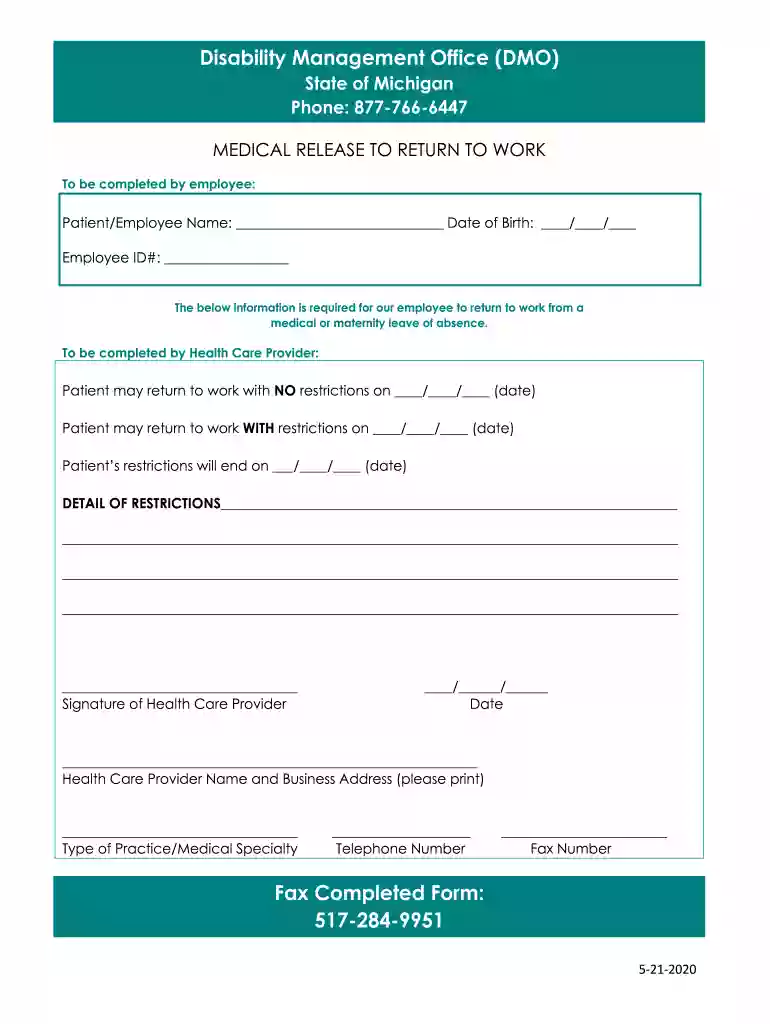
Type text, add images, blackout confidential details, add comments, highlights and more.

Draw your signature, type it, upload its image, or use your mobile device as a signature pad.

Send it via email, link, or fax. You can also download it, export it or print it out.
The "DMO State of Michigan" refers to a Medical Release to Return to Work form required by the Disability Management Office in Michigan. This document facilitates an employee's return to work following medical or maternity leave by verifying their readiness and detailing any work-related restrictions. The form must be completed by both the employee and their healthcare provider to ensure all necessary information is accurately captured.
To effectively use the DMO State of Michigan form, an employee must follow several key steps. Initially, the employee needs to fill out personal and job-related information sections. Next, the healthcare provider must complete the medical assessment portion, detailing the employee's health status and any restrictions. Finally, the form should be submitted to the employer to confirm the employee's fitness to return to work.
This form is primarily used by employees in Michigan returning from medical or maternity leave who need official documentation to confirm their ability to resume work. Employers and HR departments also engage with this form to ensure compliance with return-to-work protocols and to coordinate any necessary workplace accommodations.


For the form to be complete, employees should be ready to provide identification details and any pertinent medical documentation. This could include letters from doctors, relevant medical test results, and any previous forms related to the leave taken. Ensuring these documents are available will streamline the completion and submission process.
Michigan-specific regulations dictate that the DMO form must comply with state labor laws and disability management protocols. Employers are required to adhere to these standards, ensuring all returned forms meet the legislative requirements related to employee health and workplace safety, thus protecting both employee rights and employer responsibilities.
The form is legally binding, serving as an official document to verify an employee's readiness to return to work after medical leave. It also protects employers by confirming that any necessary accommodations are documented and agreed upon. Ensuring compliance with both state and federal laws is crucial, particularly regarding the Americans with Disabilities Act (ADA).
Employees can submit the completed form via various methods according to their organization’s preferences. Common submission methods include:
Failure to properly complete and submit the DMO form can result in delays or denial of the employee's return to work. Employers might also face penalties if they fail to comply with the state’s regulations regarding employee reintegration and documented accommodations, potentially leading to legal repercussions or fines.
We've got more versions of the dmo state of michigan form. Select the right dmo state of michigan version from the list and start editing it straight away!
| Versions | Form popularity | Fillable & printable |
|---|---|---|
| 2024 | 4.7 Satisfied (50 Votes) | |
| 2024 | 4.1 Satisfied (26 Votes) | |
| 2022 | 4.9 Satisfied (41 Votes) | |
| 2022 | 4.8 Satisfied (52 Votes) | |
| 2022 | 4.7 Satisfied (37 Votes) | |
| 2022 | 4.1 Satisfied (56 Votes) | |
| 2022 | 4.5 Satisfied (39 Votes) | |
| 2022 | 1.2 Satisfied (406 Votes) | |
| 2021 | 4.5 Satisfied (50 Votes) | |
| 2021 | 4.8 Satisfied (114 Votes) | |
| 2021 | 4.3 Satisfied (37 Votes) | |
| 2020 | 4.8 Satisfied (53 Votes) | |
| 2020 | 4.8 Satisfied (121 Votes) | |
| 2020 | 4.8 Satisfied (137 Votes) | |
| 2020 | 4.6 Satisfied (59 Votes) |
At DocHub, your data security is our priority. We follow HIPAA, SOC2, GDPR, and other standards, so you can work on your documents with confidence.
This manual is furnished with each new TENNANT Model 8400. This manual consists of the How To Use This Manual; Standard Parts; Options; Breakdowns; Engine.
MSU offers dental coverage options through Delta Dental (a Preferred Provider Organization (PPO)) and Aetna Dental (a Dental Maintenance Organization (DMO))


