




01. Edit your form online
Type text, add images, blackout confidential details, add comments, highlights and more.

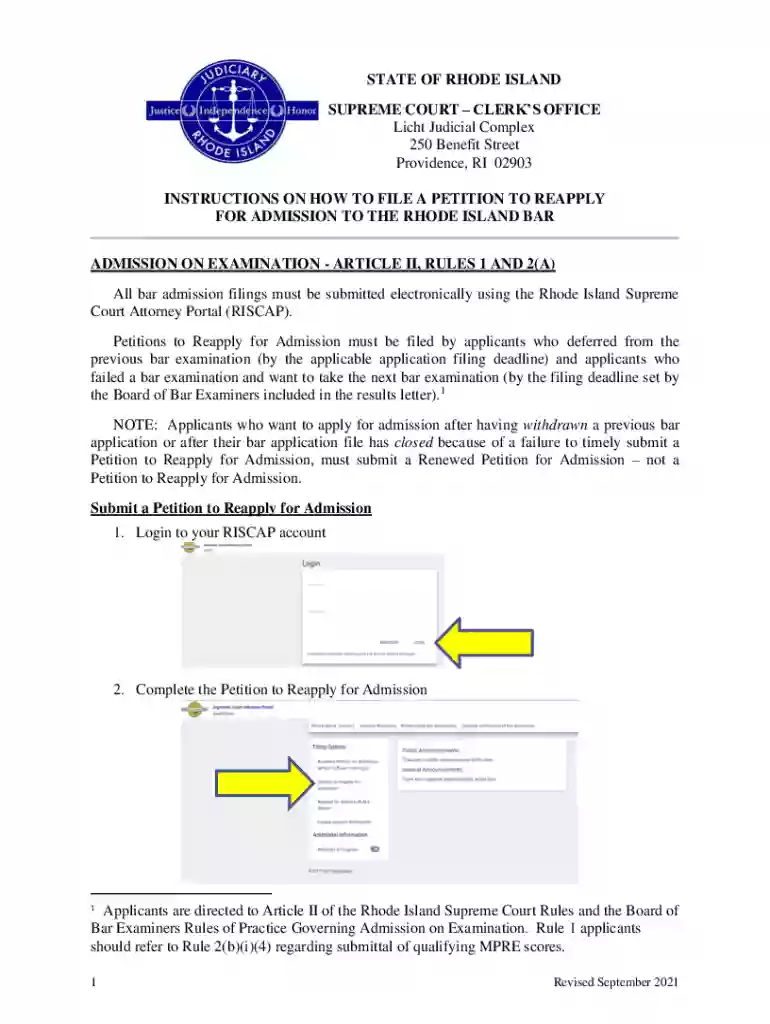
Type text, add images, blackout confidential details, add comments, highlights and more.

Draw your signature, type it, upload its image, or use your mobile device as a signature pad.

Send it via email, link, or fax. You can also download it, export it or print it out.
The "State of Rhode Island Supreme Court" refers to the highest court in the Rhode Island judiciary system. This court plays a pivotal role in interpreting state laws, resolving legal disputes, and establishing legal precedents within Rhode Island. It functions as the ultimate authority for appeals in the state, offering a vital mechanism through which legal issues can be conclusively determined. Understanding the court's jurisdiction and function is essential for legal practitioners and individuals involved in legal proceedings within Rhode Island.
Engaging with the State of Rhode Island Supreme Court requires understanding its procedural rules and case submission processes. Typically, appeals are submitted following a decision from lower courts, such as the Superior Court or Family Court. As an appellate court, the Rhode Island Supreme Court examines whether legal errors occurred during proceedings in the lower courts. Legal professionals must prepare detailed briefs and present oral arguments following specific guidelines established by the court. Participation in Supreme Court proceedings necessitates compliance with intricate procedural requirements and deadlines.
Obtain Relevant Forms: Access the necessary forms from the Rhode Island Supreme Court's website or through the Rhode Island Supreme Court Attorney Portal (RISCAP).
Complete Form Accurately: Provide comprehensive information as required. This typically includes details about the parties involved, case numbers from lower court decisions, and grounds for appeal.
Attach Required Documents: Include all supporting documentation, such as the lower court's judgment, transcripts, and any pertinent exhibits.
File Electronically or Physically: Utilize RISCAP for electronic submissions or deliver printed copies to the court's clerk if in-person submission is preferred.
Monitor the Filing: Track the status of your filing to ensure receipt and processing by the court.
Appellant Information: Details about the party appealing the case, including contact information and legal representation.
Case Details: Information on the original case, such as the docket number, verdict, and lower court details.
Grounds for Appeal: Specific reasons for contesting the earlier decision, focusing on legal errors or procedural issues.
Supporting Documentation: Required attachments, including certified copies of the original judgment and other relevant documents.
The State of Rhode Island Supreme Court serves legal professionals, litigants, and the state government by interpreting Rhode Island's laws. Typical cases involve appeals on criminal matters, complex civil disputes, and constitutional questions. Legal use entails adhering to established rules for engaging with the court, presenting well-articulated arguments, and submitting detailed legal documentation. Lawyers must ensure representation aligns with standards expected at the appellate level, and individuals should seek licensed legal counsel for navigation of Supreme Court processes.
Rhode Island's Supreme Court operates under a unique set of procedural rules that differ from federal or other state courts. These include specific filing deadlines, document formatting requirements, and ethical guidelines for legal practitioners. Familiarity with Rhode Island-specific legal precedents is crucial for effectively presenting cases. Legal practitioners must comply with state-level mandates concerning appeals, evidentiary submissions, and conduct during court proceedings.
Online Submission: Rhode Island's Supreme Court facilitates electronic submissions through RISCAP, most suitable for prompt and efficient filing.
Mail: Forms and documentation can be submitted via postal mail, a traditional method when electronic submission is unfeasible.
In-Person: Litigants and lawyers might opt for personal delivery of documents to the court's clerk, ensuring immediate receipt and addressing any queries in real-time.
Notice of Appeal: A formal statement indicating intention to appeal from a lower court's decision.
Lower Court Decision: Certified copies of the judgment or order being appealed.
Supporting Briefs: Detailed argumentation supporting the appeal, formulated according to court guidelines.
Transcripts: Necessary if the appeal relies on interpretations of previous hearings.
Case Exhibits: Requisite evidence and documentation referenced in briefs.
Rhode Island Supreme Court sets strict deadlines for appeal submissions. Typically, the Notice of Appeal must be filed within thirty days following the lower court's decision. Subsequent briefs and responses adhere to a structured timeline stipulated by the court rules. Timely compliance with these deadlines is imperative to ensure the appeal is considered. Extensions may be available under specific circumstances, but these require formal requests and valid justification.
The forms utilized for submitting cases to the State of Rhode Island Supreme Court are created and provided by the court itself. Available both online and at the court's physical location, these forms are designed to ensure uniformity and comprehensive data collection. The court's administrative body maintains and updates these forms as necessary to reflect any procedural or regulatory changes.
We've got more versions of the STATE OF RHODE ISLAND SUPREME COURT form. Select the right STATE OF RHODE ISLAND SUPREME COURT version from the list and start editing it straight away!
| Versions | Form popularity | Fillable & printable |
|---|---|---|
| 2024 | 4.7 Satisfied (50 Votes) | |
| 2024 | 4.1 Satisfied (26 Votes) | |
| 2022 | 4.9 Satisfied (41 Votes) | |
| 2022 | 4.8 Satisfied (52 Votes) | |
| 2022 | 4.7 Satisfied (37 Votes) | |
| 2022 | 4.1 Satisfied (56 Votes) | |
| 2022 | 4.5 Satisfied (39 Votes) | |
| 2022 | 1.2 Satisfied (406 Votes) | |
| 2021 | 4.5 Satisfied (50 Votes) | |
| 2021 | 4.8 Satisfied (114 Votes) | |
| 2021 | 4.3 Satisfied (37 Votes) | |
| 2020 | 4.8 Satisfied (53 Votes) | |
| 2020 | 4.8 Satisfied (121 Votes) | |
| 2020 | 4.8 Satisfied (137 Votes) | |
| 2020 | 4.6 Satisfied (59 Votes) |
At DocHub, your data security is our priority. We follow HIPAA, SOC2, GDPR, and other standards, so you can work on your documents with confidence.
Nov 18, 2025 This brief guide include major sources of law and legal information in Rhode Island, as well as general information about state and local government.Read more
May 16, 1988 It is the purpose of these rules to establish procedures for handlin!l personnel activities and transactions provided for in the State Merit.Read more
The point of entry for electronic access to case information from the Rhode Island Judiciarys (Judiciary) database whether at the courthouse or remotely.Read more


