




01. Edit your form online
Type text, add images, blackout confidential details, add comments, highlights and more.

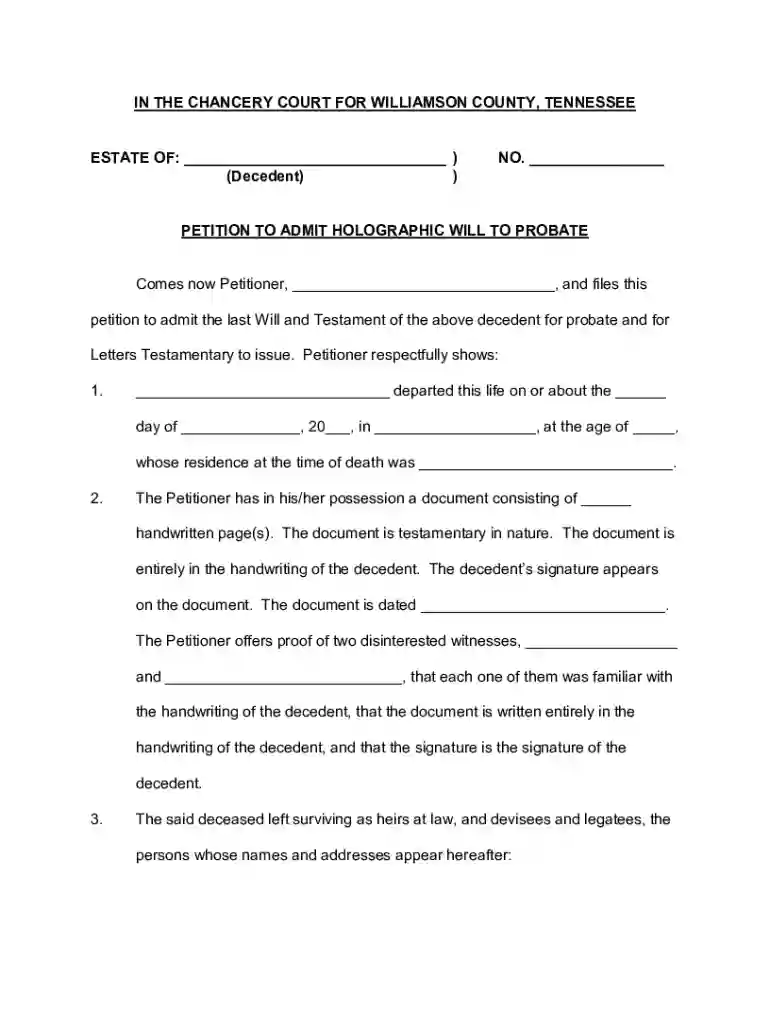
Type text, add images, blackout confidential details, add comments, highlights and more.

Draw your signature, type it, upload its image, or use your mobile device as a signature pad.

Send it via email, link, or fax. You can also download it, export it or print it out.
A "Petition to Admit Holographic Will to Probate" refers to a formal request made to a probate court to recognize and validate a holographic will. A holographic will is a will and testament that has been entirely handwritten and signed by the testator. This type of will is considered valid under specific circumstances and in certain jurisdictions, primarily because it does not require witnesses at the time of creation. The petition is necessary to initiate the probate process, which involves proving the document's validity and intent, as well as ensuring it meets all legal requirements.
A comprehensive petition to admit a holographic will to probate generally includes several critical components:
This petition plays a critical legal role in validating and executing a decedent's last wishes as stipulated in a handwritten will. Each state has unique laws governing the recognition of holographic wills, with differing requirements for admissibility in probate court. The petition ensures that all legal bases are covered and provides a structured framework for the court to examine the will's authenticity and enforceability, ultimately protecting the interests of both the decedent and beneficiaries.
Holographic wills are treated differently across the U.S., with legal acceptance varying significantly from state to state. Some common elements include:
Several essential documents are typically required when submitting a petition:
Submitting the petition to admit a holographic will to probate varies by jurisdiction:
This comprehensive guide enables users to efficiently navigate the process of admitting a holographic will to probate, ensuring all legal and procedural requirements are adequately addressed.
We've got more versions of the PETITION TO ADMIT HOLOGRAPHIC WILL TO PROBATE form. Select the right PETITION TO ADMIT HOLOGRAPHIC WILL TO PROBATE version from the list and start editing it straight away!
| Versions | Form popularity | Fillable & printable |
|---|---|---|
| 2024 | 4.7 Satisfied (50 Votes) | |
| 2024 | 4.1 Satisfied (26 Votes) | |
| 2022 | 4.9 Satisfied (41 Votes) | |
| 2022 | 4.8 Satisfied (52 Votes) | |
| 2022 | 4.7 Satisfied (37 Votes) | |
| 2022 | 4.1 Satisfied (56 Votes) | |
| 2022 | 4.5 Satisfied (39 Votes) | |
| 2022 | 1.2 Satisfied (406 Votes) | |
| 2021 | 4.5 Satisfied (50 Votes) | |
| 2021 | 4.8 Satisfied (114 Votes) | |
| 2021 | 4.3 Satisfied (37 Votes) | |
| 2020 | 4.8 Satisfied (53 Votes) | |
| 2020 | 4.8 Satisfied (121 Votes) | |
| 2020 | 4.8 Satisfied (137 Votes) | |
| 2020 | 4.6 Satisfied (59 Votes) |
At DocHub, your data security is our priority. We follow HIPAA, SOC2, GDPR, and other standards, so you can work on your documents with confidence.


May 24, 2017 In the case of a lost holographic will, the propounder should present evidence through a witness or other means to prove proper execution of aRead more
Jul 10, 2026 Handwritten wills are known as holographic wills. If the will had witnesses, they may be called to testify in court. In addition, the theRead more


