
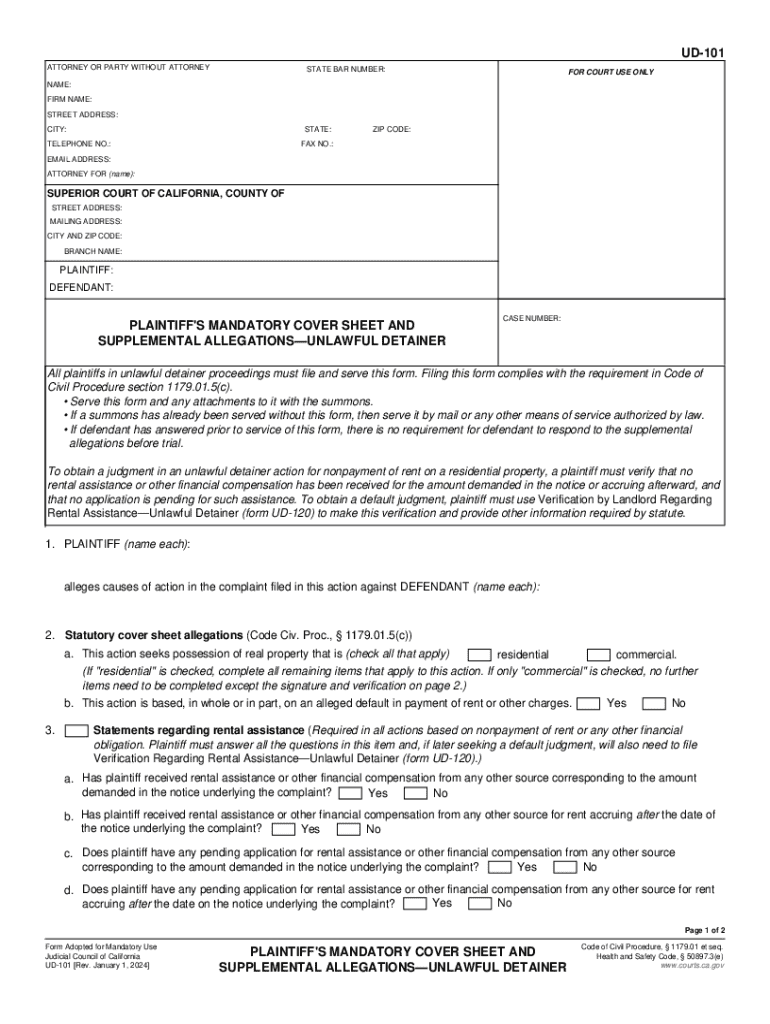







Definition and Purpose of the UD-101 Form
The UD-101 form, known as the "Plaintiff's Mandatory Cover Sheet and Supplemental Allegations Unlawful Detainer," is a critical document used in California for unlawful detainer cases. It serves as a cover sheet accompanying legal proceedings to recover possession of rental property, commonly referred to as eviction cases. The document requires plaintiffs to provide detailed information about the property in question and any rental assistance received by the tenant. This form not only ensures that all pertinent details are disclosed at the onset of a case but also helps streamline the legal process by making sure all relevant information is readily available to the court and the defendant.
Importance of Rental Assistance Documentation
One significant aspect of the UD-101 form is documenting any rental assistance the tenant has received or is anticipating. This requirement is crucial because it impacts the court’s understanding of the tenant's financial situation and the landlord’s obligations. Accurately reporting this information can influence the court’s decision, particularly in cases where the tenant has demonstrated an effort to meet rental obligations through available assistance programs.
Steps to Complete the UD-101 Form
Completing the UD-101 form accurately is essential to proceed with an unlawful detainer case. Below is an overview of the steps involved:
-
Identify Property Details: Start by inputting the complete address and description of the rental property in question.
-
Plaintiff Information: Include the full name, address, and contact information of the plaintiff, typically the property owner or landlord initiating the eviction process.
-
Rental Assistance: Provide detailed information on any rental assistance received or pending, specifying amounts and related timelines.
-
Signatures: Ensure all necessary parties have signed the document before submission. This step confirms the validity and accuracy of the information provided.
-
Attach Supplementary Documents: Include any additional documents that support the form's claims, such as notices of rent demands or communication with the tenant.
Common Mistakes to Avoid
- Failing to report all rental assistance.
- Incomplete or inaccurate property details.
- Lack of necessary signatures.
Legal Use of the UD-101 Form
The UD-101 form is legally mandated for use in California when filing for an unlawful detainer. This document helps facilitate a fair legal process by ensuring all parties have access to the same information from the start. Its primary legal function is to outline the specifics of the case in a clear and detailed manner, which helps prevent misinformation and disorganized legal proceedings. Correct use of the form is pivotal to maintaining compliance with Californian eviction laws, ensuring procedural fairness, and upholding tenants’ rights.
Compliance with California Eviction Laws
Compliance with local eviction laws is an integral part of using the UD-101 form effectively. Plaintiffs must ensure that all information is complete and accurate, and that they adhere to all filing and service requirements as mandated by state law. Failure to comply can delay the case or result in its dismissal.
State-Specific Rules for the UD-101 Form
While the UD-101 form is utilized across California for unlawful detainer proceedings, there may be nuances depending on the municipality. Local rules might dictate additional documentation or specific submission deadlines. Plaintiffs should verify these requirements with their local court clerk's office to avoid any procedural missteps. Understanding regional variances in the application of this form can prevent legal complications and ensure timely court proceedings.
Regional Variations in Form Use
- Some counties may require additional affidavits.
- Variations in rental assistance reporting may exist depending on local policies.
Key Elements of the UD-101 Form
The UD-101 form consists of several key elements to ensure comprehensive case documentation:
- Property Information: Detailed description and address.
- Plaintiff and Defendant Details: Complete contact and personal information.
- Rental Assistance Information: Disclosure of any financial aid.
- Attachments: All relevant supporting documents like notices of rent increase or eviction.
Ensuring Comprehensive Coverage
Each of these elements is critical to constructing a complete picture of the case for the court. Ensuring that all sections are filled with pertinent information helps facilitate the eviction process and ensures fair treatment for all parties involved.
Important Terms Related to the UD-101 Form
Understanding the terminology used within the UD-101 form is important for accurate completion and submission:
- Unlawful Detainer: A type of lawsuit landlords use to evict tenants from rental property due to non-compliance.
- Plaintiff: The party initiating eviction proceedings.
- Defendant: The tenant facing eviction.
- Rental Assistance: Financial aid provided to tenants to help meet rental obligations.
Clarifying Legal Jargon
Grasping these terms fosters a better understanding of the legal context and purpose of the form, thereby aiding in accurate completion and strategic planning for court procedures.
Form Submission Methods: Online, Mail, and In-Person
The UD-101 form can be submitted in multiple ways, each having its own advantages and constraints:
- Online: Direct submission via court websites can accelerate the process.
- Mail: Allows for keeping physical records but may take longer to process.
- In-Person: Direct interaction with court staff, allowing for immediate issue resolution.
Selecting the Best Submission Method
Choosing the appropriate submission method depends on the urgency of the filing, the individual's comfort with technological solutions, and any physical constraints that may prevent in-person submission.




