




01. Edit your irs 941 quarterly form online
Type text, add images, blackout confidential details, add comments, highlights and more.

Type text, add images, blackout confidential details, add comments, highlights and more.

Draw your signature, type it, upload its image, or use your mobile device as a signature pad.

Send 941 form printable via email, link, or fax. You can also download it, export it or print it out.
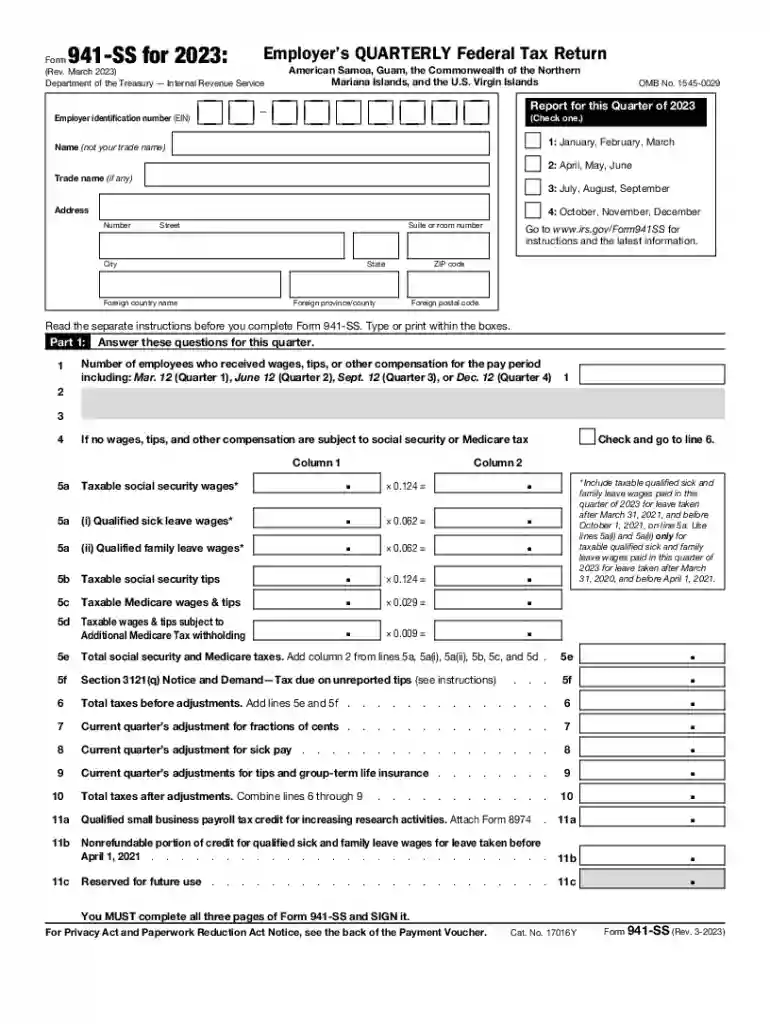
IRS Form 941-SS, Employer's Quarterly Federal Tax Return, is a critical document for employers operating in U.S. territories such as American Samoa, Guam, the Northern Mariana Islands, and the U.S. Virgin Islands. This form is used to report wages, tips, and other compensation paid to employees. It is essential for calculating and documenting the employer's portion of Social Security and Medicare taxes, as well as adjustments and credits for statutory sick and family leave wages. Employers must ensure they accurately report employee counts and any adjustments related to these taxes to maintain compliance with federal regulations.
Obtaining Form 941-SS is a straightforward process. You can download the form directly from the IRS website without any cost. For those who prefer a physical copy, requesting one via mail is an option, although it typically involves longer wait times. Employers also have the flexibility to acquire this form through tax preparation software, such as TurboTax or QuickBooks, which facilitates completing and filing the form electronically. Utilizing these resources ensures that you have the current version of the form with all necessary amendments.
Many employers find it convenient to use tax software programs to complete Form 941-SS. Platforms such as TurboTax and QuickBooks are equipped to handle the specific calculations and requirements of this form. These programs often provide guided assistance to ensure that employers fill out each section accurately, reducing the risk of errors. Additionally, electronic submission through these software programs promotes faster processing. Compatibility with various accounting tools ensures that employers can seamlessly integrate this form into their broader tax-filing processes.
Completing Form 941-SS requires careful attention to detail. The form is structured to guide you through the necessary data inputs for accurate quarterly reporting.
Gather Required Information: Start by collecting all essential payroll details, including employee wages and tax withheld for the quarter.
Fill Out Basic Information: Enter the employer identification number (EIN), trade name, and address. Verify these details to ensure IRS records are updated.
Report Wage and Tax Information: Accurately record total wages paid, taxes withheld, and employer contributions for Social Security and Medicare taxes.
Adjustments and Credits: Calculate any statutory adjustments or credits for sick and family leave wages. Note any previous overpayments, which can be credited toward future liabilities or refunded.
Reconcile with Payments Made: Compare the tax liability with deposits made to avoid discrepancies. Amend any detected errors before submission.
Signature and Submission: Ensure authorized personnel signs the form. Submit the completed form by the specified due date, utilizing either electronic filing or prescribed mailing addresses if filing by paper.
The filing deadlines for Form 941-SS are critical to avoid penalties. The form is due the last day of the month following each quarter. For instance, the Q1 form is due April 30, Q2 by July 31, Q3 by October 31, and Q4 by January 31 of the following year. Late submissions could result in fines or interest on tax amounts due.
Form 941-SS is divided into several sections, each capturing specific information crucial for government records and compliance.
Understanding these components ensures that the form is filled out accurately, reflecting all relevant financial and employment data.
Non-compliance with Form 941-SS filing requirements, such as late submissions or incorrect information, can result in significant penalties. The IRS may impose a failure-to-file penalty, which accrues monthly, up to a maximum of five months. There are also fines for underreporting taxes or failing to make timely tax deposits. Employers should maintain meticulous records and adhere to submission deadlines to avoid such financial liabilities.
Form 941-SS can be filed either digitally or on paper. Electronic filings, supported by IRS-approved software, are becoming increasingly popular due to their convenience and faster processing times. However, some employers still prefer paper submissions, particularly those with less frequent access to reliable internet services. Regardless of the method chosen, ensuring accurate and prompt filing is crucial.
Form 941-SS is primarily utilized by employers in specific U.S. territories responsible for reporting employee compensation and employer taxes. It is crucial for businesses operating in these territories to understand the dynamics of filing given different business types — whether a corporation, LLC, or partnership. Understanding how various scenarios, like hiring new staff or adjusting for leave wages, affect quarterly reports is important for compliance and financial planning.
Employers in these regions rely heavily on accurate quarterly reporting to avoid penalties and ensure smooth operation of payroll activities.


We've got more versions of the irs 941 quarterly form form. Select the right irs 941 quarterly form version from the list and start editing it straight away!
| Versions | Form popularity | Fillable & printable |
|---|---|---|
| 2023 | 4.3 Satisfied (32 Votes) | |
| 2022 | 4.9 Satisfied (55 Votes) | |
| 2022 | 4.8 Satisfied (116 Votes) | |
| 2021 | 4.3 Satisfied (126 Votes) | |
| 2021 | 4.3 Satisfied (100 Votes) | |
| 2020 | 4.3 Satisfied (210 Votes) | |
| 2020 | 4.4 Satisfied (169 Votes) | |
| 2019 | 4.4 Satisfied (89 Votes) | |
| 2018 | 4.4 Satisfied (93 Votes) | |
| 2017 | 4.4 Satisfied (32 Votes) | |
| 2016 | 4.3 Satisfied (121 Votes) | |
| 2015 | 3.9 Satisfied (35 Votes) | |
| 2014 | 4 Satisfied (55 Votes) | |
| 2013 | 4 Satisfied (26 Votes) | |
| 2012 | 4 Satisfied (48 Votes) |
At DocHub, your data security is our priority. We follow HIPAA, SOC2, GDPR, and other standards, so you can work on your documents with confidence.
May 2, 2017 941-X, Adjusted Employers QUARTERLY Federal Tax. Return or Claim for Refund; Form 943-X, Adjusted. Employers Annual Federal Tax Return forRead more
Apr 1, 2025 Form 941 for 2026: (Rev. March 2026). Employers QUARTERLY Federal Tax Return. Department of the Treasury Internal Revenue Service. 950126.Read more
Complete Form 941-V if you are making a payment with Form 941, Employers Quarterly Federal Tax. Return. We will use the completed voucher to credit yourRead more


