




01. Edit your 941 form 2019 online
Type text, add images, blackout confidential details, add comments, highlights and more.

Type text, add images, blackout confidential details, add comments, highlights and more.

Draw your signature, type it, upload its image, or use your mobile device as a signature pad.

Send 2019 form 941 via email, link, or fax. You can also download it, export it or print it out.
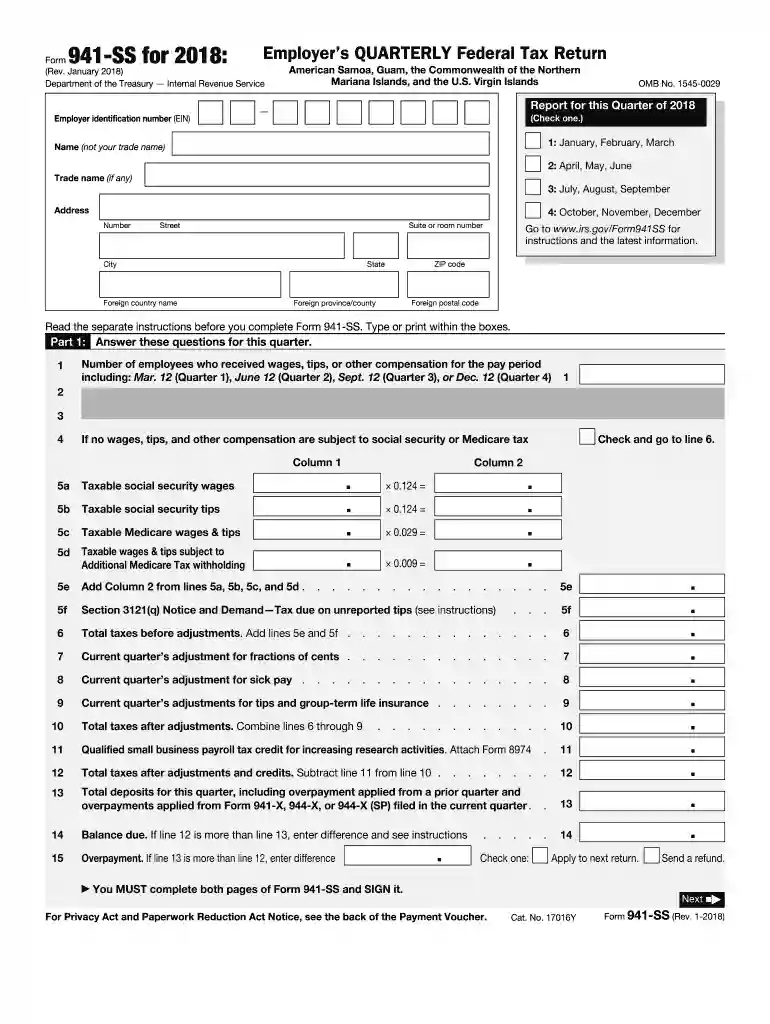
The 2018 Form 941, known as the Employer's Quarterly Federal Tax Return, is crucial for businesses operating in U.S. territories such as American Samoa, Guam, Northern Mariana Islands, and the U.S. Virgin Islands. This form helps employers report employee wages, tips, and other compensations. It includes sections on employee counts, taxable wages, tax liabilities, adjustments, and payment details. Understanding these sections is vital to ensure accurate reporting and compliance with IRS regulations.
Form 941 comprises several significant elements. Employers must declare their total number of employees and report details regarding wages and tips paid out. The form also requires information on federal income tax withheld and the employer's portion of Social Security and Medicare taxes. Specific fields cater to adjustments, such as fractions of cents or overpayments/underpayments from previous quarters, crucial for maintaining accurate tax records and avoiding discrepancies.
Adhering to IRS guidelines when completing Form 941 is essential. The form must be filed quarterly to ensure compliance with federal tax laws, with deadlines typically falling at the end of each month following a quarter's close (January, April, July, and October). Employers who fail to file may face penalties, highlighting the importance of timely submissions. The form guides taxpayers in understanding the legal responsibilities associated with payroll tax returns.
DocHub streamlines the process of completing the 2018 Form 941 online. Users can easily edit, sign, and submit this form digitally via DocHub's secure platform. The platform allows for real-time collaboration and offers interactive tools for inserting necessary details into the form. For ease of use, DocHub supports importing forms from cloud services and exporting completed forms back to storage solutions like Google Drive or Dropbox.
Employers in U.S. territories like American Samoa and Guam who have paid wages subject to federal payroll taxes must file Form 941. This includes corporations, non-profits, and partnerships. Each entity should report their liabilities for Social Security and Medicare taxes. By filing this form, employers meet statutory requirements necessary for proper tax filings.
Understanding terminology associated with Form 941 is crucial for accurate completion:
Employers can choose between digital and traditional methods of submitting Form 941:
Failing to comply with the timely and correct filing of Form 941 can result in penalties from the IRS. Late filing may incur a penalty of 5% of the unpaid tax per month. Similarly, inaccuracies can also attract additional fines. Thus, employers must prioritize understanding the compliance rules associated with this tax form.
Selecting detailed, practical content on the 2018 Form 941 ensures readers fully comprehend all necessary filing aspects, promoting accurate submissions and federal compliance.
We've got more versions of the 941 form 2019 form. Select the right 941 form 2019 version from the list and start editing it straight away!
| Versions | Form popularity | Fillable & printable |
|---|---|---|
| 2023 | 4.3 Satisfied (32 Votes) | |
| 2022 | 4.9 Satisfied (55 Votes) | |
| 2022 | 4.8 Satisfied (116 Votes) | |
| 2021 | 4.3 Satisfied (126 Votes) | |
| 2021 | 4.3 Satisfied (100 Votes) | |
| 2020 | 4.3 Satisfied (210 Votes) | |
| 2020 | 4.4 Satisfied (169 Votes) | |
| 2019 | 4.4 Satisfied (89 Votes) | |
| 2018 | 4.4 Satisfied (93 Votes) | |
| 2017 | 4.4 Satisfied (32 Votes) | |
| 2016 | 4.3 Satisfied (121 Votes) | |
| 2015 | 3.9 Satisfied (35 Votes) | |
| 2014 | 4 Satisfied (55 Votes) | |
| 2013 | 4 Satisfied (26 Votes) | |
| 2012 | 4 Satisfied (48 Votes) |
At DocHub, your data security is our priority. We follow HIPAA, SOC2, GDPR, and other standards, so you can work on your documents with confidence.
Nov 6, 2025 You can e-file employment tax returns Form 940, Form 941, Form 943, Form 944, and Form 945. You can also e-file corrected employment taxRead more
May 2, 2017 After logging into BSO, navigate to the Electronic Wage Reporting home page and click on the Forms W-2c/W-3c Online tab. Also, see E-filingRead more


