




01. Edit your 941 ss 2021 online
Type text, add images, blackout confidential details, add comments, highlights and more.

Type text, add images, blackout confidential details, add comments, highlights and more.

Draw your signature, type it, upload its image, or use your mobile device as a signature pad.

Send 941 ss via email, link, or fax. You can also download it, export it or print it out.
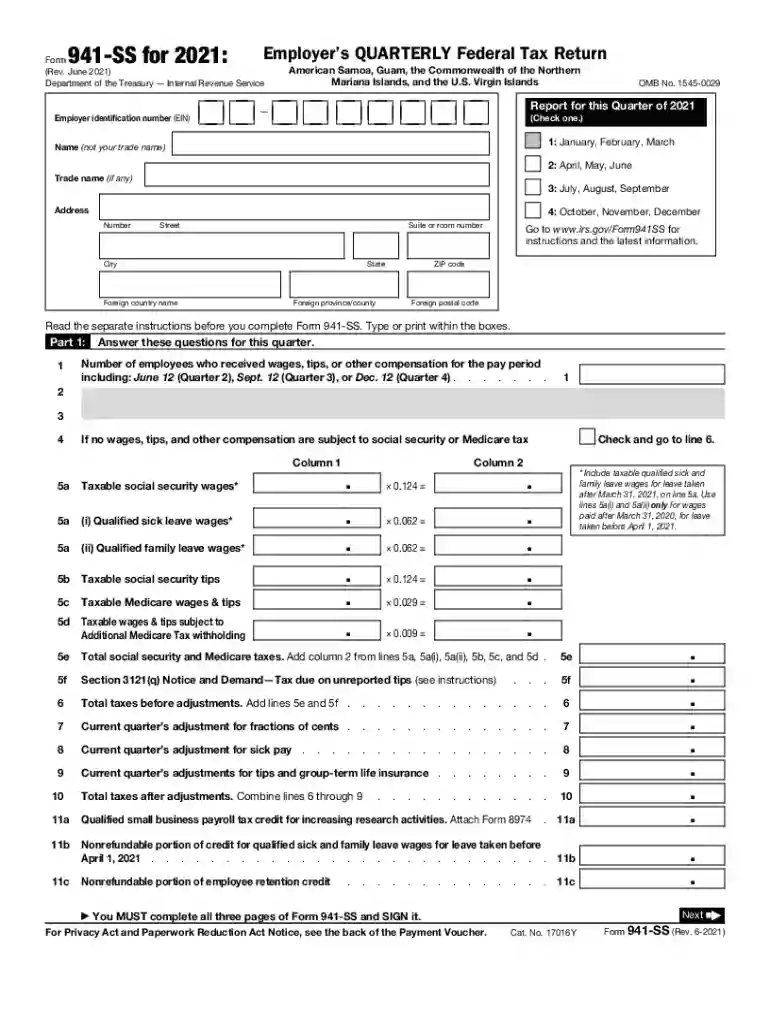
Form 941-SS is an Employer's Quarterly Federal Tax Return specifically designed for employers operating in American Samoa, Guam, the Northern Mariana Islands, and the U.S. Virgin Islands. It is used to report wages paid to employees, tips received, and other taxable compensations. The form also calculates social security and Medicare taxes owed by both the employer and employees. Moreover, it includes adjustments for prior tax periods and accounts for credits applicable to employment taxes.
Filling out Form 941-SS correctly requires a methodical approach. Employers should begin by gathering accurate payroll data for the entire quarter. This data will ensure precision in declaring total wages and calculating taxable amounts. Using payroll software often simplifies this process by automatically tallying totals and taxes.
Completing Form 941-SS involves several clear steps to ensure compliance and accuracy:
Filing deadlines for Form 941-SS are critical to avoid penalties. The form must be filed quarterly with specific deadlines: April 30 for the first quarter, July 31 for the second, October 31 for the third, and January 31 for the fourth.
Employers can obtain Form 941-SS through the IRS website, where it is available as a downloadable PDF. It can also be requested by mail from the IRS or picked up from local IRS offices.
There are multiple ways to submit Form 941-SS:
Employers must comply with federal tax laws when using Form 941-SS, adhering to all guidelines regarding reportable wages, tax rates, and applicable credits. The IRS provides detailed instructions on their website to aid in compliance.
Failure to file Form 941-SS or underreporting can lead to hefty penalties. Misreporting may elicit fines ranging from 2% to 15% of the underreported amount, depending on the timeliness of corrections.
While Form 941-SS is specific to certain U.S. territories, employers in other regions typically use Form 941, which serves a similar purpose. It's important to select the correct form to reflect regional tax obligations accurately.
Employers in American Samoa, Guam, the Commonwealth of the Northern Mariana Islands, and the U.S. Virgin Islands who pay wages subject to social security and Medicare taxes are required to use this form. Specific guidelines apply to the eligibility for credits and adjustments detailed within the form.
We've got more versions of the 941 ss 2021 form. Select the right 941 ss 2021 version from the list and start editing it straight away!
| Versions | Form popularity | Fillable & printable |
|---|---|---|
| 2023 | 4.3 Satisfied (32 Votes) | |
| 2022 | 4.9 Satisfied (55 Votes) | |
| 2022 | 4.8 Satisfied (116 Votes) | |
| 2021 | 4.3 Satisfied (126 Votes) | |
| 2021 | 4.3 Satisfied (100 Votes) | |
| 2020 | 4.3 Satisfied (210 Votes) | |
| 2020 | 4.4 Satisfied (169 Votes) | |
| 2019 | 4.4 Satisfied (89 Votes) | |
| 2018 | 4.4 Satisfied (93 Votes) | |
| 2017 | 4.4 Satisfied (32 Votes) | |
| 2016 | 4.3 Satisfied (121 Votes) | |
| 2015 | 3.9 Satisfied (35 Votes) | |
| 2014 | 4 Satisfied (55 Votes) | |
| 2013 | 4 Satisfied (26 Votes) | |
| 2012 | 4 Satisfied (48 Votes) |
At DocHub, your data security is our priority. We follow HIPAA, SOC2, GDPR, and other standards, so you can work on your documents with confidence.
Mar 31, 2026 Use Form 941-SS to report social security and Medicare taxes for workers in American Samoa, Guam, the Commonwealth of the Northern Mariana Islands, and the USRead more
Feb 8, 2023 For tax purposes, an alien is an individual who is not a U.S. citizen. Aliens are classified as nonresident aliens and resident aliens. This.Read more


