




01. Edit your notice to employee as to change in relationship online
Type text, add images, blackout confidential details, add comments, highlights and more.

Type text, add images, blackout confidential details, add comments, highlights and more.

Draw your signature, type it, upload its image, or use your mobile device as a signature pad.

Send notice to employee as to change in relationship word document via email, link, or fax. You can also download it, export it or print it out.
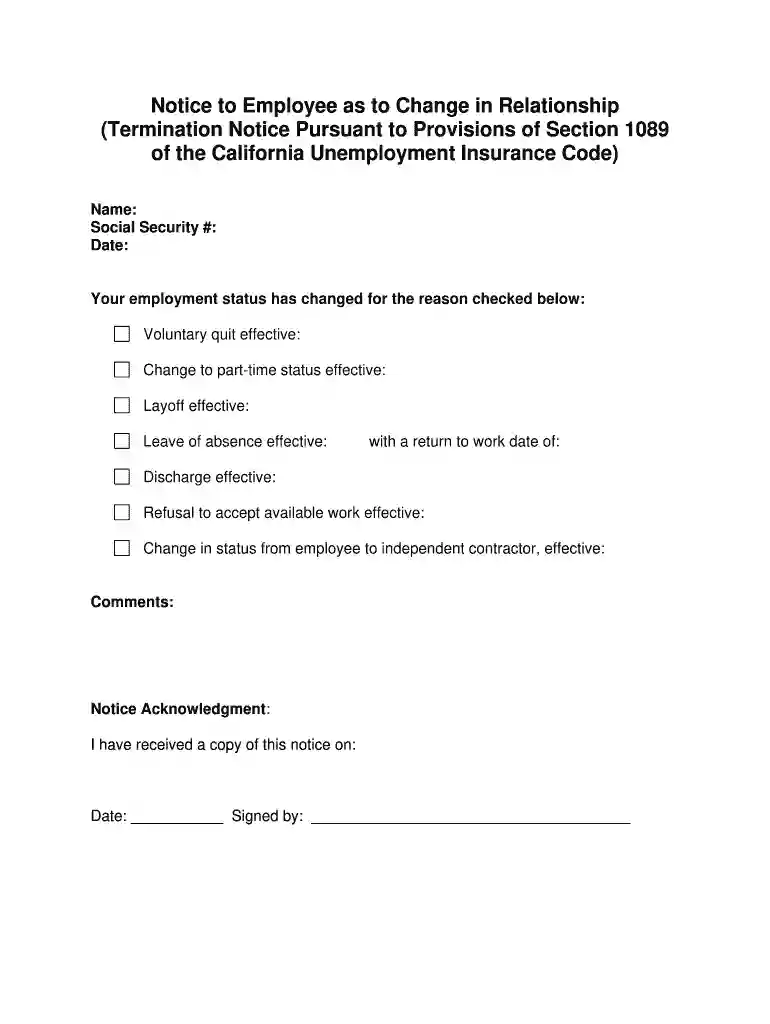
The Notice of Change in Relationship form serves as a critical communication tool for employers in the United States when informing employees about changes in their employment status. This document fulfills the obligations under various state regulations, including California Unemployment Insurance Code Section 1089, outlining the reasons for the change.
The primary function of this form is to ensure that employees are formally notified of any shifts in their employment status, which could include:
Properly issuing this notice helps protect both the employer and employee by maintaining transparency and providing necessary information for unemployment claims.
Employers must adhere to specific guidelines when completing the Notice of Change in Relationship form:
In California, the form should explicitly include:
This specificity not only ensures compliance but also provides clarity that can be helpful for both the employee and the employer in future dealings.
To effectively complete the form, follow these key steps:
Various scenarios may necessitate the use of this form, including:
In each of these situations, issuing the notice not only fulfills legal requirements but also helps maintain good employer-employee relationships by providing formal documentation of the changes.
The Notice of Change in Relationship form is not merely a formality but a legal document that must adhere to state and federal employment laws. Employers must understand the implications of improperly completing or failing to issue this notice, which can lead to:
Adhering to the legal framework surrounding the issuance of this form is vital to protecting employer interests and ensuring the employees are informed of their rights and status changes.
Here are some practical examples where the Notice of Change in Relationship form is applied:
Example 1: An employee voluntarily decides to leave their position for a new opportunity. The employer issues the notice, specifying the rate of final pay, any remaining benefits, and the official end date of employment.
Example 2: A company undergoes a restructuring process and notifies an employee of their transition from a full-time to a part-time position. The notice details the new work hours, pay structure, and responsibilities associated with the new role.
Effective management of employment relationships, including the timely issuance of the Notice of Change in Relationship form, ensures clarity and compliance with legal requirements. By following the stipulated guidelines, employers can maintain a professional environment and foster trustworthy relationships with their employees.
We've got more versions of the notice to employee as to change in relationship form. Select the right notice to employee as to change in relationship version from the list and start editing it straight away!
| Versions | Form popularity | Fillable & printable |
|---|---|---|
| 2024 | 4.7 Satisfied (50 Votes) | |
| 2024 | 4.1 Satisfied (26 Votes) | |
| 2022 | 4.9 Satisfied (41 Votes) | |
| 2022 | 4.8 Satisfied (52 Votes) | |
| 2022 | 4.7 Satisfied (37 Votes) | |
| 2022 | 4.1 Satisfied (56 Votes) | |
| 2022 | 4.5 Satisfied (39 Votes) | |
| 2022 | 1.2 Satisfied (406 Votes) | |
| 2021 | 4.5 Satisfied (50 Votes) | |
| 2021 | 4.8 Satisfied (114 Votes) | |
| 2021 | 4.3 Satisfied (37 Votes) | |
| 2020 | 4.8 Satisfied (53 Votes) | |
| 2020 | 4.8 Satisfied (121 Votes) | |
| 2020 | 4.8 Satisfied (137 Votes) | |
| 2020 | 4.6 Satisfied (59 Votes) |
At DocHub, your data security is our priority. We follow HIPAA, SOC2, GDPR, and other standards, so you can work on your documents with confidence.
Your employment status has changed for the reason checked below. Voluntary quit effective . etaD. Layoff effective . Date. Leave of absenceRead more
SAMPLE. NOTICE TO EMPLOYEE AS TO CHANGE IN RELATIONSHIP. (Issued pursuant to provisions of Section 1089 of the California Unemployment Insurance Code).Read more
Has there been a change of ownership or control within the last 12 months to any of the entities (1, 2 and 3)?. □ Yes. □ No. If Yes, provide: NY Medicaid IDRead more


