







Purpose and Overview of Form 1120-F
Form 1120-F, also known as the U.S. Income Tax Return of a Foreign Corporation, is a critical document used by foreign corporations to report income, deductions, and other tax-related information to the Internal Revenue Service (IRS). It is pivotal for ensuring compliance with U.S. tax laws when foreign entities earn income that is effectively connected with the U.S. trade or business activities.
- Effectively Connected Income (ECI): Foreign corporations must report any income that is effectively connected to a U.S. trade or business.
- Designed for Foreign Corporations: The form specifically caters to non-U.S. entities that engage in business within the United States.
- Compliance Requirement: Filing this form is mandatory to meet U.S. tax obligations and avoid penalties.
Steps to Complete Form 1120-F
Completing Form 1120-F involves several steps, and understanding each section is vital for accuracy and compliance.
- Determine Filing Necessity: Ascertain if your corporation's activity in the U.S. mandates filing this form.
- Collect Required Information: Gather necessary details such as gross receipts, cost of goods sold, and other pertinent financial data.
- Complete Part I: Begin with the income section to report effectively connected and non-effectively connected income.
- Fill Out Deductions in Part II: Accurately report allowable deductions to minimize taxable income.
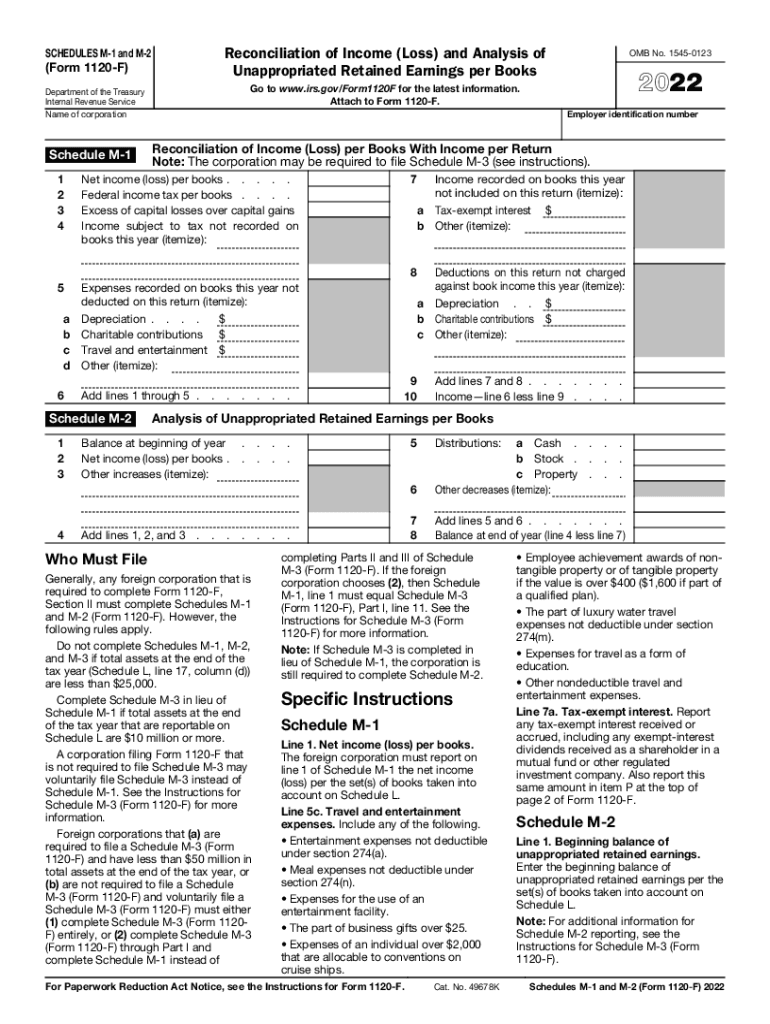
- Schedule Attachments: Attach relevant schedules like M-1 and M-2 for reconciliation of income and retained earnings.
Filing Deadlines for Form 1120-F
Adhering to filing deadlines is essential to avoid penalties.
- Regular Due Date: Generally, Form 1120-F is due on the 15th day of the 6th month following the end of the corporation's fiscal year.
- Extensions: Corporations can request an extension using Form 7004, providing additional time to file without incurring late fees.
- Penalties for Late Filing: Failure to file on time may result in monetary penalties and interest charges.
Eligibility Criteria
Not every foreign corporation is required to file Form 1120-F.
- Engagement in U.S. Business: Corporations that are actively involved in a trade or business in the U.S. need to file.
- Income Thresholds: Entities with U.S.-source income that meet specific thresholds must report using this form.
- Exceptions: Certain treaties and exemptions might waive filing requirements under specific agreements.


Required Documents for Form 1120-F
Providing accurate and complete information is crucial for a successful filing.
- Financial Statements: Current balance sheets and profit/loss statements.
- Tax Identification Number (TIN): A valid TIN or Employer Identification Number (EIN) must be included.
- Supporting Schedules: Attach required schedules such as M-3 for corporations with total assets above a certain threshold.
Penalties for Non-Compliance
Failing to comply with IRS mandates for Form 1120-F can lead to serious repercussions.
- Monetary Penalties: Financial penalties can accrue for late filing or inaccuracies in the submitted form.
- Interest on Unpaid Taxes: Unpaid taxes may attract interest charges, increasing the overall tax liability.
- Legal Action: In severe cases of non-compliance, legal measures might be taken by the IRS.
IRS Guidelines for Form 1120-F
Adhering to IRS guidelines ensures the accurate reporting of income and deductions.
- Comprehensive Instructions: The IRS provides detailed instructions for each section of the form.
- Schedule Requirements: Specific schedules need to be filed to address particular financial items adequately.
- Updates and Revisions: Keep informed about any updates in IRS guidelines or revisions to the form.
Practical Examples of Using Form 1120-F
Real-world scenarios illustrate the importance and application of Form 1120-F.
- Multinational Corporations: Large foreign corporations with subsidiaries in the U.S. need accurate filing for consolidated financial activities.
- Service-Based Businesses: Foreign service providers operating within the U.S. are required to report U.S.-sourced service income.
- Branch Offices: Non-U.S. companies with U.S. branches utilize this form to report financial metrics specific to their American operations.
Software Compatibility with Form 1120-F
Filing accuracy can be improved using software solutions compatible with Form 1120-F.
- Tax Software Options: Platforms like TurboTax and QuickBooks can facilitate the filing process by automating calculations and ensuring compliance.
- Integration with Accounting Systems: Seamless connections between tax software and in-house accounting systems help streamline tax reporting.
- Filing Assistance: Some software offers expert assistance and guidance to help corporations correctly complete their tax returns.
Key Elements of Form 1120-F
Understanding the critical components of Form 1120-F assists in proper preparation and submission.
- Part I – Income and Deductions: Captures all income types and permissible deductions.
- Part II – Tax Computation: Focuses on computing tax liability after considering qualified deductions.
- Schedules and Attachments: Necessary for providing deeper insights into financial data and reconciliation tasks.


