




01. Edit your schedule m 2 retained earnings worksheet online
Type text, add images, blackout confidential details, add comments, highlights and more.

Type text, add images, blackout confidential details, add comments, highlights and more.

Draw your signature, type it, upload its image, or use your mobile device as a signature pad.

Send retained earnings reconciliation worksheet via email, link, or fax. You can also download it, export it or print it out.
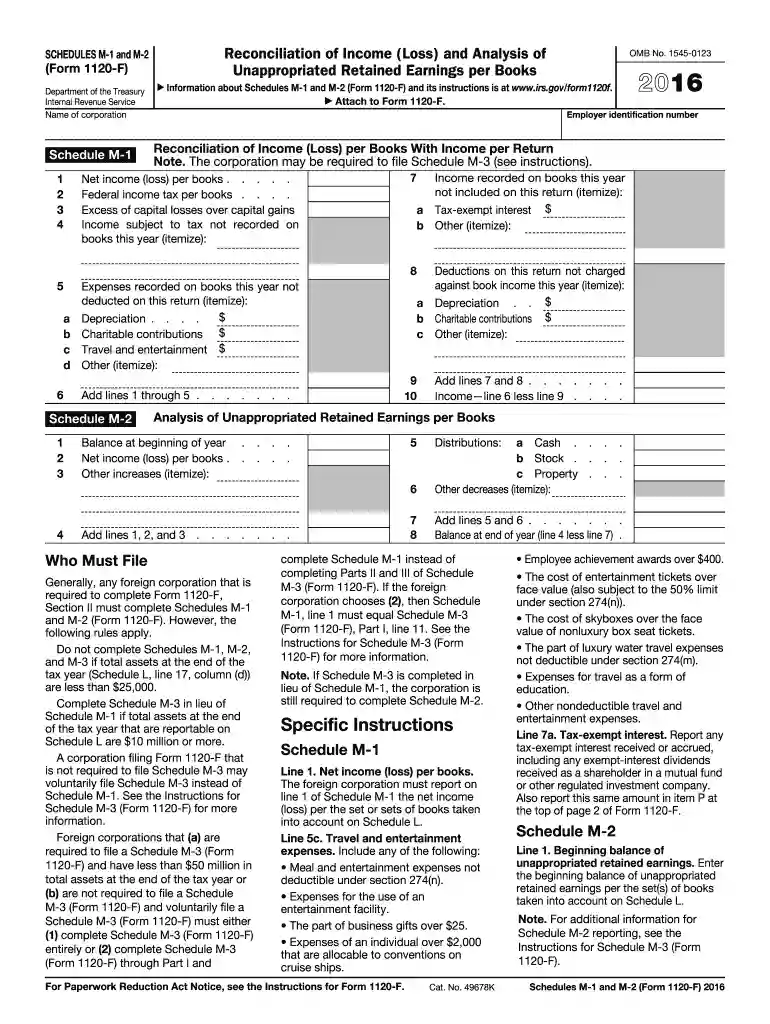
Schedules M-1 and M-2 are essential components of Form 1120-F, specifically designed for foreign corporations to report key financial information. Schedule M-1 reconciles the income (or loss) recorded on a corporation's financial books with the income reported on its tax return. This process ensures that any discrepancies between financial accounting and tax reporting are clearly explained. In contrast, Schedule M-2 analyzes the corporation’s unappropriated retained earnings. These schedules play a crucial role in maintaining transparency and accuracy in the reporting of financial activities.
To effectively use Schedules M-1 and M-2, it's important to understand their distinct purposes and requirements:
Schedule M-1:
Schedule M-2:
Ensuring that these schedules accurately reflect the corporation’s financial activities is critical for compliance with IRS regulations.
Collect Financial Statements:
Reconcile Income with Schedule M-1:
Analyze Retained Earnings with Schedule M-2:
Review and Verify:
Understanding these terms is crucial for accurately completing the schedules.
The IRS provides specific instructions for completing Schedules M-1 and M-2. These guidelines outline who must file the schedules, the type of information to be included, and how to correct errors if discovered later. Following IRS guidelines is essential for avoiding penalties and ensuring all required information is accurately reported.
Foreign corporations are legally required to file Schedules M-1 and M-2 as part of Form 1120-F if they engage in U.S. trade or business activities. The schedules must accurately reflect the corporation’s financial activities and adhere to IRS reporting standards. Non-compliance or inaccuracies can lead to significant legal consequences and financial penalties.
Failure to file Schedules M-1 and M-2 or providing incorrect information can result in penalties from the IRS. Common penalties include fines for late submission and other punitive charges for deliberate misinformation. Ensuring timely and accurate filings is critical to avoid these penalties.
The filing deadline for Form 1120-F, including Schedules M-1 and M-2, is typically the fifteenth day of the sixth month after the end of the corporation's tax year. It is crucial to adhere to this deadline to avoid late filing penalties and to maintain compliance with IRS regulations.
Form 1120-F, along with its schedules, can be filed both digitally and on paper. While a paper submission might be preferred by some, electronic filing offers advantages like faster processing times and immediate confirmation of receipt. It is essential to choose the method that best suits the corporation’s needs and ensures compliance with IRS deadlines.
We've got more versions of the schedule m 2 retained earnings worksheet form. Select the right schedule m 2 retained earnings worksheet version from the list and start editing it straight away!
| Versions | Form popularity | Fillable & printable |
|---|---|---|
| 2025 | 4.9 Satisfied (55 Votes) | |
| 2024 | 4.7 Satisfied (23 Votes) | |
| 2023 | 4.7 Satisfied (59 Votes) | |
| 2022 | 4.6 Satisfied (39 Votes) | |
| 2021 | 4.8 Satisfied (120 Votes) | |
| 2020 | 4.3 Satisfied (107 Votes) | |
| 2019 | 4.2 Satisfied (101 Votes) | |
| 2018 | 4.4 Satisfied (61 Votes) | |
| 2017 | 4.4 Satisfied (129 Votes) | |
| 2016 | 4.2 Satisfied (95 Votes) | |
| 2015 | 4.4 Satisfied (71 Votes) | |
| 2014 | 4 Satisfied (49 Votes) | |
| 2013 | 4 Satisfied (54 Votes) | |
| 2012 | 4 Satisfied (30 Votes) | |
| 2011 | 4 Satisfied (23 Votes) |
At DocHub, your data security is our priority. We follow HIPAA, SOC2, GDPR, and other standards, so you can work on your documents with confidence.
M-1 Reconciliation of Income (Loss) per Books With Income per Return . Schedule M-2 Analysis of Unappropriated Retained Earnings per Books (Line 25, ScheduleRead more
The foreign corporation must report on line 1 of Schedule M-1 the net income. (loss) per the set or sets of books taken into account on Schedule L. Line 5c.Read more


