




01. Edit your form online
Type text, add images, blackout confidential details, add comments, highlights and more.

Type text, add images, blackout confidential details, add comments, highlights and more.

Draw your signature, type it, upload its image, or use your mobile device as a signature pad.

Send it via email, link, or fax. You can also download it, export it or print it out.
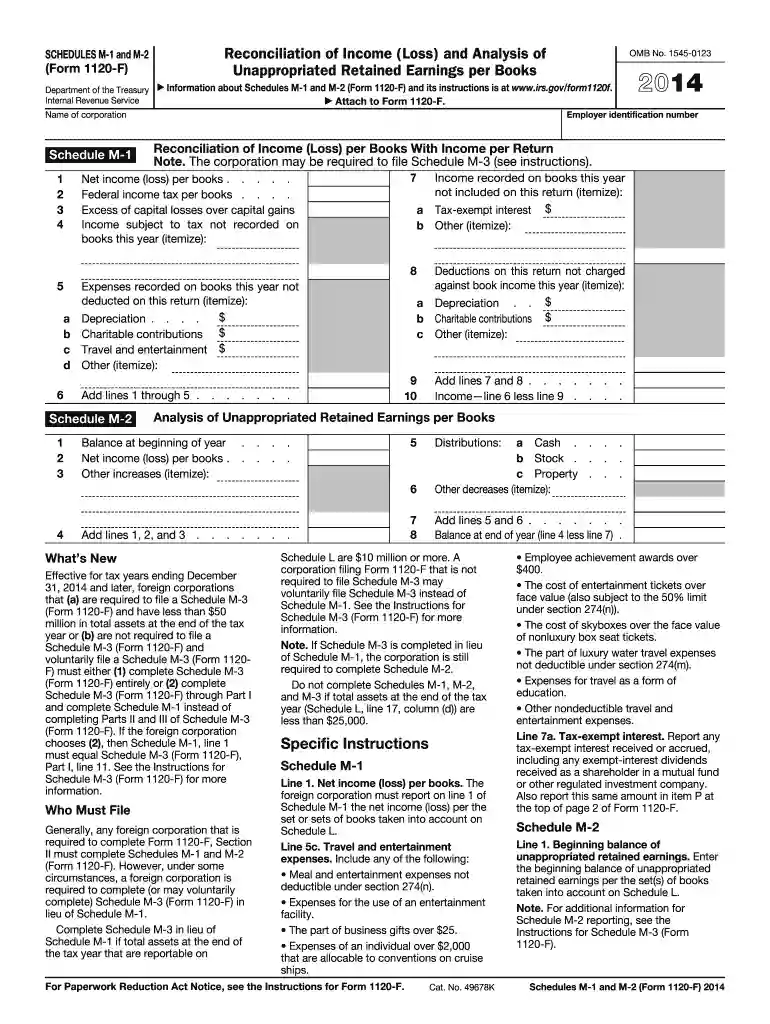
The 2014 M-2 form is a critical component of Form 1120-F, used primarily by foreign corporations to reconcile income or loss per books with income reported on tax returns. This specific form also assists in analyzing unappropriated retained earnings. It is essential for corporations that need to provide a detailed account of their financial activities as regulated by the IRS.
Accessing the 2014 M-2 form is essential for ensuring timely compliance for foreign corporations.
Understanding the completion process of the M-2 form is crucial for accuracy in financial reporting.
Focusing on the central components of the M-2 form enables corporations to meet all necessary filing requirements.
The M-2 form is tailored for specific organizational use cases.


Understanding IRS guidelines ensures compliance and avoids common pitfalls.
Timely submission is necessary to avoid penalties and align with IRS standards.
Non-compliant submissions can lead to significant financial and legal repercussions.
Entities should choose the submission method that best aligns with their operational workflows.
By covering these critical elements of the 2014 M-2 form, corporations can navigate the complexities of international tax compliance with greater confidence and accuracy.
We've got more versions of the 2014 m 2 form form. Select the right 2014 m 2 form version from the list and start editing it straight away!
| Versions | Form popularity | Fillable & printable |
|---|---|---|
| 2025 | 4.9 Satisfied (55 Votes) | |
| 2024 | 4.7 Satisfied (23 Votes) | |
| 2023 | 4.7 Satisfied (59 Votes) | |
| 2022 | 4.6 Satisfied (39 Votes) | |
| 2021 | 4.8 Satisfied (120 Votes) | |
| 2020 | 4.3 Satisfied (107 Votes) | |
| 2019 | 4.2 Satisfied (101 Votes) | |
| 2018 | 4.4 Satisfied (61 Votes) | |
| 2017 | 4.4 Satisfied (129 Votes) | |
| 2016 | 4.2 Satisfied (95 Votes) | |
| 2015 | 4.4 Satisfied (71 Votes) | |
| 2014 | 4 Satisfied (49 Votes) | |
| 2013 | 4 Satisfied (54 Votes) | |
| 2012 | 4 Satisfied (30 Votes) | |
| 2011 | 4 Satisfied (23 Votes) |
At DocHub, your data security is our priority. We follow HIPAA, SOC2, GDPR, and other standards, so you can work on your documents with confidence.
This line to be completed by your employer: Total exemptions (example: employee claims M on line 3 and. 2 on line 4. Employer should use column M-2 (marriedRead more
Schedule M-2 Analysis of Unappropriated Retained Earnings per Books 1 Balance at beginning of year . 2 Net income (loss) per books


