




01. Edit your form online
Type text, add images, blackout confidential details, add comments, highlights and more.

Type text, add images, blackout confidential details, add comments, highlights and more.

Draw your signature, type it, upload its image, or use your mobile device as a signature pad.

Send it via email, link, or fax. You can also download it, export it or print it out.
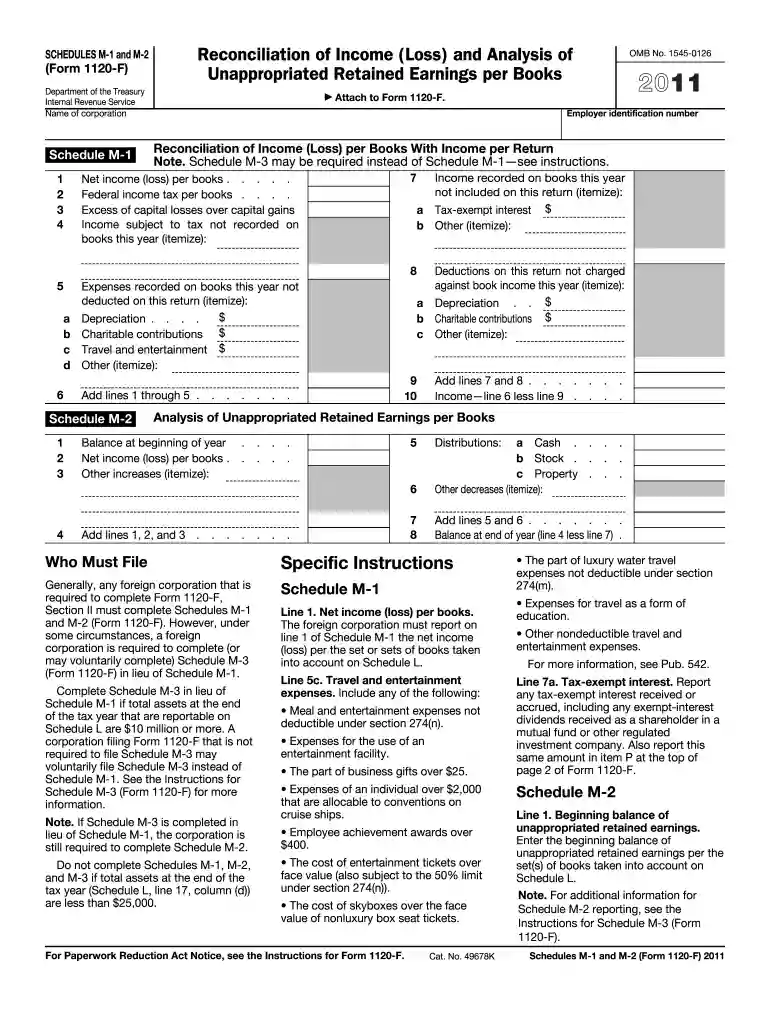
Form 1120 M-2, utilized during the 2011 tax year, is part of the U.S. corporate tax filing process. It specifically relates to Schedule M-2, which is used by corporations to analyze their unappropriated retained earnings. This process involves reconciling the corporation's income per books with income reported on tax returns. Understanding its role is crucial for corporations in ensuring they accurately track profits that have not been distributed as dividends but can still impact tax liabilities.
Completing Form 1120 M-2 involves several key steps.
Understanding key terminology is crucial:
The IRS provides specific guidance for filing Form 1120 M-2 as part of the corporate tax return. Tax preparers must adhere to instructions outlining how to adjust for book-tax differences, disclose non-deductible expenses, and report major changes in business activities that affect retained earnings. Compliance ensures accurate reporting and minimizes risk of audits.
Corporations typically must file Form 1120 with Schedule M-2 by the 15th day of the third month following the end of their tax year. For most, this is March 15. Extensions may be available; however, forms must be postmarked or electronically submitted by the deadline to avoid penalties.
Failing to file Form 1120 M-2 can result in substantial penalties. These may include fines for inaccurate reporting, late submission, or failure to file. Corporations might incur a monthly penalty calculated based on net worth and tax liability, stressing the importance of timely and accurate submissions.
To complete and file Form 1120 M-2, corporations need:
Form 1120 M-2, part of the broader Form 1120 used for corporate tax returns, is issued by the Internal Revenue Service (IRS). It is specifically used by corporations to meet tax reconciliation requirements while providing a detailed report of their financial operations and retained earnings for federal tax purposes.
We've got more versions of the form 1120 m 2 2011 form. Select the right form 1120 m 2 2011 version from the list and start editing it straight away!
| Versions | Form popularity | Fillable & printable |
|---|---|---|
| 2025 | 4.9 Satisfied (55 Votes) | |
| 2024 | 4.7 Satisfied (23 Votes) | |
| 2023 | 4.7 Satisfied (59 Votes) | |
| 2022 | 4.6 Satisfied (39 Votes) | |
| 2021 | 4.8 Satisfied (120 Votes) | |
| 2020 | 4.3 Satisfied (107 Votes) | |
| 2019 | 4.2 Satisfied (101 Votes) | |
| 2018 | 4.4 Satisfied (61 Votes) | |
| 2017 | 4.4 Satisfied (129 Votes) | |
| 2016 | 4.2 Satisfied (95 Votes) | |
| 2015 | 4.4 Satisfied (71 Votes) | |
| 2014 | 4 Satisfied (49 Votes) | |
| 2013 | 4 Satisfied (54 Votes) | |
| 2012 | 4 Satisfied (30 Votes) | |
| 2011 | 4 Satisfied (23 Votes) |
At DocHub, your data security is our priority. We follow HIPAA, SOC2, GDPR, and other standards, so you can work on your documents with confidence.
Do not consider any penalty for underpayment of estimated tax. What is the balance to be shown on line 8 of Schedule M-2 on Form 1120? a. $19,000 b. $18,000 c.Read more
Apr 15, 1976 Increased section 179 deduction dollar limits. The maximum amount you can elect to deduct for most sec- tion 179 property you placed inRead more
Reconciliation of Income (Loss) per Books With Income per Return. Note. Schedule M-3 may be required instead of Schedule M-1see instructions.Read more


