




01. Edit your form m 1 online
Type text, add images, blackout confidential details, add comments, highlights and more.

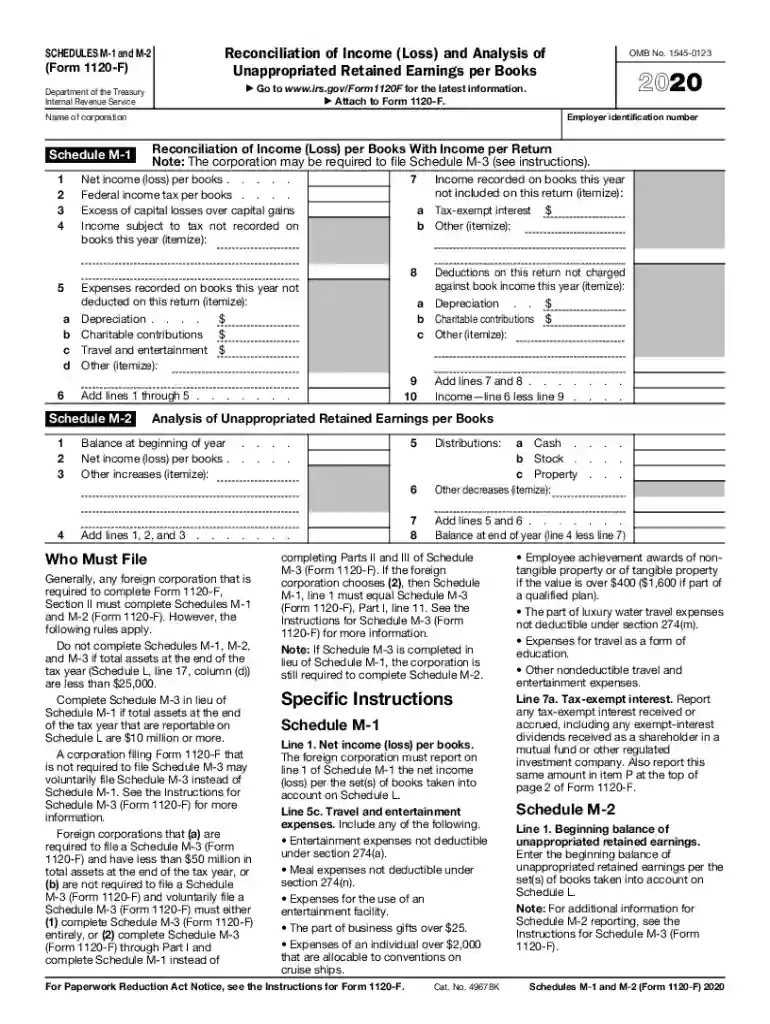
Type text, add images, blackout confidential details, add comments, highlights and more.

Draw your signature, type it, upload its image, or use your mobile device as a signature pad.

Send m1 form via email, link, or fax. You can also download it, export it or print it out.
Form M-1 is an essential part of IRS Form 1120-F used by foreign corporations to reconcile their book income with taxable income. This form plays a crucial role in ensuring compliance with U.S. tax laws, enabling accurate reporting of financial activities by detailing adjustments to income and expenses. By outlining these reconciliations, Form M-1 assists corporations in understanding their tax obligations and ensuring that all incomes are reported correctly to the Internal Revenue Service.
Using Form M-1 involves accurately gathering and presenting financial data that reflects your corporation's income tax requirements. Begin by collecting information on book income and then systematically adjust this for the differences that arise due to tax laws. It's crucial to detail all discrepancies clearly and consistently, ensuring that the final taxable income aligns with federal requirements. Double-check calculations and entries for accuracy, considering revisions or amendments where necessary.
Gather Financial Statements: Collect all relevant income and expense reports that detail your corporation’s financial activities.
Identify Discrepancies: Examine financial reports to spot differences between book income and taxable income due to deferrals, adjustments, or deductions allowed.
Adjust Book Income: Using the identified discrepancies, adjust your book income accordingly in line with IRS guidelines.
Complete the Form: Fill out Form M-1 by clearly listing adjustments and the reconciled figures for your corporation.
Review for Accuracy: Ensure that all information is accurately reported and abstraction consistently applied.
Submit with Form 1120-F: Attach the completed Form M-1 to Form 1120-F and submit to the IRS by the relevant deadline.
Form M-1 features several crucial components, including:
The Internal Revenue Service (IRS) issues Form M-1 as part of the compliance requirements for foreign corporations filing Form 1120-F. This issuance is integral for standardizing and systematizing how these corporations report their financial and tax obligations.
The IRS provides detailed instructions to ensure accurate completion of Form M-1. These guidelines emphasize the importance of presenting discrepancies fully and justifying each adjustment. Compliance with these instructions is crucial for avoiding inaccuracies and potential penalties, and ensures thorough documentation of each item affecting reconciliation.
Adhering to these deadlines is crucial, as late submissions may incur penalties.
Penalties for failing to accurately complete or timely file Form M-1 may include:
Understanding and mitigating these penalties can prevent significant legal and financial repercussions for corporations.
We've got more versions of the form m 1 form. Select the right form m 1 version from the list and start editing it straight away!
| Versions | Form popularity | Fillable & printable |
|---|---|---|
| 2025 | 4.9 Satisfied (55 Votes) | |
| 2024 | 4.7 Satisfied (23 Votes) | |
| 2023 | 4.7 Satisfied (59 Votes) | |
| 2022 | 4.6 Satisfied (39 Votes) | |
| 2021 | 4.8 Satisfied (120 Votes) | |
| 2020 | 4.3 Satisfied (107 Votes) | |
| 2019 | 4.2 Satisfied (101 Votes) | |
| 2018 | 4.4 Satisfied (61 Votes) | |
| 2017 | 4.4 Satisfied (129 Votes) | |
| 2016 | 4.2 Satisfied (95 Votes) | |
| 2015 | 4.4 Satisfied (71 Votes) | |
| 2014 | 4 Satisfied (49 Votes) | |
| 2013 | 4 Satisfied (54 Votes) | |
| 2012 | 4 Satisfied (30 Votes) | |
| 2011 | 4 Satisfied (23 Votes) |
At DocHub, your data security is our priority. We follow HIPAA, SOC2, GDPR, and other standards, so you can work on your documents with confidence.
Form M-1 30 days prior to operating in States Y or Z. The administrator of MEWA C must also report by filing the Form M-1 annually by every March 1 thereafter.Read more
The Cisco Nexus 7000 M1-Series 8-Port 10 Gigabit Ethernet Module with XL Option (Figure 1) is a cost-effective, highly scalable, high-performance moduleRead more
The Form M-1 is an annual report that must be filed by Multiple Employer Welfare Arrangements (MEWAs). The Form M-1 must be filed no later than March 1


