




01. Edit your form online
Type text, add images, blackout confidential details, add comments, highlights and more.

Type text, add images, blackout confidential details, add comments, highlights and more.

Draw your signature, type it, upload its image, or use your mobile device as a signature pad.

Send it via email, link, or fax. You can also download it, export it or print it out.
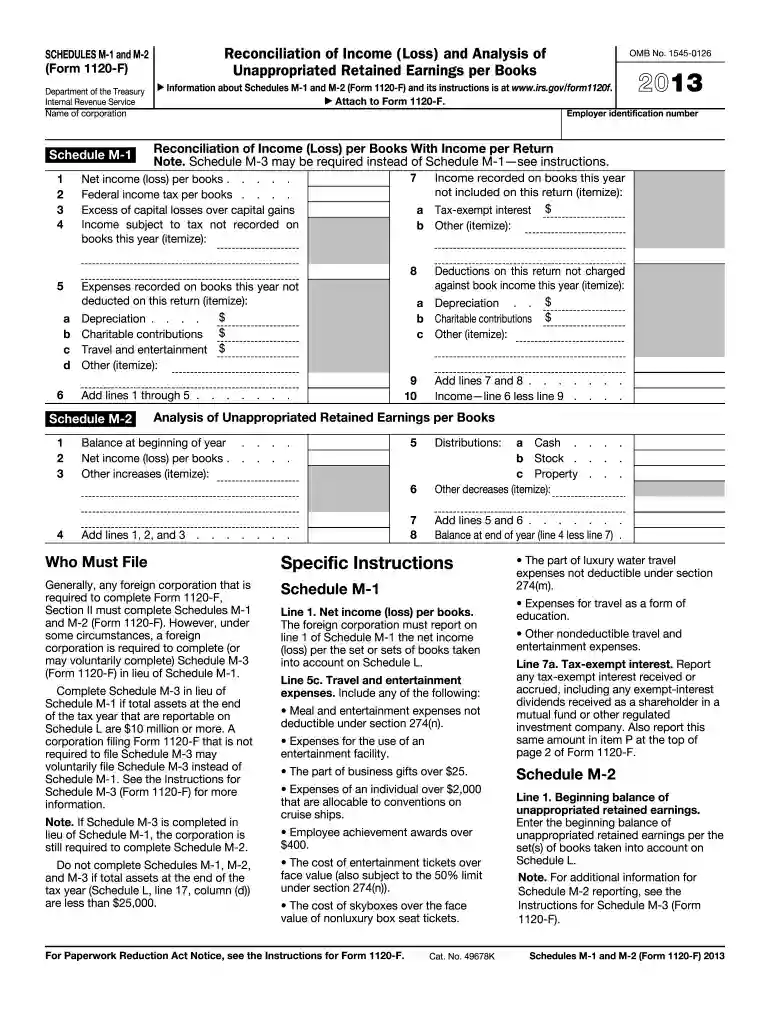
The 2013 M-2 form is a component of the IRS Form 1120-F, required for foreign corporations to reconcile book income with taxable income and to analyze unappropriated retained earnings. It provides a detailed breakdown of undistributed income after accounting for taxes and deductions. The form aims to ensure transparency and compliance with U.S. tax regulations for foreign corporations doing business in the United States. By understanding the specific details required in Schedule M-2, businesses can accurately report financial data to the IRS.
The IRS mandates that foreign corporations use Schedule M-2 to reconcile financial and taxable income accurately. The form requires corporations to itemize changes in retained earnings, ensuring they match income reported on other schedules. Businesses should refer to IRS Publication 542 for more detailed instructions on corporate taxation and compliance.
The Internal Revenue Service (IRS) issues the 2013 M-2 form. As part of Form 1120-F, it is integral for foreign corporations operating in the U.S. to file their tax returns. It is accessed primarily through IRS publications and tax preparation software recognized by the IRS.
The typical deadline for filing Form 1120-F, and thus the M-2 form, is the 15th day of the fourth month after the fiscal year ends. However, extensions may be available. For example, if a corporation operates on a calendar year, the due date would be April 15.
Failing to file the 2013 M-2 form accurately and on time can result in penalties, including fines and interest on unpaid taxes. The IRS may impose penalties for understating income and inaccurately reporting retained earnings, emphasizing the need for accuracy and completeness when submitting tax documents.
We've got more versions of the 2013 m 2 form form. Select the right 2013 m 2 form version from the list and start editing it straight away!
| Versions | Form popularity | Fillable & printable |
|---|---|---|
| 2025 | 4.9 Satisfied (55 Votes) | |
| 2024 | 4.7 Satisfied (23 Votes) | |
| 2023 | 4.7 Satisfied (59 Votes) | |
| 2022 | 4.6 Satisfied (39 Votes) | |
| 2021 | 4.8 Satisfied (120 Votes) | |
| 2020 | 4.3 Satisfied (107 Votes) | |
| 2019 | 4.2 Satisfied (101 Votes) | |
| 2018 | 4.4 Satisfied (61 Votes) | |
| 2017 | 4.4 Satisfied (129 Votes) | |
| 2016 | 4.2 Satisfied (95 Votes) | |
| 2015 | 4.4 Satisfied (71 Votes) | |
| 2014 | 4 Satisfied (49 Votes) | |
| 2013 | 4 Satisfied (54 Votes) | |
| 2012 | 4 Satisfied (30 Votes) | |
| 2011 | 4 Satisfied (23 Votes) |
At DocHub, your data security is our priority. We follow HIPAA, SOC2, GDPR, and other standards, so you can work on your documents with confidence.
May 2, 2017 Notice 2013-61 provides special administrative procedures for employers to make claims for refunds or adjustments of overpayments of socialRead more
Compensation of officers, directors, and trustees (Schedule K). Salaries and wages. Repairs and maintenance. Bad debts. Interest (attach statement).Read more
Report any tax-exempt interest received or accrued, including any exempt-interest dividends received as a shareholder in a mutual fund or other regulated.Read more


