




01. Edit your form online
Type text, add images, blackout confidential details, add comments, highlights and more.

Type text, add images, blackout confidential details, add comments, highlights and more.

Draw your signature, type it, upload its image, or use your mobile device as a signature pad.

Send it via email, link, or fax. You can also download it, export it or print it out.
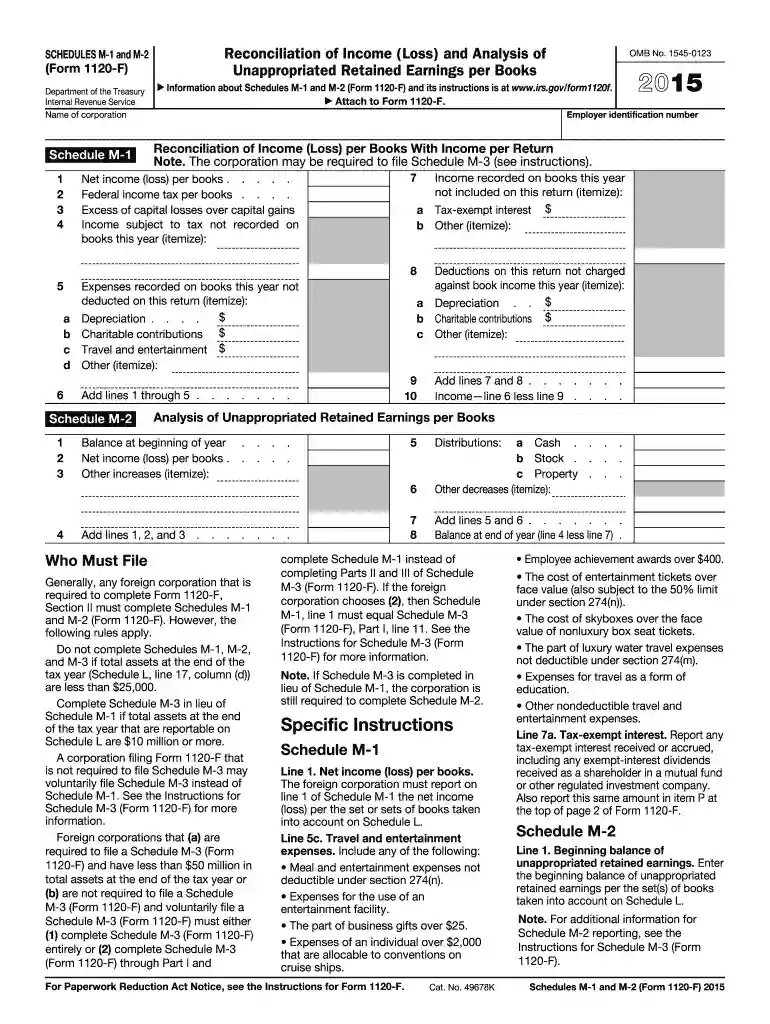
The 2015 Form 1120-F, known as the U.S. Income Tax Return of a Foreign Corporation, is primarily utilized by foreign corporations to report their income, deductions, and tax liability to the Internal Revenue Service (IRS). The form is essential for businesses with income effectively connected to a trade or business in the United States. This document helps ensure compliance with U.S. tax laws and accurately reflects a corporation's financial activities within the country.
Foreign corporations must distinguish between income that is effectively connected to their U.S. operations and income that is not. The effectively connected income (ECI) is subject to U.S. taxation and must be reported on Form 1120-F. Income not considered ECI is generally not taxed unless specific provisions apply.
Foreign corporations can acquire Form 1120-F through several methods to ensure they meet filing requirements. The IRS provides access via its official website, where corporations can download the form directly.
Completing the Form 1120-F requires attention to detail, ensuring all financial data is accurately reported. The following steps outline the process:
Form 1120-F applies to foreign corporations engaged in a trade or business within the United States. Eligibility is determined by the following criteria:
Certain foreign corporations may be exempt from filing if they engage in limited or no business activities within the U.S. It is important to consult IRS guidelines to understand these exemptions.
Several essential components make up Form 1120-F, each requiring careful attention:
Precision in reporting ensures compliance and minimizes the risk of penalties. Corporations should maintain accurate bookkeeping throughout the fiscal year.
Failing to file Form 1120-F or providing incorrect information may result in significant penalties imposed by the IRS. These include:
Corporations should consider preparatory reviews or consulting tax professionals to ensure the form is completed correctly and submitted on time.
The IRS provides comprehensive guidelines to assist foreign corporations in preparing and filing Form 1120-F. These include specific instructions for:
Corporations are encouraged to use IRS resources, such as the official instructions manual for Form 1120-F, to navigate any complex areas or seek clarification on unique scenarios.
The filing deadline for Form 1120-F is typically the 15th day of the 6th month following the end of the corporation's tax year. For calendar year filers, this generally means a June 15th deadline.
Corporations may file for an automatic extension by submitting Form 7004. This extension provides an additional six months to file but does not extend the time to pay any taxes due.
Form 1120-F caters to various foreign business structures conducting U.S. activities, including:
Each entity type might have unique filing requirements or tax implications, emphasizing the need to determine proper classification and associated obligations before filing.
While Form 1120-F addresses federal tax obligations, foreign corporations should also be aware of state-specific tax rules. States may impose their filing requirements or tax obligations on income within their jurisdictions.
Some states might require additional forms or have different nexus thresholds, affecting which corporations must file and pay state taxes. Consulting with state tax authorities can aid in understanding these requirements.
We've got more versions of the 2015 form 1120f form. Select the right 2015 form 1120f version from the list and start editing it straight away!
| Versions | Form popularity | Fillable & printable |
|---|---|---|
| 2025 | 4.9 Satisfied (55 Votes) | |
| 2024 | 4.7 Satisfied (23 Votes) | |
| 2023 | 4.7 Satisfied (59 Votes) | |
| 2022 | 4.6 Satisfied (39 Votes) | |
| 2021 | 4.8 Satisfied (120 Votes) | |
| 2020 | 4.3 Satisfied (107 Votes) | |
| 2019 | 4.2 Satisfied (101 Votes) | |
| 2018 | 4.4 Satisfied (61 Votes) | |
| 2017 | 4.4 Satisfied (129 Votes) | |
| 2016 | 4.2 Satisfied (95 Votes) | |
| 2015 | 4.4 Satisfied (71 Votes) | |
| 2014 | 4 Satisfied (49 Votes) | |
| 2013 | 4 Satisfied (54 Votes) | |
| 2012 | 4 Satisfied (30 Votes) | |
| 2011 | 4 Satisfied (23 Votes) |
At DocHub, your data security is our priority. We follow HIPAA, SOC2, GDPR, and other standards, so you can work on your documents with confidence.
Apr 15, 1976 Enter here and as other income on the form or schedule on which you originally took the deduction (for example, Schedule C or F (Form 1040),
Information about Form 1120. Income from controlled foreign corporations under subpart F 14 15 Foreign dividend gross-up. 2015 overpayment credited to 2016.
Jan 29, 2016 Use Form 1120-F to report the income, gains, losses, deductions, credits, and to figure the U.S. income tax liability of a foreign corporation.Read more


