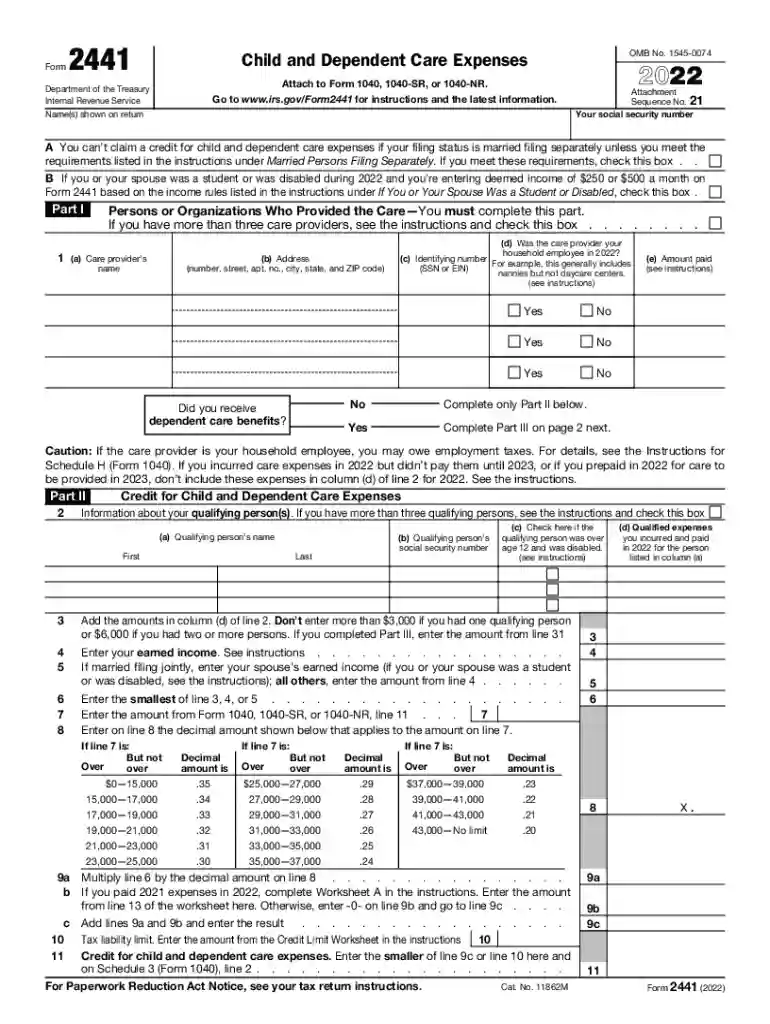
Definition and Purpose of Form 2441: Child and Dependent Care Expenses
Form 2441 is utilized by taxpayers in the United States to claim the Child and Dependent Care Expenses credit. This credit is designed to provide financial relief to individuals who incur expenses for the care of qualifying children and dependents while they work or look for work. The form must be submitted alongside tax returns such as Form 1040, 1040-SR, or 1040-NR. It serves as a detailed record of care providers, qualifying persons, and outlines the amount of dependent care benefits available.
Key Elements of Form 2441
- Qualified Expenses: Includes care for dependents under 13 or individuals incapable of self-care.
- Eligible Care Providers: Must be identified with valid taxpayer identification numbers (TIN).
- Income Consideration: The credit amount is influenced by the taxpayer’s earned income and the total qualified expenses.
Steps to Complete Form 2441
To accurately complete Form 2441, taxpayers must follow a series of steps that ensure compliance with IRS requirements:
- Identify Qualified Dependents: Determine the dependents or persons who fall under the categories defined by the IRS for this credit.
- Detail Care Provider Information: Include names, addresses, and TINs for each care provider.
- Report Qualifying Expenses: List all expenses incurred during the tax year for the care of identified dependents.
- Calculate Earned Income and Credits: Utilize IRS tables to cross-reference income with expenses, determining final credit eligibility.
- Fill Out Parts of the Form: Ensure all parts of Form 2441 are completed correctly, which may involve entering information on dependent care benefits if applicable.
Eligibility Criteria for Form 2441
To qualify for the Child and Dependent Care credit, both the stated dependents and the taxpayer(s) must meet specific conditions:

- Filing Status: Credits are available for Single, Head of Household, Qualifying Widow(er) with a dependent child, or Married Filing Jointly. Notably, restrictions apply to spouses filing separately.
- Work-Related Expenses: Costs must be incurred to enable the taxpayer to work or seek employment.
- Age and Self-Care Capability: Dependents must either be under the age of 13 or unable to care for themselves due to a physical or mental incapacity.
Important IRS Guidelines for Form 2441
The IRS enforces strict guidelines regarding the submission and accuracy of Form 2441:
- Documentation: Taxpayers are advised to retain receipts and documentation for all claimed care expenses.
- Income Limits: Be aware of annual income thresholds which cap the potential credit.
- Non-Employer Provided Benefits: Accurately report any dependent care benefits received through employment, which affect claimed credits.
Required Documents for Form 2441
When preparing to file Form 2441, taxpayers must gather and be prepared to provide:
- Receipts: Proof of payment for child and dependent care.
- Provider Details: Taxpayer identification numbers for all care providers.
- Tax Forms: Integrate Form 2441 with primary forms like 1040, ensuring consistency in reported financial data.
Filing Deadlines for Form 2441
Adhering to submission timelines is crucial to avoid penalties:
- Annual Deadline: Typically align the completion of Form 2441 with the April 15 filing deadline for annual tax returns.
- Extensions: Taxpayers may file for extensions if additional time is necessary, impacting all associated documents including Form 2441.
Form Submission Methods for Form 2441
Taxpayers have multiple options for submitting Form 2441:
- Digital/Online Filing: Integrating Form 2441 with an electronic tax submission provides immediate confirmation of receipt.
- Mail: For those who prefer traditional filing, a paper version is available with detailed submission instructions.
- Tax Software: Many software packages like TurboTax and QuickBooks offer compatibility with Form 2441, streamlining the process for electronic submissions.
Software Compatibility for Form 2441
Many taxpayers leverage digital tools when managing their tax obligations:
- Tax Preparation Software: Modern solutions often include comprehensive support for Form 2441, ensuring calculations and information entry are accurate and compliant.
- Online Portals: IRS e-filing systems are widely compatible with popular software, facilitating a smooth filing process.
Practical Scenarios for Using Form 2441
Exploring examples can provide clarity on how Form 2441 is effectively utilized:
- Dual-Income Households: Couples with both individuals working full-time may maximize this credit by coordinating expense documentation.
- Income Fluctuations: Individuals experiencing variable incomes throughout the year must adjust their claimed credits in alignment with total earned income reported.
- Self-Employed Taxpayers: While self-employment introduces complexity, accurate expense tracking can justify credit eligibility under Form 2441 provisions.
Penalties for Non-Compliance with Form 2441
Failing to accurately complete or submit Form 2441 can result in significant repercussions:
- Monetary Penalties: The IRS may impose fines for underreporting credits or failing to adhere to eligibility requirements.
- Audit Risks: Inaccurate entries may trigger audits, subjecting taxpayers to additional scrutiny and potential penalties.