




01. Edit your form online
Type text, add images, blackout confidential details, add comments, highlights and more.

Type text, add images, blackout confidential details, add comments, highlights and more.

Draw your signature, type it, upload its image, or use your mobile device as a signature pad.

Send it via email, link, or fax. You can also download it, export it or print it out.
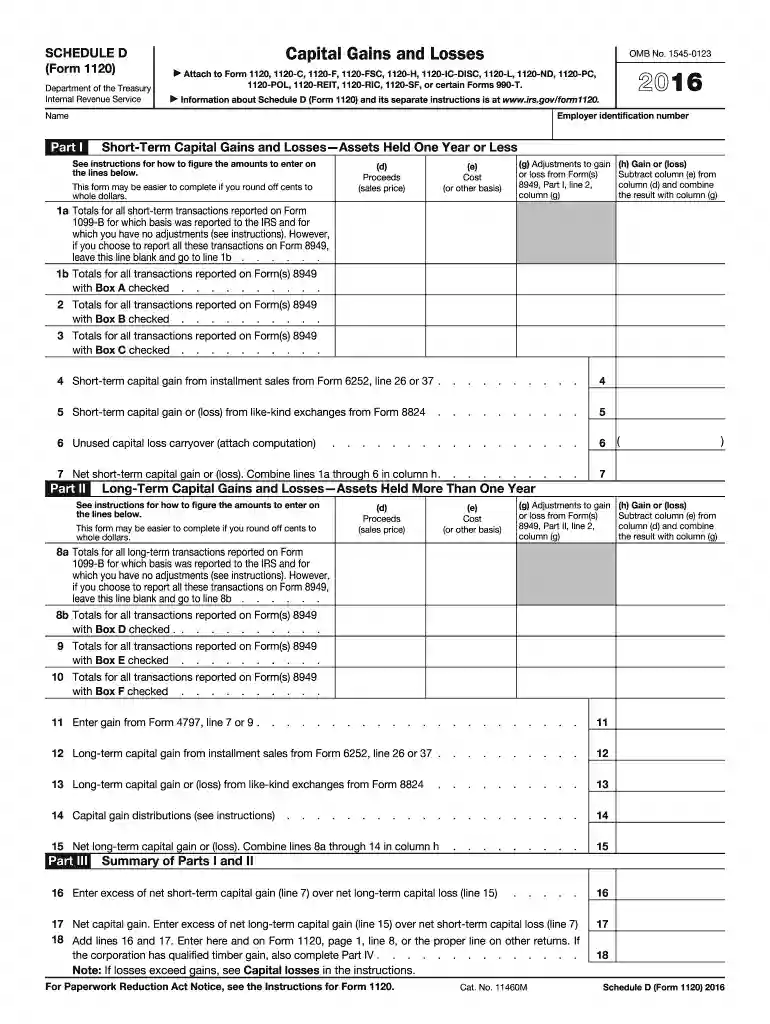
Schedule D (Form 1120) is primarily a tax form used by corporations to report their capital gains and losses from asset transactions. This form is critical for detailing both short-term and long-term capital transactions, ensuring corporations accurately declare gains or losses. The document aids in calculating the capital gain amount, which becomes a part of the taxable income for corporate tax filing.
DocHub offers immense utility for handling your 1120 Schedule D (Form 1120) for 2016. The platform's suite of tools enhances the ease of editing, signing, and sharing your form. By importing your form into DocHub, you can:
Completing Schedule D accurately involves several key steps that ensure all necessary information is reported accurately.
To efficiently complete the 1120 Schedule D for 2016, you need the following documents:
Deadlines are crucial for compliance when filing Schedule D (Form 1120). Corporations typically must adhere to the following schedules:
The IRS provides particular guidelines for completing Schedule D:
Failure to adhere to the regulations involving 1120 Schedule D can result in penalties. Corporations face:
Schedule D (Form 1120) is predominantly used by:
This sectioned approach to understanding and utilizing Schedule D (Form 1120) ensures maximum clarity and utility for corporations dealing with capital gains and losses during the 2016 tax year.
We've got more versions of the 1120 schedule dDocHubcom 2016 form form. Select the right 1120 schedule dDocHubcom 2016 form version from the list and start editing it straight away!
| Versions | Form popularity | Fillable & printable |
|---|---|---|
| 2025 | 4.6 Satisfied (46 Votes) | |
| 2024 | 4.4 Satisfied (56 Votes) | |
| 2023 | 4.7 Satisfied (48 Votes) | |
| 2022 | 4.2 Satisfied (24 Votes) | |
| 2021 | 4.8 Satisfied (151 Votes) | |
| 2020 | 4.4 Satisfied (230 Votes) | |
| 2019 | 4.2 Satisfied (143 Votes) | |
| 2018 | 4.3 Satisfied (108 Votes) | |
| 2017 | 4.4 Satisfied (145 Votes) | |
| 2016 | 4.3 Satisfied (99 Votes) | |
| 2015 | 4.4 Satisfied (33 Votes) | |
| 2014 | 4.1 Satisfied (60 Votes) | |
| 2013 | 4.2 Satisfied (67 Votes) | |
| 2012 | 4 Satisfied (40 Votes) | |
| 2011 | 4 Satisfied (60 Votes) |
At DocHub, your data security is our priority. We follow HIPAA, SOC2, GDPR, and other standards, so you can work on your documents with confidence.


