




01. Edit your form online
Type text, add images, blackout confidential details, add comments, highlights and more.

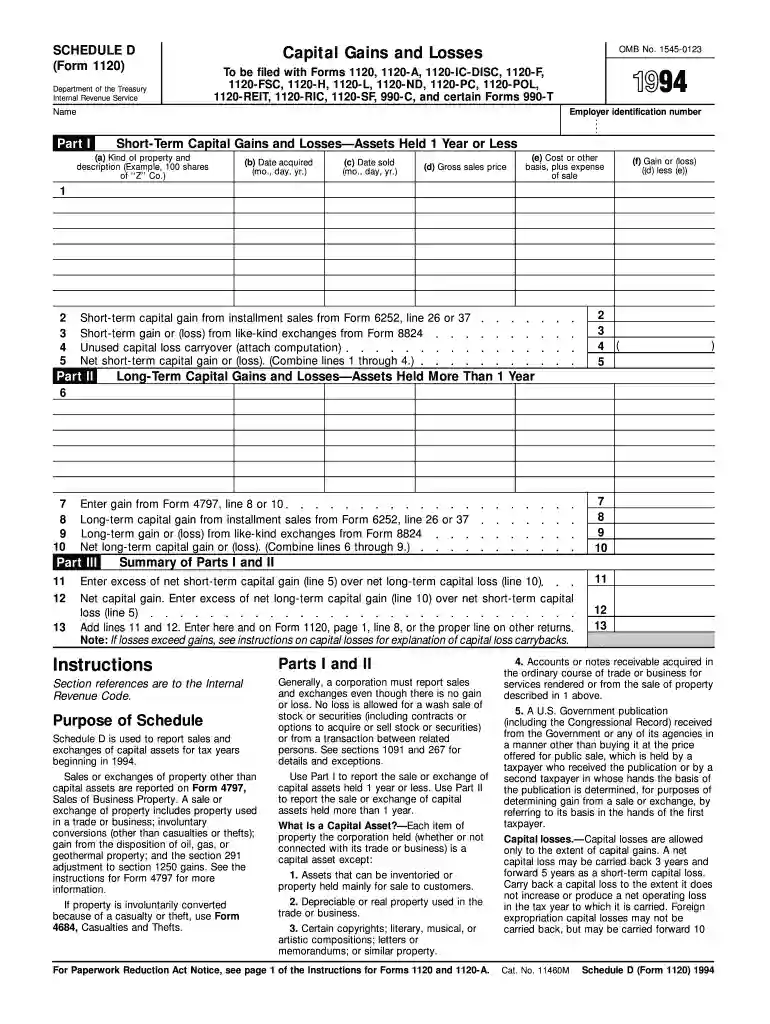
Type text, add images, blackout confidential details, add comments, highlights and more.

Draw your signature, type it, upload its image, or use your mobile device as a signature pad.

Send it via email, link, or fax. You can also download it, export it or print it out.
The 1994 Form 1120, also known as the U.S. Corporation Income Tax Return, is a document used by corporations in the United States to report their financial information to the IRS. This form plays a critical role in determining a corporation’s federal tax obligations. Generally, the form includes sections that solicit details about income, deductions, tax credits, and other relevant financial activities within a corporation. By completing this form, corporations ensure they comply with federal tax regulations while providing a transparent account of their fiscal year performance.
Acquiring the 1994 Form 1120 for corporate tax reporting can be done through several avenues. You can visit the IRS website, where archived forms from prior years, including the 1994 version, are available for download. Alternatively, corporations can request a physical copy of the form by contacting the IRS directly. Other sources for obtaining this form include professional tax software that provides comprehensive access to historical tax documents needed for financial reporting.
Filling out the 1994 Form 1120 requires attention to detail and accuracy. Below are the outlined steps in completing this tax form:
Gather Necessary Documents: Ensure all financial statements, including income statements and balance sheets, are available as they are needed when completing various sections of the form.
Identify Income and Deductions: Properly categorize all revenue streams and allowable deductions. This may include operating income, dividends, and interest, along with business expenses and depreciation.
Complete All Schedules: If applicable, fill out corresponding schedules, such as Schedule C or Schedule J, which detail specific financial activities like dividends and Special Deductions for corporations.
Calculate Tax Liability: Using the provided formulas in the form, corporations should compute their total tax liability.
Finalize and Review: Before submission, review the form to ensure all entries are accurate and all sections are completed.
Understanding specific terminology is vital when dealing with the 1994 Form 1120. Here are some key terms:
Adhering to IRS guidelines is mandatory for the proper completion and submission of the 1994 Form 1120. The IRS specifies instructions for all the form's segments, offering definitions and criteria for income categorization and deduction claims. It's crucial that corporations consider these guidelines to prevent misfiling, which could lead to penalties or audits.
Avoiding penalties involves meeting the designated deadlines for form submission. Typically, the 1994 Form 1120 must be filed by the 15th day of the third month after the end of the tax year—commonly March 15 for calendar-year filers. Extensions can be granted upon request, providing extra time for corporations that demonstrate needs due to specific circumstances, though penalties or interest on late tax payments may apply.
Corporations are expected to have several documents on hand when completing the 1994 Form 1120. Important documents include:
Failure to comply with submission requirements of the 1994 Form 1120 can result in significant penalties. Common penalties include late filing fees where the IRS charges a set percentage of the taxes unpaid by the due date. Additionally, there’s a failure-to-pay penalty escalating over time until the taxes are paid. Corporations can also face accuracy-related penalties if misleading statements are identified on the submitted forms, impacting the reported tax liability.
While the 1994 Form 1120 is primarily used by corporations, it's important to note that different entity types such as C corporations and certain LLCs operating as C corporations must file this form. Specifically, businesses choosing to be taxed as C Corporations report their earnings and outline respective tax responsibilities via this comprehensive tax document. It is not applicable for partnerships or sole proprietorships, which require different forms.
By understanding these aspects of the 1994 Form 1120, corporations can adeptly navigate tax reporting requirements, ensuring compliance and accurate submission to the IRS.
We've got more versions of the 1994 form 1120 form. Select the right 1994 form 1120 version from the list and start editing it straight away!
| Versions | Form popularity | Fillable & printable |
|---|---|---|
| 2025 | 4.6 Satisfied (46 Votes) | |
| 2024 | 4.4 Satisfied (56 Votes) | |
| 2023 | 4.7 Satisfied (48 Votes) | |
| 2022 | 4.2 Satisfied (24 Votes) | |
| 2021 | 4.8 Satisfied (151 Votes) | |
| 2020 | 4.4 Satisfied (230 Votes) | |
| 2019 | 4.2 Satisfied (143 Votes) | |
| 2018 | 4.3 Satisfied (108 Votes) | |
| 2017 | 4.4 Satisfied (145 Votes) | |
| 2016 | 4.3 Satisfied (99 Votes) | |
| 2015 | 4.4 Satisfied (33 Votes) | |
| 2014 | 4.1 Satisfied (60 Votes) | |
| 2013 | 4.2 Satisfied (67 Votes) | |
| 2012 | 4 Satisfied (40 Votes) | |
| 2011 | 4 Satisfied (60 Votes) |
At DocHub, your data security is our priority. We follow HIPAA, SOC2, GDPR, and other standards, so you can work on your documents with confidence.
Form 1120-W (WORKSHEET) 1994 Underpayment of Estimated Tax.A corporation that does not pay estimated tax when due may be charged an underpayment penalty
Note: The 1994 Form 1120 may also be used if (1) the corporation has a tax year of less than 12 months that begins and ends in 1995 and (2) the 1995 Form 1120Read more


